
Liancourt Rocks
Japan /
Shimane /
Hirata /
World
/ Japan
/ Shimane
/ Hirata
World / Japan / Shimane
archipelago, territorial dispute
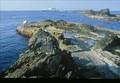
The Liancourt Rocks, also known as Dokdo or Tokto (독도/獨島, literally "solitary island") in Korean or Takeshima (たけしま/竹島, literally "bamboo island") in Japanese, are a group of small islets in the Sea of Japan (East Sea). Sovereignty over the islets is disputed between Japan and South Korea. The islets are currently administered by South Korea, which has its Coast Guard stationed there.
The Franco-English name of the islets derives from Le Liancourt, the name of the French whaling ship whose crew almost crashed on the rocks in 1849. Both the Korean and Japanese names have changed over time, a testament to the historical confusion over the subject which led to today's heated dispute.
The Liancourt Rocks consist of two main islets and 35 smaller rocks. Their total surface area of the islets is 0.18745 square kilometres (46.32 acres), with the highest elevation of 169 metres (550 ft) found at an unnamed location on the west islet. Two Korean citizens, an octopus fisherman and his wife, are permanent residents on the islets. A small Korean police detachment, administrative personnel, and lighthouse staff are stationed in non-permanent supporting positions on the islets.
South Korea administers the islets as Dokdo-ri, Ulleung-eup, Ulleung County, North Gyeongsang Province. Japan classifies them as part of Okinoshima, Oki District, Shimane Prefecture.
The islets lie in rich fishing grounds which could also contain large gas deposits.
Wikipedia article for Korean name:
en.wikipedia.org/wiki/Dokdo_%28disambiguation%29
Wikipedia article for Japanese name:
en.wikipedia.org/wiki/Takeshima_%28disambiguation%29
The Franco-English name of the islets derives from Le Liancourt, the name of the French whaling ship whose crew almost crashed on the rocks in 1849. Both the Korean and Japanese names have changed over time, a testament to the historical confusion over the subject which led to today's heated dispute.
The Liancourt Rocks consist of two main islets and 35 smaller rocks. Their total surface area of the islets is 0.18745 square kilometres (46.32 acres), with the highest elevation of 169 metres (550 ft) found at an unnamed location on the west islet. Two Korean citizens, an octopus fisherman and his wife, are permanent residents on the islets. A small Korean police detachment, administrative personnel, and lighthouse staff are stationed in non-permanent supporting positions on the islets.
South Korea administers the islets as Dokdo-ri, Ulleung-eup, Ulleung County, North Gyeongsang Province. Japan classifies them as part of Okinoshima, Oki District, Shimane Prefecture.
The islets lie in rich fishing grounds which could also contain large gas deposits.
Wikipedia article for Korean name:
en.wikipedia.org/wiki/Dokdo_%28disambiguation%29
Wikipedia article for Japanese name:
en.wikipedia.org/wiki/Takeshima_%28disambiguation%29
Wikipedia article: http://en.wikipedia.org/wiki/Liancourt_Rocks
Nearby cities:
Coordinates: 37°14'34"N 131°52'2"E
This article is protected.
- Iturup 1553 km
- Aksai Chin 4754 km
- Shaksgam Valley 4904 km
- State of Jammu and Kashmir 5128 km
- Pak Occupied Kashmir 5173 km
- Abkhazia 7404 km
- Diyala Governorate 7561 km
- Halaib Triangle 9130 km
- South Georgia 18020 km
- The Falkland Islands 18185 km
- Seonginbong 92 km
- The Pristine Forest at Seongin Peak 93 km
- Ulleungdo (Ulleung Island) 94 km
- Location of the loss of the cruiser "Svetlana" 182 km
- KHNP, Hanul Nuclear Power Plant 221 km
- Hupo-myeon 224 km
- Tonghae Satellite Launching Station 445 km
- Hwadae-gun (Hwadae County) 447 km
- Myŏngch'ŏn-gun (Myonchon County) 469 km
- Kilju-gun (Kilju County) 482 km
Comments