
AHRC Fineson Residence (New York City, New York)
USA /
New Jersey /
West New York /
New York City, New York /
East 16th Street, 208
World
/ USA
/ New Jersey
/ West New York
interesting place, commercial building
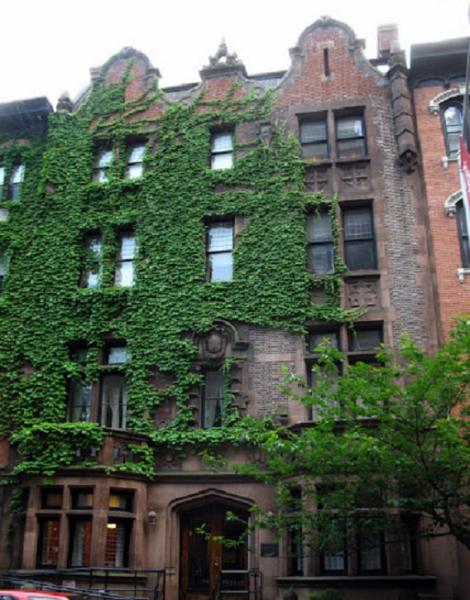
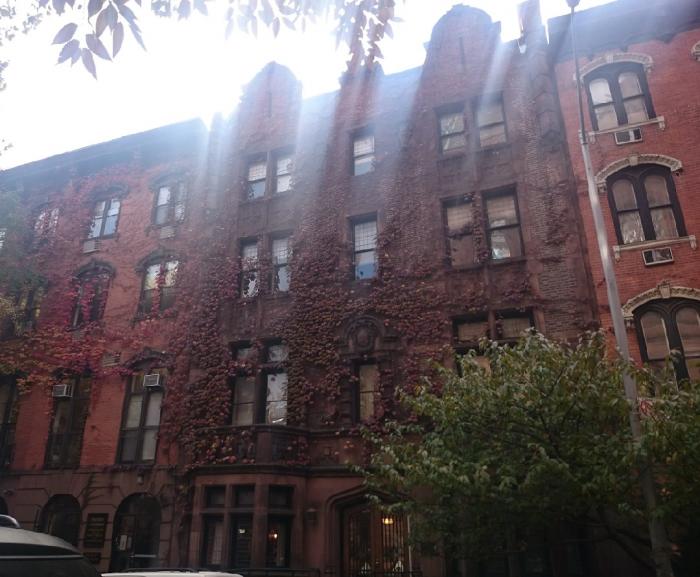
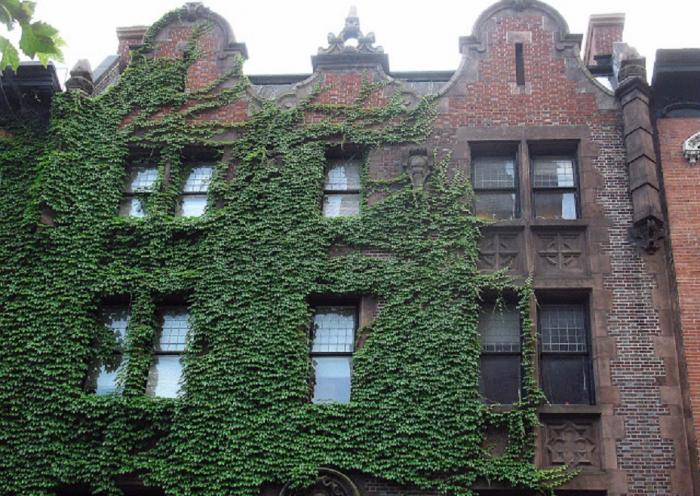
4-story Tudor/Flemish-revival commercial building originally completed as part of a row of eight matching houses in 1852. The two houses at Nos. 208 & 210 were radically altered in 1901-02 by architect George Wood to create a "Deaconess Home" called the Rainsford House, after William S. Rainsford then rector of St. George's.
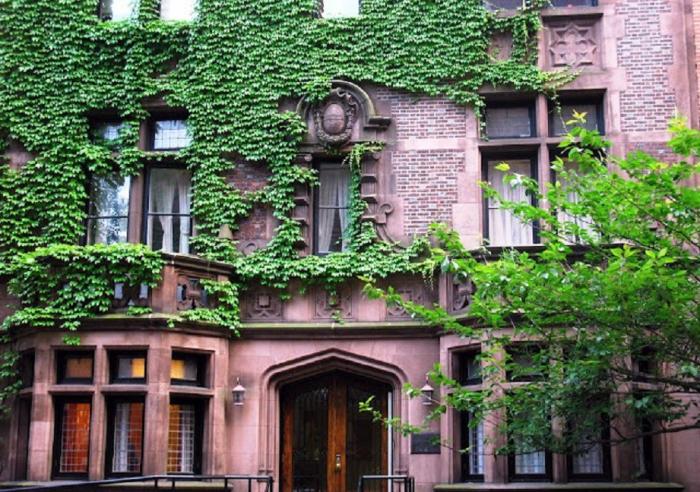
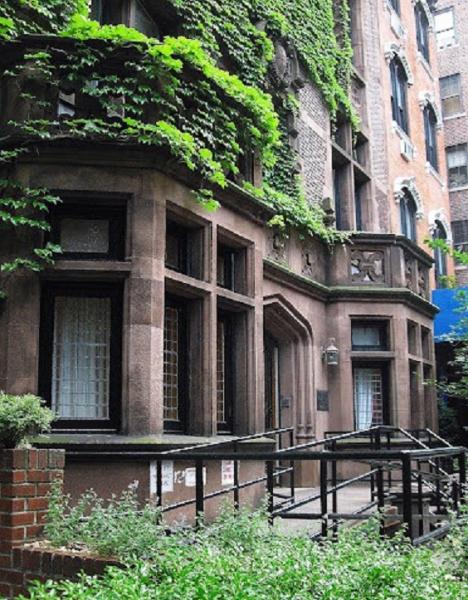
The rebuilt facade is symmetrical, with a ribbed brownstone Tudor-arch entranceway flanked by projecting 3-sided bay windows with stone mullions and transom bars. The ground floor of smooth-faced stonework terminates in a deep ornamented bandcourse, which forms balconies above the bays. On the upper floors, which are brick, single square-headed windows at the sides are accentuated by stone keyed enframements. The center window at the 2nd floor is crowned by a molded arch with cartouche and is flanked by fluted Ionic pilasters with faceted stone blocks and elongated volutes.
Variations of the cross and quatrefoil motif on the spandrel panels beneath the windows and cartouches at the 4th floor further enliven the facade. The picturesque Flemish style roof line has three curvilinear gables extending above a sloping roof and topped by decorative
stone coping. It is closed at the ends by elongated terminal features carried on brackets. Lancet windows, a carry-over from military architecture, pierce the two round-arched end gables, and the central gable has been truncated to receive a crowning ornament. The facade is partially covered with climbing ivy.
In 1938 the church decided on another use for the Deaconess House. It was renovated and dedicated on October 31 by Reverend Elmore McNeill McKee as “Rainsford House,” named in honor of the former rector. The building would be used as a residence for young single business men who were required to devote part of their time in community service in the neighborhood. The building was used for a time in the 1970's by Odyssey House—a facility offering treatment to drug and alcohol abusers and the mentally ill and later by Olmstead Hall where St. George’s soup kitchen served a free hot meal to around 140 people each week.
It is now home to the AHRC, a non-profit organization founded in 1948 that provides a wide range of services, support, and opportunities for people with intellectual and other developmental disabilities and their families.
www.ahrcnyc.org/news/fifty-years-at-home-with-ahrc-nycs...
The rebuilt facade is symmetrical, with a ribbed brownstone Tudor-arch entranceway flanked by projecting 3-sided bay windows with stone mullions and transom bars. The ground floor of smooth-faced stonework terminates in a deep ornamented bandcourse, which forms balconies above the bays. On the upper floors, which are brick, single square-headed windows at the sides are accentuated by stone keyed enframements. The center window at the 2nd floor is crowned by a molded arch with cartouche and is flanked by fluted Ionic pilasters with faceted stone blocks and elongated volutes.
Variations of the cross and quatrefoil motif on the spandrel panels beneath the windows and cartouches at the 4th floor further enliven the facade. The picturesque Flemish style roof line has three curvilinear gables extending above a sloping roof and topped by decorative
stone coping. It is closed at the ends by elongated terminal features carried on brackets. Lancet windows, a carry-over from military architecture, pierce the two round-arched end gables, and the central gable has been truncated to receive a crowning ornament. The facade is partially covered with climbing ivy.
In 1938 the church decided on another use for the Deaconess House. It was renovated and dedicated on October 31 by Reverend Elmore McNeill McKee as “Rainsford House,” named in honor of the former rector. The building would be used as a residence for young single business men who were required to devote part of their time in community service in the neighborhood. The building was used for a time in the 1970's by Odyssey House—a facility offering treatment to drug and alcohol abusers and the mentally ill and later by Olmstead Hall where St. George’s soup kitchen served a free hot meal to around 140 people each week.
It is now home to the AHRC, a non-profit organization founded in 1948 that provides a wide range of services, support, and opportunities for people with intellectual and other developmental disabilities and their families.
www.ahrcnyc.org/news/fifty-years-at-home-with-ahrc-nycs...
Nearby cities:
Coordinates: 40°44'3"N 73°59'8"W
- 44 East 14th Street 0.5 km
- 888 Broadway 0.6 km
- Wanamaker Store Annex 0.7 km
- NYU Langone Translational Research Building 1.2 km
- B. Altman & Co. Dry Goods Store Building 1.2 km
- Ehrich Brothers Co. Department Store Building 1.2 km
- Chelsea Studios 1.6 km
- John Q. Aymar Building 1.7 km
- 333 East 38th Street 1.8 km
- 241 Canal Street 2.1 km
- Stuyvesant Square Park 0.2 km
- Consolidated Edison Building 0.2 km
- Mount Sinai Beth Israel Hospital 0.3 km
- Gramercy 0.3 km
- First Avenue Subway Station (L) 0.5 km
- Stuyvesant Town 0.7 km
- NoHo 0.7 km
- Kips Bay 0.9 km
- East Village 1 km
- Alphabet City 1.2 km