
2 West 16th Street (New York City, New York)
USA /
New Jersey /
West New York /
New York City, New York /
West 16th Street, 2
World
/ USA
/ New Jersey
/ West New York
apartment building
Add category
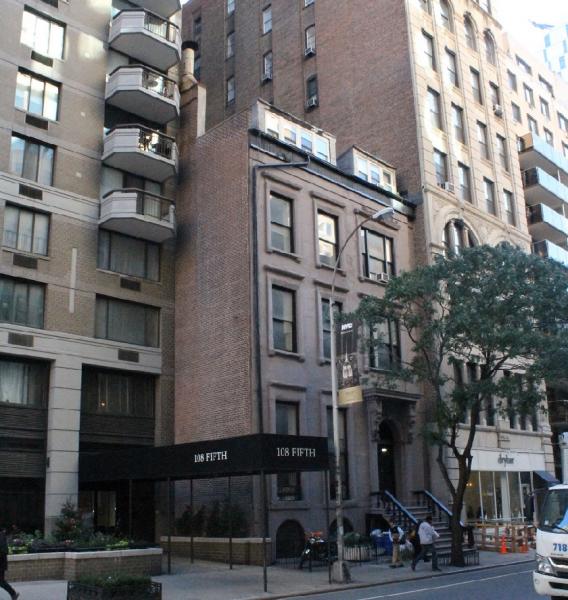
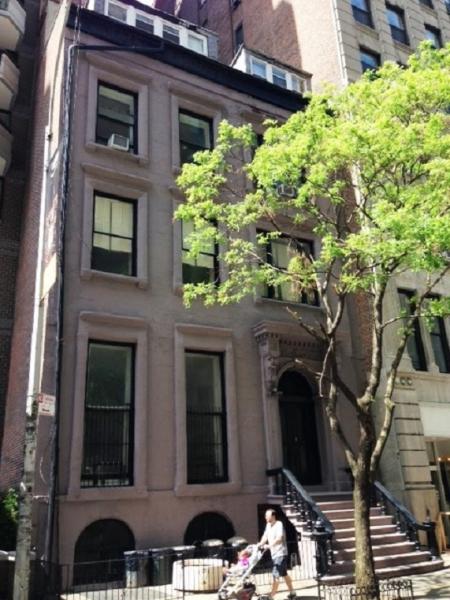

3.5-story (plus raised basement) Italianate residential building completed in 1852 as a townhouse. It has a brownstone front that is rather deteriorated. The exposed basement has arched windows in its two easternmost bays, each with decorative wrought-iron grilles. The
western bay is under the stoop which is enclosed by a decorative wrought-iron grill. West of the stoop a narrow door enters the basement apartments. This door has decorative iron strap hinges.
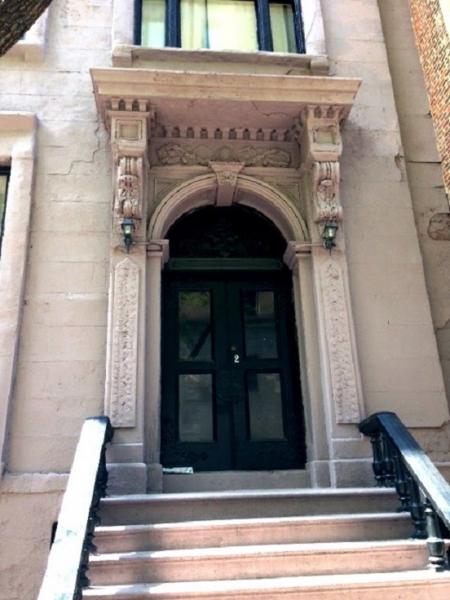
Above the basement the facade three openings per story, with those in the western bay wider than the others. The first story windows are taller than those above. The windows have full surrounds which have lost their original definition. In contrast, the richly decorated arched entry framed by embellished pilaster panels and a bracketed denticulated hood with a foliate frieze is in relatively good condition . The door itself is old but probably not original, with elaborate iron hinge straps and hardware. Above the door is a wrought-iron grill in the tympanum. The entry is approached by a stone stoop with a wooden balustrade. The cornice has been replaced by a modern corrugated metal band. The roof silhouette is broken by two shed-roofed skylights with bands of rectangular windows.
The house was built for John Lovejoy, but he sold the completed house to Lorenzo and Mary A. Jove. They leased the house to Henry G. Stebbins (a member of the House of Representatives) as early as 1857, and sold it to him in 1864. After his death in 1881, the house was sold to J. Joseph Alexandre. His wife, Nathalie Alexandre, retained possession of No. 2 West 16th Street until December 1897, when she sold it to wealthy banker, coal merchant, and Director of the Union Pacific Railroad, James W. Ellsworth. It was then sold to real estate operator John Bradley in 1903, and the house was converted to a dressmaking factory. In 1907, it was sold again and converted to apartments. In 1926-1927 a new 5-sided, 2-story building was erected on the rear portion of the lot as a single-family apartment with a 2-car garage. By 1931 it had been altered for use by an N.Y.U. fraternity, having a reading room and two sleeping rooms on each floor. In 1944 it had been reconverted for use as a dwelling and studio, without a garage, in which use it remains today.
western bay is under the stoop which is enclosed by a decorative wrought-iron grill. West of the stoop a narrow door enters the basement apartments. This door has decorative iron strap hinges.
Above the basement the facade three openings per story, with those in the western bay wider than the others. The first story windows are taller than those above. The windows have full surrounds which have lost their original definition. In contrast, the richly decorated arched entry framed by embellished pilaster panels and a bracketed denticulated hood with a foliate frieze is in relatively good condition . The door itself is old but probably not original, with elaborate iron hinge straps and hardware. Above the door is a wrought-iron grill in the tympanum. The entry is approached by a stone stoop with a wooden balustrade. The cornice has been replaced by a modern corrugated metal band. The roof silhouette is broken by two shed-roofed skylights with bands of rectangular windows.
The house was built for John Lovejoy, but he sold the completed house to Lorenzo and Mary A. Jove. They leased the house to Henry G. Stebbins (a member of the House of Representatives) as early as 1857, and sold it to him in 1864. After his death in 1881, the house was sold to J. Joseph Alexandre. His wife, Nathalie Alexandre, retained possession of No. 2 West 16th Street until December 1897, when she sold it to wealthy banker, coal merchant, and Director of the Union Pacific Railroad, James W. Ellsworth. It was then sold to real estate operator John Bradley in 1903, and the house was converted to a dressmaking factory. In 1907, it was sold again and converted to apartments. In 1926-1927 a new 5-sided, 2-story building was erected on the rear portion of the lot as a single-family apartment with a 2-car garage. By 1931 it had been altered for use by an N.Y.U. fraternity, having a reading room and two sleeping rooms on each floor. In 1944 it had been reconverted for use as a dwelling and studio, without a garage, in which use it remains today.
Nearby cities:
Coordinates: 40°44'14"N 73°59'35"W
- Chelsea Lane II 0.1 km
- The Parker Gramercy 0.1 km
- 5 West 13th Street 0.2 km
- Montparnasse Apartments 0.2 km
- Butterfield House Apartments 0.3 km
- Courtney House Apartments 0.3 km
- The Greenwich 0.3 km
- John Adams Apartments 0.4 km
- 101 West 15th by Stonehenge 0.4 km
- The Sierra Chelsea Apartments 0.4 km
- West Village 0.9 km
- Greenwich Village 0.9 km
- Chelsea 1.2 km
- Midtown (Manhattan, NY) 1.6 km
- Lower (Downtown) Manhattan 1.8 km
- Manhattan 5.2 km
- Hudson County, New Jersey 6.8 km
- Brooklyn 11 km
- Queens 14 km
- The Palisades 25 km