
IESE Business School
USA /
New Jersey /
West New York /
West 57th Street, 165
World
/ USA
/ New Jersey
/ West New York
World / United States / New York
school, historic landmark, 1916_construction, Renaissance Revival (architecture)
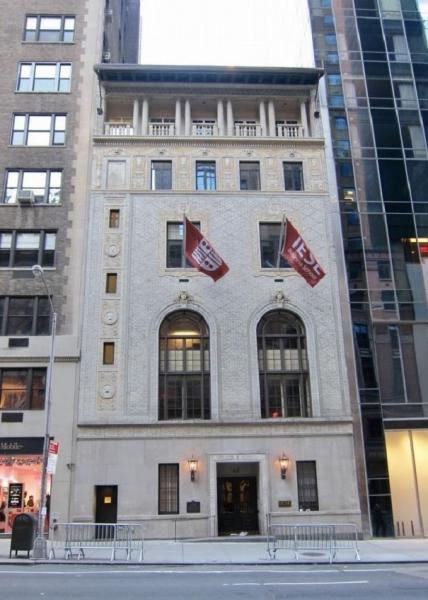


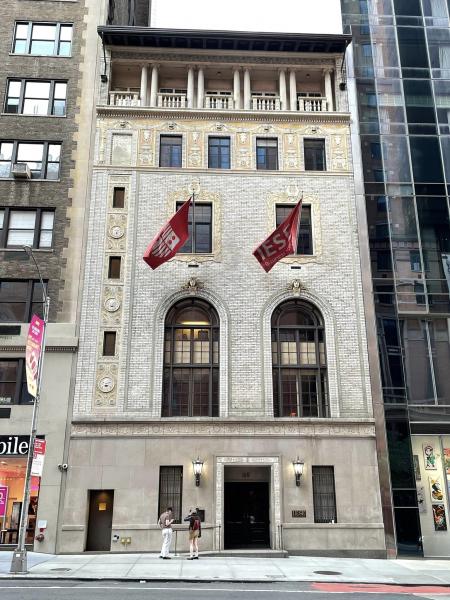

6-story Italian-Renaissance education building completed in 1916. Designed by George and Henry Boehm, it was built to house the school of Russian-born dance teacher Louis Chalif, who declared in 1924: "As long as orchestras syncopate like barbarians banging on human skulls in a cannibalistic orgy, shoulders and arms will wriggle and writhe. Given a dignified tango or waltz rhythm, the body responds gracefully and with modesty." The Chalif family lost the building in 1934; from 1946 to 1959 it was the headquarters of the music publisher Carl Fischer, and then it housed Columbia Artists Management, which specializes in classic music and dance.
IESE Business School (Instituto de Estudios Superiores de la Empresa, English: "Institute of Higher Business Studies" or "International Graduate School of Management") is the graduate business school of the University of Navarra. IESE has campuses in Barcelona, Madrid, as well as here in New York City and teaching facilities in Munich and Sao Paulo. IESE is an initiative of Opus Dei, a personal prelature of the Catholic Church. In 2007, this building was chosen to be IESE Business School's new home in North America: the IESE New York Center.
The former Louis A. Chalif Normal School of Dancing features upper floors clad in tan-gray-colored brick laid in a diamond pattern, and notable polychrome terra-cotta. The ground floor, originally clad in ivory-colored Dover marble with a terminating band of terra-cotta, was remodeled several times, including in 1959-60. This latter alteration was removed in 1983, and the original configuration was re-created. The base is currently clad in Indiana limestone, with a polished granite base band. Originally, there were two small basement windows with iron grilles. The entrance surround nearly replicates the original design. The original entrance platform and step were marble; currently they are polished granite. Recessed wood entrance doors are similar to the originals, with multi-pane windows and bottom panels. Originally, the doors were surmounted by a transom (currently there is a limestone panel with the numbers "165"), and the entrance was surmounted by the letters "Chalif." The entrance is flanked by sconces similar to the originals (the current ones were formerly located in the Central Park Zoo) and by windows with iron grilles (the original sconces and grilles were gray-green; the current ones are black and dark brown, respectively). A recessed service entrance to the west originally had a wood door with a small window and iron grille; the current metal door is similar. The floor is terminated by a band course of terra-cotta, somewhat similar to the original design with griffins, and close in color to the building's original terra-cotta.
The 2nd & 3rd floors are clad in tan-gray-colored brick, laid in a diamond pattern, framed with terra-cotta moldings. The 4th floor and the westernmost bay are clad in terra-cotta panels. The continuous panels of the westernmost bay have, alternately, roundels with masks, or small windows. The 2nd floor has large, round-arched openings with brick and terra-cotta surrounds with keystones surmounted by female heads. The 3rd-floor windows have terra-cotta surrounds surmounted by lyres, and two flagpoles are installed at the bases of the 3rd-floor windows. The 4th floor has terra-cotta panels, with skulls, urns, and griffins, alternating with windows (the westernmost is blind and filled with marble (apparently parged), surmounted by a terra-cotta frieze with swags and masks. This floor is terminated by a denticulated terra-cotta cornice.
The top floor consists of a colonnaded loggia. Paired columns (except the easternmost, which is single), with a concrete finish on the shafts and terra-cotta Ionic capitals and bases, support a terra-cotta frieze, all flanked by pilasters. Sections of terra-cotta balustrade project between the columns. The sloped, deeply overhanging copper cornice is decorated with rosettes and modillions. The copper gutter is a replacement (1995), with copper leaders supported by original copper corbels. The roof was originally covered with green Spanish tile; it is now covered with asphalt shingles.
www.iese.edu/en/usa/home/IESEintheUSA.asp
morgankroche.smugmug.com/PRODIGAL-SON-SEASON-2-HERO/EPI...
IESE Business School (Instituto de Estudios Superiores de la Empresa, English: "Institute of Higher Business Studies" or "International Graduate School of Management") is the graduate business school of the University of Navarra. IESE has campuses in Barcelona, Madrid, as well as here in New York City and teaching facilities in Munich and Sao Paulo. IESE is an initiative of Opus Dei, a personal prelature of the Catholic Church. In 2007, this building was chosen to be IESE Business School's new home in North America: the IESE New York Center.
The former Louis A. Chalif Normal School of Dancing features upper floors clad in tan-gray-colored brick laid in a diamond pattern, and notable polychrome terra-cotta. The ground floor, originally clad in ivory-colored Dover marble with a terminating band of terra-cotta, was remodeled several times, including in 1959-60. This latter alteration was removed in 1983, and the original configuration was re-created. The base is currently clad in Indiana limestone, with a polished granite base band. Originally, there were two small basement windows with iron grilles. The entrance surround nearly replicates the original design. The original entrance platform and step were marble; currently they are polished granite. Recessed wood entrance doors are similar to the originals, with multi-pane windows and bottom panels. Originally, the doors were surmounted by a transom (currently there is a limestone panel with the numbers "165"), and the entrance was surmounted by the letters "Chalif." The entrance is flanked by sconces similar to the originals (the current ones were formerly located in the Central Park Zoo) and by windows with iron grilles (the original sconces and grilles were gray-green; the current ones are black and dark brown, respectively). A recessed service entrance to the west originally had a wood door with a small window and iron grille; the current metal door is similar. The floor is terminated by a band course of terra-cotta, somewhat similar to the original design with griffins, and close in color to the building's original terra-cotta.
The 2nd & 3rd floors are clad in tan-gray-colored brick, laid in a diamond pattern, framed with terra-cotta moldings. The 4th floor and the westernmost bay are clad in terra-cotta panels. The continuous panels of the westernmost bay have, alternately, roundels with masks, or small windows. The 2nd floor has large, round-arched openings with brick and terra-cotta surrounds with keystones surmounted by female heads. The 3rd-floor windows have terra-cotta surrounds surmounted by lyres, and two flagpoles are installed at the bases of the 3rd-floor windows. The 4th floor has terra-cotta panels, with skulls, urns, and griffins, alternating with windows (the westernmost is blind and filled with marble (apparently parged), surmounted by a terra-cotta frieze with swags and masks. This floor is terminated by a denticulated terra-cotta cornice.
The top floor consists of a colonnaded loggia. Paired columns (except the easternmost, which is single), with a concrete finish on the shafts and terra-cotta Ionic capitals and bases, support a terra-cotta frieze, all flanked by pilasters. Sections of terra-cotta balustrade project between the columns. The sloped, deeply overhanging copper cornice is decorated with rosettes and modillions. The copper gutter is a replacement (1995), with copper leaders supported by original copper corbels. The roof was originally covered with green Spanish tile; it is now covered with asphalt shingles.
www.iese.edu/en/usa/home/IESEintheUSA.asp
morgankroche.smugmug.com/PRODIGAL-SON-SEASON-2-HERO/EPI...
Wikipedia article: http://en.wikipedia.org/wiki/IESE_Business_School#IESE_New_York_Center
Nearby cities:
Coordinates: 40°45'55"N 73°58'45"W
- Central Park 3.9 km
- Green-Wood Cemetery 12 km
- Fort Hancock Historic Core 32 km
- Hartshorne Woods County Park 41 km
- Bell Works Holmdel Complex 47 km
- Fort Monmouth Reuse and Redevelopment Area 50 km
- Donnell Estate (1902 - 1927) 53 km
- Ben Franklin Bridge 134 km
- Judge Morris Estate (White Clay Creek State Park) 188 km
- Fort DuPont 190 km
- Midtown (North Central) 0.9 km
- Lincoln Square 1.1 km
- Hell's Kitchen (Clinton) 1.3 km
- Midtown (Manhattan, NY) 1.8 km
- Manhattan 1.8 km
- Upper East Side 2.2 km
- Upper West Side 2.4 km
- Hudson County, New Jersey 8.7 km
- Queens 16 km
- The Palisades 22 km