
United Charities Building
USA /
New Jersey /
West New York /
Park Avenue South, 287
World
/ USA
/ New Jersey
/ West New York
office building, charitable organization, Richardsonian Romanesque (architecture)
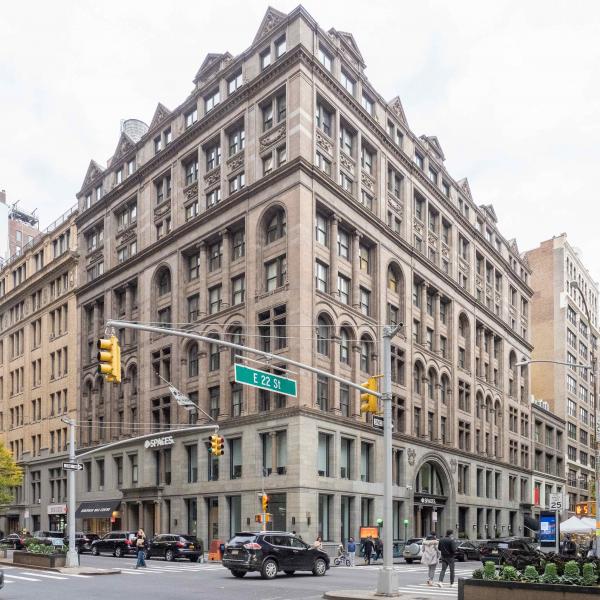


131-foot, 9-story Romanesque/Renaissance-revival office building completed in 1893. Designed by R.H. Robertson in collaboration with Rowe & Baker, it later had additions by architect James Baker built in 1897 and 1915.
The facades are horizontally divided into four distinct bands, demarcated by cornices. The lowest bank, two stories of light-grey limestone articulated by rectangular window openings, has as its focus a 2-story semi-circular arched opening housing the main entrance on East 22nd Street. There is a short set of dark-grey granite steps, and a ramp with modern metal handrails leading up from the east. There are four glass doors, with the outer two separated by Ionic columns of polished granite. The arch is enhanced by guilloche, egg-and-dart, and bead-and-reel patterns. On either side of the arch are decorative cartouches which together exhibit the date 1892. Surmounting the entrance is the legend "United Charities Building" in bronze letters, and a tripartite semi-circular window with floral pilasters.
A smaller entrance at the east end displays Classical-revival terra-cotta decoration, and was formerly the entrance to the Assembly Hall, now a restaurant space. Marked by a shallow portico with a narrow set of granite steps, it is decorated with floral pilasters, cherubs, and bead-and-reel detailing. The semi-circular window above the doorway is covered by a rounded, black canvas canopy that extends down the steps. Above, an entablature bears the restaurant's name HAWKSMOOR in bronze lettering, flanked by ribbons and topped by a dentiled cornice.
A denticulated cornice divides the facades' lowest band from the upper stories of brown Philadelphia pressed brick. The second major band, comprising four stories, emphasizes the contrast between flat and curved surfaces. It is articulated by a rhythmic system of trabeated and arched openings. 2-story pilastered triple arches alternate with square-headed paired windows on the 3rd and 4th floors. Square-headed triple-windows articulated with 2-story Ionic columns alternate with two-story single arches on the 5th and 6th floors, terminating with two 2-story arches at the east. A relatively simple cornice divides the 6th floor from the upper stories.
The remaining three floors are slightly recessed from the cornice and constitute the upper two sections. They are an 1897 addition by J. B. Baker. The third horizontal section consists of two stories of paired rectangular windows, divided by terra-cotta panels of foliate garlands. This section is capped by the buildings' most ornate cornice, bracketed and denticulated, above which is the 9th floor. On this uppermost story, paired rectangular windows capped by an ornamented gable alternate with a series of three rectangular windows surmounted by an ornate pediment. The sloped roof, which continues behind the gables and pediments, maintains its original Spanish tiles on the 22nd Street facade, and has received matching tiles on the Park Avenue facade.
Originally the United Charities Building had only seven stories, with the exception of the easternmost section which had only six. The elevation was capped with a flat roof with balustrade at the 6-story section, and with a sloped roof with gabled and pedimented dormers at the 7-story section.
Although the main building still houses some charitable organizations, such as the Community Service Society, today it is used for multiple purposes. The northern part of the main building, which had been partitioned from the rest and renamed the Kennedy Building, is now apartments, while the 22nd Street extension became the headquarters for the Dockworkers' Union in 1946. The union sold the building in the 1980s and it was converted for commercial use. Hawksmoor, a British steakhouse and cocktail bar, leased space at the United Charities Building in 2018 and moved there in late 2021. On Park Avenue South the ground floor is occupied by European Wax Center.
www.preserve2.org/gramercy/proposes/ext/ension/105e22.h...
css.cul.columbia.edu/catalog/rbml_css_0499
The facades are horizontally divided into four distinct bands, demarcated by cornices. The lowest bank, two stories of light-grey limestone articulated by rectangular window openings, has as its focus a 2-story semi-circular arched opening housing the main entrance on East 22nd Street. There is a short set of dark-grey granite steps, and a ramp with modern metal handrails leading up from the east. There are four glass doors, with the outer two separated by Ionic columns of polished granite. The arch is enhanced by guilloche, egg-and-dart, and bead-and-reel patterns. On either side of the arch are decorative cartouches which together exhibit the date 1892. Surmounting the entrance is the legend "United Charities Building" in bronze letters, and a tripartite semi-circular window with floral pilasters.
A smaller entrance at the east end displays Classical-revival terra-cotta decoration, and was formerly the entrance to the Assembly Hall, now a restaurant space. Marked by a shallow portico with a narrow set of granite steps, it is decorated with floral pilasters, cherubs, and bead-and-reel detailing. The semi-circular window above the doorway is covered by a rounded, black canvas canopy that extends down the steps. Above, an entablature bears the restaurant's name HAWKSMOOR in bronze lettering, flanked by ribbons and topped by a dentiled cornice.
A denticulated cornice divides the facades' lowest band from the upper stories of brown Philadelphia pressed brick. The second major band, comprising four stories, emphasizes the contrast between flat and curved surfaces. It is articulated by a rhythmic system of trabeated and arched openings. 2-story pilastered triple arches alternate with square-headed paired windows on the 3rd and 4th floors. Square-headed triple-windows articulated with 2-story Ionic columns alternate with two-story single arches on the 5th and 6th floors, terminating with two 2-story arches at the east. A relatively simple cornice divides the 6th floor from the upper stories.
The remaining three floors are slightly recessed from the cornice and constitute the upper two sections. They are an 1897 addition by J. B. Baker. The third horizontal section consists of two stories of paired rectangular windows, divided by terra-cotta panels of foliate garlands. This section is capped by the buildings' most ornate cornice, bracketed and denticulated, above which is the 9th floor. On this uppermost story, paired rectangular windows capped by an ornamented gable alternate with a series of three rectangular windows surmounted by an ornate pediment. The sloped roof, which continues behind the gables and pediments, maintains its original Spanish tiles on the 22nd Street facade, and has received matching tiles on the Park Avenue facade.
Originally the United Charities Building had only seven stories, with the exception of the easternmost section which had only six. The elevation was capped with a flat roof with balustrade at the 6-story section, and with a sloped roof with gabled and pedimented dormers at the 7-story section.
Although the main building still houses some charitable organizations, such as the Community Service Society, today it is used for multiple purposes. The northern part of the main building, which had been partitioned from the rest and renamed the Kennedy Building, is now apartments, while the 22nd Street extension became the headquarters for the Dockworkers' Union in 1946. The union sold the building in the 1980s and it was converted for commercial use. Hawksmoor, a British steakhouse and cocktail bar, leased space at the United Charities Building in 2018 and moved there in late 2021. On Park Avenue South the ground floor is occupied by European Wax Center.
www.preserve2.org/gramercy/proposes/ext/ension/105e22.h...
css.cul.columbia.edu/catalog/rbml_css_0499
Wikipedia article: http://en.wikipedia.org/wiki/United_Charities_Building
Nearby cities:
Coordinates: 40°44'22"N 73°59'10"W
- St. Paul Inside the Walls 38 km
- La Salle College High School 125 km
- Woodmont Historic Site 134 km
- Archmere Academy 163 km
- St Mark's High School 184 km
- Red Lion Christian Academy 192 km
- St. Mary's Seminary & University and Ecumenical Institute of Theology 273 km
- Seton Keough High School (former location) 281 km
- Cardinal GIbbons School (closed) 281 km
- Days End Farm Horse Rescue 307 km
- CUNY Baruch College 0.2 km
- Gramercy Park 0.2 km
- Gramercy Square Condominium 0.4 km
- Midtown (South Central) 0.4 km
- Flatiron District 0.4 km
- Gramercy 0.4 km
- Washington Irving Educational Campus 0.5 km
- The Ball Field 0.6 km
- Kips Bay 0.7 km
- Stuyvesant Town 1.1 km