
Washington Irving Educational Campus (New York City, New York)
USA /
New Jersey /
West New York /
New York City, New York /
Irving Place, 40
World
/ USA
/ New Jersey
/ West New York
World / United States / New York
school, Gothic revival (architecture), interesting place, 1913_construction
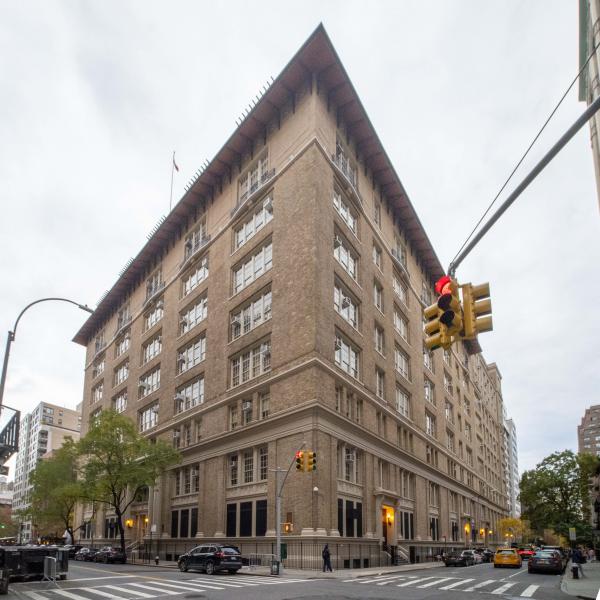

201-foot, 12-story Neo-Renaissance public school originally completed in 1913. Designed by C.B.J. Snyder, Superintendent of School Buildings for New York City, with decoration by O.H. Bauer, it opened as the Girls' Technical High School, the first school for girls in the city. It soon changed names to the Washington Irving High School, but it wasn't until 1986 that it first became co-ed. Washington Irving High School closed in 2015, and the building now houses six schools under the New York City Department of Education.
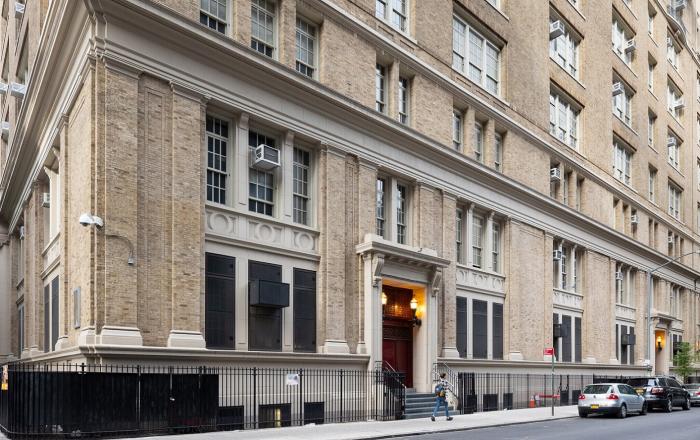
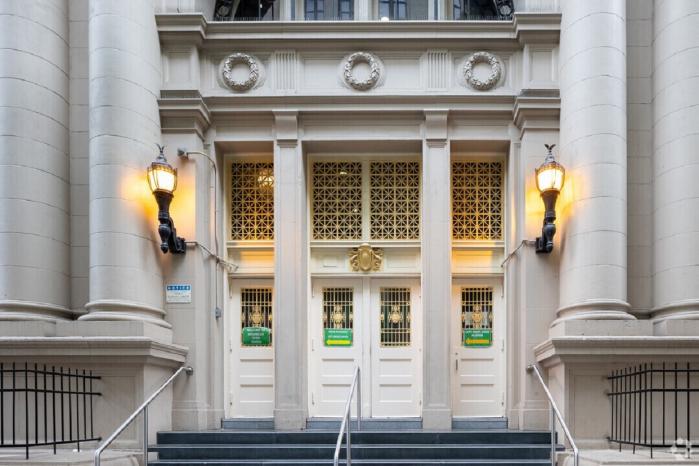
The original building by Snyder is eight stories high, although the extension on 16th Street designed by Walter C. Martin and built in 1938, is twelve stories high. Both are clad in buff-colored brick, limestone, and terra-cotta, with a limestone basement level that is partially above grade, and behind black iron fencing along Irving Place. There is an imposing arched entrance facing Irving Place, atop a low and wide set of steps. The double-height entry has four white wooden doors, the outer two separated by stone pilasters that also separate the three bronze grilles above the doors. A large, tripartite fanlight is separated from the grilles and doors below by a broad stone band with three carved wreaths. A scrolled keystone tops the arch, and the whole ensemble is framed by two pairs of monuments, engaged Ionic columns beginning above the basement level and supporting an entablature and cornice that caps the 2nd floor. "WASHINGTON IRVING HIGH SCHOOL'' is carved on the main panel, and the cornice has scrolled modillions, dentils, and egg-and-dart molding, surmounted by a stone balustrade at the 3rd floor. It continues as a broad stone band course to either side along the west facade. The west facade has five main bays, each with triple-windows on the lower floors (with stone spandrels between the 1st & 2nd floors), bands of four windows on the 4th-7th floors, and triple-windows on the 8th. They all have white wooden framing and are divided into many small panes. Thin string courses set off the 4th & 8th floors; at the 8th floor they protrude forward slightly into shallow curved balconies with iron railings. The facade is crowned by a projecting roof cornice with simple brackets.
A similar design follows on the north and south facades, each spanning seven bays. The middle three and end bays have triple-windows at every floor, while the other two bays are narrower, with double-windows on the upper floors and tall entrances on the ground floor, approached by stairs crossing the basement level. These entrances have prominent stone enframements, with scrolled brackets carrying cornices. They have red iron doors and grilles above, three to each of the four entrances. In front of the building, at the corner of Irving Place and 17th Street, is a bust of Washington Irving by Friedrich Beer.
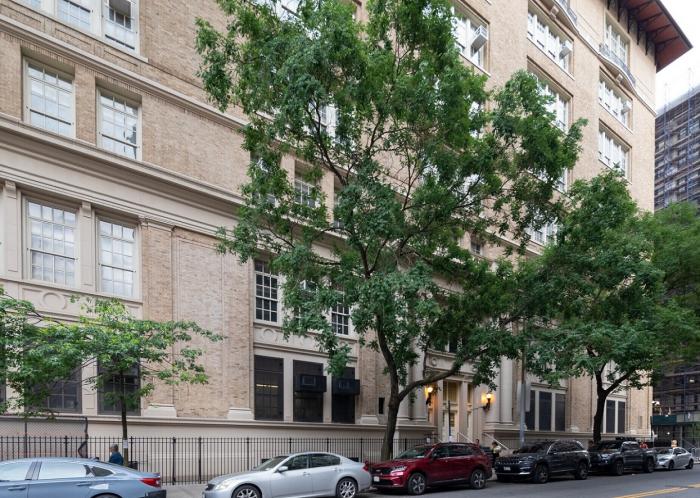
The 12-story addition on 16th Street, completed in 1938, was designed by Walter C. Martin. It largely follows the basic design and ornament of the original building, but with a differing fenestration pattern. In the center are five bays of double-windows, while at the ends are pavilion towers with large entrances. Each has a set of three wooden doors below multi-pane transoms on two levels. Unlike the original building, the doors are placed at street level, with no stairs. The upper parts of the entries are flanked by a pair of very narrow windows, which another pair flanking the double-windows at the 2nd floor. The 3rd floor has triple-window, and the 4th-12th floors have wider bands of four windows. The center bays set back above the 9th floor, and the end towers set back above the 10th at a deeper, full-floor setback.
The incredible interior includes a 2-story foyer executed by C.H. Rugg with a mezzanine balcony, and a large skylit auditorium, all created in Snyder's favorite Collegiate Gothic mode. It features 1930's murals by Barry Faulkner, Robert Knight Ryland, and Salvatore Lascari. There is also an overmantle by Frances Grimes.
The constituent schools include the Gramercy Arts High School, the High School for Language and Diplomacy, the International High School at Union Square, the Union Square Academy for Health Sciences, the Academy for Software Engineering, and the Success Academy Charter School.
sites.google.com/landd.org/washingtonirvingcampus/home
www.flickr.com/photos/navema/5031251223
forgotten-ny.com/2005/10/open-house-new-york-2005/
nycsca.org/Community/Public-Art-for-Public-Schools/Coll...
hdl.handle.net/2027/uc1.c2645284?urlappend=%3Bseq=62
The original building by Snyder is eight stories high, although the extension on 16th Street designed by Walter C. Martin and built in 1938, is twelve stories high. Both are clad in buff-colored brick, limestone, and terra-cotta, with a limestone basement level that is partially above grade, and behind black iron fencing along Irving Place. There is an imposing arched entrance facing Irving Place, atop a low and wide set of steps. The double-height entry has four white wooden doors, the outer two separated by stone pilasters that also separate the three bronze grilles above the doors. A large, tripartite fanlight is separated from the grilles and doors below by a broad stone band with three carved wreaths. A scrolled keystone tops the arch, and the whole ensemble is framed by two pairs of monuments, engaged Ionic columns beginning above the basement level and supporting an entablature and cornice that caps the 2nd floor. "WASHINGTON IRVING HIGH SCHOOL'' is carved on the main panel, and the cornice has scrolled modillions, dentils, and egg-and-dart molding, surmounted by a stone balustrade at the 3rd floor. It continues as a broad stone band course to either side along the west facade. The west facade has five main bays, each with triple-windows on the lower floors (with stone spandrels between the 1st & 2nd floors), bands of four windows on the 4th-7th floors, and triple-windows on the 8th. They all have white wooden framing and are divided into many small panes. Thin string courses set off the 4th & 8th floors; at the 8th floor they protrude forward slightly into shallow curved balconies with iron railings. The facade is crowned by a projecting roof cornice with simple brackets.
A similar design follows on the north and south facades, each spanning seven bays. The middle three and end bays have triple-windows at every floor, while the other two bays are narrower, with double-windows on the upper floors and tall entrances on the ground floor, approached by stairs crossing the basement level. These entrances have prominent stone enframements, with scrolled brackets carrying cornices. They have red iron doors and grilles above, three to each of the four entrances. In front of the building, at the corner of Irving Place and 17th Street, is a bust of Washington Irving by Friedrich Beer.
The 12-story addition on 16th Street, completed in 1938, was designed by Walter C. Martin. It largely follows the basic design and ornament of the original building, but with a differing fenestration pattern. In the center are five bays of double-windows, while at the ends are pavilion towers with large entrances. Each has a set of three wooden doors below multi-pane transoms on two levels. Unlike the original building, the doors are placed at street level, with no stairs. The upper parts of the entries are flanked by a pair of very narrow windows, which another pair flanking the double-windows at the 2nd floor. The 3rd floor has triple-window, and the 4th-12th floors have wider bands of four windows. The center bays set back above the 9th floor, and the end towers set back above the 10th at a deeper, full-floor setback.
The incredible interior includes a 2-story foyer executed by C.H. Rugg with a mezzanine balcony, and a large skylit auditorium, all created in Snyder's favorite Collegiate Gothic mode. It features 1930's murals by Barry Faulkner, Robert Knight Ryland, and Salvatore Lascari. There is also an overmantle by Frances Grimes.
The constituent schools include the Gramercy Arts High School, the High School for Language and Diplomacy, the International High School at Union Square, the Union Square Academy for Health Sciences, the Academy for Software Engineering, and the Success Academy Charter School.
sites.google.com/landd.org/washingtonirvingcampus/home
www.flickr.com/photos/navema/5031251223
forgotten-ny.com/2005/10/open-house-new-york-2005/
nycsca.org/Community/Public-Art-for-Public-Schools/Coll...
hdl.handle.net/2027/uc1.c2645284?urlappend=%3Bseq=62
Wikipedia article: http://en.wikipedia.org/wiki/Washington_Irving_Campus
Nearby cities:
Coordinates: 40°44'7"N 73°59'13"W
- Fashion Institute of Technology 1.6 km
- Con Edison Learning Centre 3.5 km
- Long Island City High School 5.6 km
- Mount Sinai School of Medicine 6.8 km
- St. John's Preparatory School 7.9 km
- Alfred E Smith Career-Technology High School, 11 km
- South Bronx High School 11 km
- Forest Hills High School 12 km
- St. Joseph's School 16 km
- Herbert H. Lehman High School 17 km
- Zeckendorf Towers 0.2 km
- Consolidated Edison Building 0.2 km
- Union Square Park 0.3 km
- Gramercy 0.3 km
- 14th Street / Union Square Subway Station (4,5,6,<6>,L,N,Q,R) 0.3 km
- Meta Platforms NYC Headquarters 0.6 km
- NoHo 0.8 km
- New York University - Washington Square Campus 1 km
- East Village 1.1 km
- Greenwich Village 1.3 km