
Arnold Constable & Co. Building
USA /
New Jersey /
West New York /
Broadway, 881
World
/ USA
/ New Jersey
/ West New York
office building
Add category

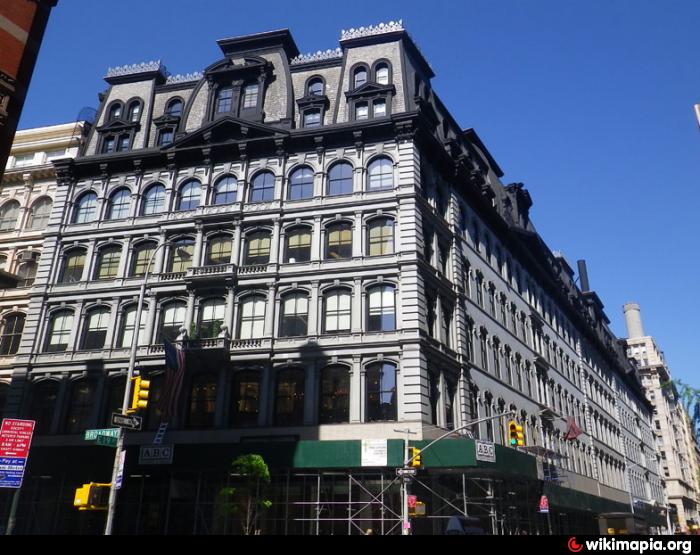


7-story Second Empire-style office building completed in 1868. Designed by Griffith Thomas as a department store for the prominent dry-goods company Arnold Constable, the building was extended in 1872 and 1876 all the way to Fifth Avenue to take up the whole north side of the lot along East 19th Street between Broadway and Fifth Avenue. It has a notable 2-story pavilioned mansard roof. Its French design hinted at the rare European goods from labels like the House of Worth that was carried by the store.
The Broadway facade is in a composition of stacked arch orders with a slightly projecting central pavilion, surmounted by a boldly scaled 2-story mansard roof. The building is clad in marble, now painted, with the cornice and roof of iron with slate shingles. The facade is nine bays wide and framed by rusticated corner piers. While the ornamentation of the main facade is derived from Renaissance and Baroque sources, the roof is French Second Empire.
The 2nd-4th floors are designed in a series of modified Doric arch orders with segmental-arches and pilasters. A 3-bay central pavilion is articulated at each floor by engaged Corinthian columns supporting a balcony that is most prominent in the central bay. The 3rd-floor balcony has heavy corner finials. The 5th floor is a round-arched order with tall pilasters in two sections, paneled below the impost and embellished with a vegetal motif above it. These pilasters carry a bracketed cornice, slightly projecting in the central six bays beneath a pediment.
The mansard roof is in three major parts, with square corner pavilions connected by hyphens too a central pavilion. All walls are battered, with those in the central pavilion curving upward, and all are surmounted by cresting except the central pavilion. Lower level windows and those in the central pavilion are set in rich pedimented frames, with those in the upper level, round arched, in simple moldings.
The block-long East 19th Street facade is in three main sections framed by end bays and surmounted by a mansard roof. The three main sections are separated by full-height rusticated piers. The central section is a series of stacked arcades, all in marble, flanked by brick sections (originally red) with stone trim. The end bays are miniature versions of the main facades, each two windows wide and identical in design. The eastern end bay is in marble like the Broadway facade and the western end bay is in cast-iron like the Fifth Avenue facade.
The central section consists of segmental-arches on paneled pilasters in the 2nd through 4th floors and round arches on paneled pilasters above. The side sections with brick walls in running bond consist of tiers of fourteen windows with decorative architraves and a decorated flat central pavilion articulated by closely paired central windows. These have, respectively, a triangular pediment, a segmental pediment, and a prominent lintel over the 2nd, 3rd & 4th floors. At the 5th floor, pilasters carry a projecting section of the cornice on which rests a pediment. The 2nd floor of the eastern side section is higher than the remainder of the 2nd floor.
The mansard roof is in six major pavilions connected by hyphens. All but one pavilion have battered walls with two of those having curved walls, and there is cresting over all but the curved walled pavilions, the irregular square block, and the Fifth Avenue corner. Above the end bays are square pavilions; above the central section is one square pavilion like those above the end bays, and one without battered walls; above the side sections are big curved pavilions. Lower level windows and those in the curved pavilions are set in rich pedimented frames, with those in the upper level, round arched, in simple moldings. The one irregular square pavilion without battered walls has high arched windows in a paneled pilaster order. There is an iron chimney stack next to this pavilion.
The Fifth Avenue facade is identical in all respects save the following to the Broadway facade: it is executed in cast-iron; the balconies have been removed from the 2nd through 4th floors, and portions of the rooftop cresting are missing and damaged.
The western extension was built to accommodate the wholesale department which moved here from another site. At the time the Arnold Constable store moved here it was the second largest dry goods store in New York. When the building was extended in 1872, it added carpet and upholstery divisions becoming a full department store. When it expanded to Fifth Avenue in 1876-1877 to accommodate the wholesale department it was said to be "one of the largest business establishments in the world". In 1914, this store was closed and the business moved uptown to Fifth Avenue and 40th Street. In 1915 the whole complex was converted for use as a wholesale store. In the 1980s the upper floors were converted to offices. The ground floor is occupied by Crate & Barrel, and Aritzia apparel.
daytoninmanhattan.blogspot.com/2010/03/arnold-constable...
digitalcollections.nypl.org/items/510d47e4-4230-a3d9-e0...
The Broadway facade is in a composition of stacked arch orders with a slightly projecting central pavilion, surmounted by a boldly scaled 2-story mansard roof. The building is clad in marble, now painted, with the cornice and roof of iron with slate shingles. The facade is nine bays wide and framed by rusticated corner piers. While the ornamentation of the main facade is derived from Renaissance and Baroque sources, the roof is French Second Empire.
The 2nd-4th floors are designed in a series of modified Doric arch orders with segmental-arches and pilasters. A 3-bay central pavilion is articulated at each floor by engaged Corinthian columns supporting a balcony that is most prominent in the central bay. The 3rd-floor balcony has heavy corner finials. The 5th floor is a round-arched order with tall pilasters in two sections, paneled below the impost and embellished with a vegetal motif above it. These pilasters carry a bracketed cornice, slightly projecting in the central six bays beneath a pediment.
The mansard roof is in three major parts, with square corner pavilions connected by hyphens too a central pavilion. All walls are battered, with those in the central pavilion curving upward, and all are surmounted by cresting except the central pavilion. Lower level windows and those in the central pavilion are set in rich pedimented frames, with those in the upper level, round arched, in simple moldings.
The block-long East 19th Street facade is in three main sections framed by end bays and surmounted by a mansard roof. The three main sections are separated by full-height rusticated piers. The central section is a series of stacked arcades, all in marble, flanked by brick sections (originally red) with stone trim. The end bays are miniature versions of the main facades, each two windows wide and identical in design. The eastern end bay is in marble like the Broadway facade and the western end bay is in cast-iron like the Fifth Avenue facade.
The central section consists of segmental-arches on paneled pilasters in the 2nd through 4th floors and round arches on paneled pilasters above. The side sections with brick walls in running bond consist of tiers of fourteen windows with decorative architraves and a decorated flat central pavilion articulated by closely paired central windows. These have, respectively, a triangular pediment, a segmental pediment, and a prominent lintel over the 2nd, 3rd & 4th floors. At the 5th floor, pilasters carry a projecting section of the cornice on which rests a pediment. The 2nd floor of the eastern side section is higher than the remainder of the 2nd floor.
The mansard roof is in six major pavilions connected by hyphens. All but one pavilion have battered walls with two of those having curved walls, and there is cresting over all but the curved walled pavilions, the irregular square block, and the Fifth Avenue corner. Above the end bays are square pavilions; above the central section is one square pavilion like those above the end bays, and one without battered walls; above the side sections are big curved pavilions. Lower level windows and those in the curved pavilions are set in rich pedimented frames, with those in the upper level, round arched, in simple moldings. The one irregular square pavilion without battered walls has high arched windows in a paneled pilaster order. There is an iron chimney stack next to this pavilion.
The Fifth Avenue facade is identical in all respects save the following to the Broadway facade: it is executed in cast-iron; the balconies have been removed from the 2nd through 4th floors, and portions of the rooftop cresting are missing and damaged.
The western extension was built to accommodate the wholesale department which moved here from another site. At the time the Arnold Constable store moved here it was the second largest dry goods store in New York. When the building was extended in 1872, it added carpet and upholstery divisions becoming a full department store. When it expanded to Fifth Avenue in 1876-1877 to accommodate the wholesale department it was said to be "one of the largest business establishments in the world". In 1914, this store was closed and the business moved uptown to Fifth Avenue and 40th Street. In 1915 the whole complex was converted for use as a wholesale store. In the 1980s the upper floors were converted to offices. The ground floor is occupied by Crate & Barrel, and Aritzia apparel.
daytoninmanhattan.blogspot.com/2010/03/arnold-constable...
digitalcollections.nypl.org/items/510d47e4-4230-a3d9-e0...
Nearby cities:
Coordinates: 40°44'18"N 73°59'26"W
- Gramercy Court Building 0.1 km
- 111 Fifth Avenue 0.1 km
- 122 Fifth Avenue 0.2 km
- American Woolen Building 0.2 km
- 215 Park Avenue South 0.2 km
- Spingler Building 0.3 km
- 44 Union Square 0.3 km
- Mercantile Building 0.4 km
- Consolidated Edison Building 0.5 km
- St. Denis Building 0.7 km
- Flatiron District 0.2 km
- Union Square Park 0.3 km
- 14th Street / Union Square Subway Station (4,5,6,<6>,L,N,Q,R) 0.4 km
- 44 East 14th Street 0.4 km
- Washington Irving Educational Campus 0.5 km
- Zeckendorf Towers 0.5 km
- Midtown (South Central) 0.6 km
- Gramercy 0.6 km
- Greenwich Village 1.1 km
- Chelsea 1.2 km