
41 Park Row (Pace University Campus)
USA /
New Jersey /
Hoboken /
Park Row, 41
World
/ USA
/ New Jersey
/ Hoboken
World / United States / New York
university, office building, high-rise, Brick Gothic (architecture), commercial building, 1889_construction


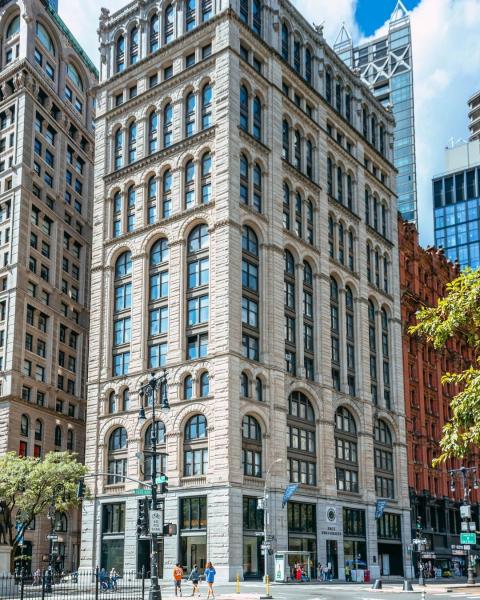

187-foot, 16-story Romanesque-revival university building completed in 1889 as a 13-story office building and printing plant. Designed by George B. Post for the New York Times, it is one of the last survivors of Newspaper Row, the center of newspaper publishing in New York City from the 1830s to the 1920s. Post, the country's pre-eminent architect-engineer, achieved a major technological feat with this commission which required him to incorporate the floor framing from the Times's 5-story 1857 building so newspaper operations could continue on site while the new building was under construction.
When the Times relocated to Times Square in 1904, the building at 41 Park Row had the mansard roof removed and three additional stories added, designed by Robert Maynicke. The former ground-floor offices were converted to retail use. Pace University acquired the building in 1951 for part of its Manhattan campus, converting the offices to classrooms and making changes to the base. Later improvements included an auditorium, cafeteria, sizable library, science laboratories and gymnasium. Space is also available for alumni affairs to serve the more than 70,000 former students.
The building stands on a trapezoidal lot, adjoining the Potter Building. The 2-story base is faced in light-grey Maine granite, while Indiana limestone is employed for the 3rd-14th floors, and terra-cotta for the top two floors. The facades are organized into three bays on Spruce Street and four bays on Nassau and Park Row.
At the base, the Spruce Street facade is divided into six major floor groupings which are defined by string courses that extend over the piers. The base is articulated with rusticated pillars resting on plain bases. On the Park Row side, the base is very similar, except that the center pier is widened to frame a central entrance, originally the main entrance to the office tower. Raised metal lettering above the entrance reads "PACE UNIVERSITY". Above that is a large clock with Roman numerals and Gothic hands. In the 1950s the main entrance was moved to the south bay of this facade, where it has a recessed aluminum and glass entrance at the ground floor and a fixed multi-pane aluminum and glass window at the 2nd floor. As on the Spruce Street facade, the 1st- & 2nd-story windows are separated by grey aluminum spandrel panels. The Nassau Street base is also similar, with its southern bay having a secondary entrance and a freight elevator.
Above the base is a 3-story section comprised of a giant double-story arcade topped by a single story of coupled round-arches. Miniature balustrades extend along the bottom of the large arches which are also enriched by corner colonnettes, foliate capitals, and molded archivolts. The spandrel panels are articulated with prominent string courses below the window sills and above the window lintels. A double string course sets off the lower 3-story section from the 4-story arcade which extends from the 6th to the 9th floor. The decorative treatment for the 4-story arcade is similar to that of the lower sections, but here the foliate molding employed for the column capitals extends to the corner piers and the arcade is capped by a molded frieze enriched with crockets and ball flowers. The iron spandrels between the windows are original.
The 10th & 11th floors are united by a 2-story arcade featuring coupled arches set between heavier piers. This section is distinguished by its corbel decoration above the arches featuring animal heads, grotesque masks, and foliate motifs. The 12th & 13th floors are also united by a double-story arcade, virtually identical to the 10th & 11th floors except for differences in the carved decoration on the corbels. The 14th floor is transitional, set off by continuous moldings above the below the trabeated windows. Gargoyles in the form of griffins project from the corners of the facade.
The richly embellished 15th & 16th floors, faced with terra-cotta, are united by paired double-story arches profiled by moldings and giant pilasters decorated with recessed panels and foliated capitals. Angled projections at the top of the piers create a complex roof line which is further enhanced by the foliate cornice and balustraded roof parapet punctuated by crocketed finials. The spandrel panels have a dentiled molding.
The ground floor is occupied by a Barnes & Noble bookstore affiliated with Pace University.
When the Times relocated to Times Square in 1904, the building at 41 Park Row had the mansard roof removed and three additional stories added, designed by Robert Maynicke. The former ground-floor offices were converted to retail use. Pace University acquired the building in 1951 for part of its Manhattan campus, converting the offices to classrooms and making changes to the base. Later improvements included an auditorium, cafeteria, sizable library, science laboratories and gymnasium. Space is also available for alumni affairs to serve the more than 70,000 former students.
The building stands on a trapezoidal lot, adjoining the Potter Building. The 2-story base is faced in light-grey Maine granite, while Indiana limestone is employed for the 3rd-14th floors, and terra-cotta for the top two floors. The facades are organized into three bays on Spruce Street and four bays on Nassau and Park Row.
At the base, the Spruce Street facade is divided into six major floor groupings which are defined by string courses that extend over the piers. The base is articulated with rusticated pillars resting on plain bases. On the Park Row side, the base is very similar, except that the center pier is widened to frame a central entrance, originally the main entrance to the office tower. Raised metal lettering above the entrance reads "PACE UNIVERSITY". Above that is a large clock with Roman numerals and Gothic hands. In the 1950s the main entrance was moved to the south bay of this facade, where it has a recessed aluminum and glass entrance at the ground floor and a fixed multi-pane aluminum and glass window at the 2nd floor. As on the Spruce Street facade, the 1st- & 2nd-story windows are separated by grey aluminum spandrel panels. The Nassau Street base is also similar, with its southern bay having a secondary entrance and a freight elevator.
Above the base is a 3-story section comprised of a giant double-story arcade topped by a single story of coupled round-arches. Miniature balustrades extend along the bottom of the large arches which are also enriched by corner colonnettes, foliate capitals, and molded archivolts. The spandrel panels are articulated with prominent string courses below the window sills and above the window lintels. A double string course sets off the lower 3-story section from the 4-story arcade which extends from the 6th to the 9th floor. The decorative treatment for the 4-story arcade is similar to that of the lower sections, but here the foliate molding employed for the column capitals extends to the corner piers and the arcade is capped by a molded frieze enriched with crockets and ball flowers. The iron spandrels between the windows are original.
The 10th & 11th floors are united by a 2-story arcade featuring coupled arches set between heavier piers. This section is distinguished by its corbel decoration above the arches featuring animal heads, grotesque masks, and foliate motifs. The 12th & 13th floors are also united by a double-story arcade, virtually identical to the 10th & 11th floors except for differences in the carved decoration on the corbels. The 14th floor is transitional, set off by continuous moldings above the below the trabeated windows. Gargoyles in the form of griffins project from the corners of the facade.
The richly embellished 15th & 16th floors, faced with terra-cotta, are united by paired double-story arches profiled by moldings and giant pilasters decorated with recessed panels and foliated capitals. Angled projections at the top of the piers create a complex roof line which is further enhanced by the foliate cornice and balustraded roof parapet punctuated by crocketed finials. The spandrel panels have a dentiled molding.
The ground floor is occupied by a Barnes & Noble bookstore affiliated with Pace University.
Wikipedia article: http://en.wikipedia.org/wiki/Park_Row_(Manhattan)
Nearby cities:
Coordinates: 40°42'41"N 74°0'22"W
- Pace University - New York City campus - One Pace Plaza 0.1 km
- New York University Tandon School of Engineering 2.4 km
- Long Island University: Brooklyn Campus 3 km
- St. Joseph's College - Brooklyn Campus 3.8 km
- Medgar Evers College - CUNY 6.3 km
- New Jersey City University 7 km
- New Jersey City University - NJCU 7.7 km
- SUNY Downstate 8 km
- Brooklyn College (CUNY) 10 km
- St. John's University - Staten Island Campus 12 km
- City Hall Park 0.1 km
- Civic Center 0.4 km
- NYPD Civic Center Security Zone 0.4 km
- Financial District 0.6 km
- TriBeCa 0.8 km
- Lower (Downtown) Manhattan 1.4 km
- Hudson County, New Jersey 6.1 km
- Manhattan 8.2 km
- Brooklyn 9 km
- Queens 13 km