
Holy Spirit Medieval Hospital
Romania /
Sibiu /
Azilului Street, 4
World
/ Romania
/ Sibiu
/ Sibiu
World / Romania
place with historical importance, nursing home, Medieval / Middle Ages, hospice, listed building / architectural heritage, 18th century construction, 14th century construction, 13th century construction, tourist attraction


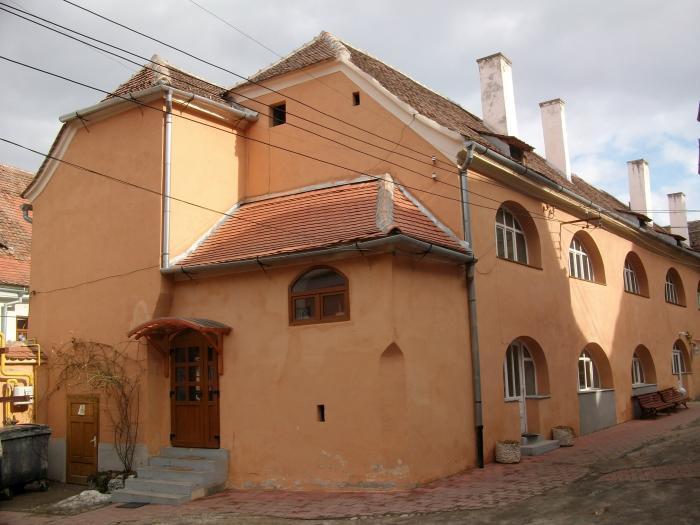
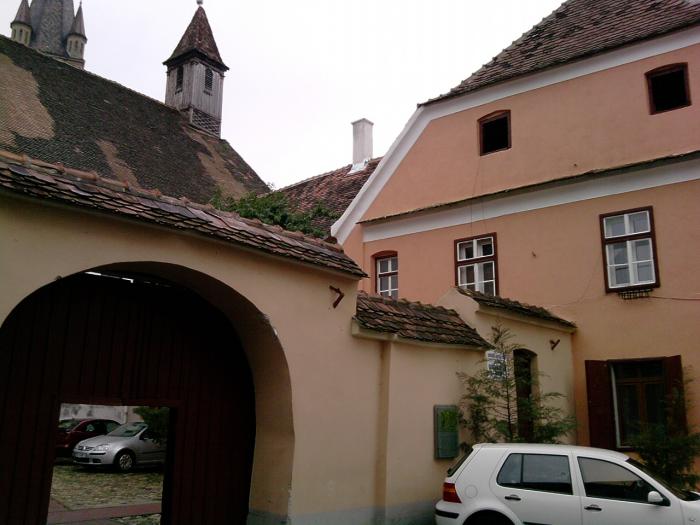
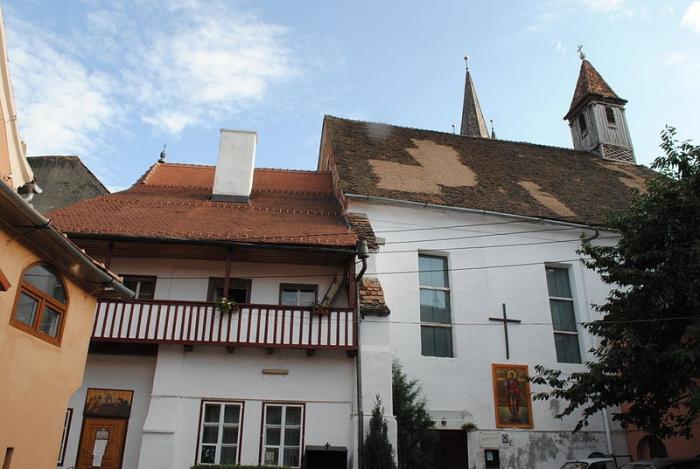

Documented in 1292, it is the oldest hospital/hospice from Transylvania and present day Romania, still functioning as a home for the elderly.
On Azilului Street at Nr. 4 is the Church of the Asylum and the medieval hospital (today an old people's home), first documented in 1292 when the city community handed over ''a house of ours located in Sibiu, together with everything related to it, which had been used for a long time. by us as a hospital'', to the order of the Hospitallers of the Holy Spirit (Bruderschaft von Heiligen Geist).
In this place most likely there was the Monastery of the Premonstratensians, attested in the city in 1234, without indicating the exact location. The monastery and cemetery were destroyed in the Mongol invasion of 1241-42. Probably around 1250 the community reused the location, setting up a ''hospital'', ceded in 1292 to the order of the Holy Spirit. Archaeological excavations have demonstrated the existence of a level of wooden constructions prior to the Mongol invasion (1241), the presence of tombs in the 12th-13th centuries, indicating the existence of the Premonstratensian monastery on this location.
The current Church of the Asylum was built on the foundation of a Romanesque hospital hall with stone walls (wrongly considered the oldest church in Sibiu) documented in 1292. After 1292 to the hall was added the current apse (choir), the building being transformed into a hospital hall with chapel by the order of the Holy Spirit. During the 14th-15th-18th centuries, buildings were added to the ensemble, reaching its current size. In 1766 the hospital had 47 rooms.
After the fire of 1760, the building was transformed into a hall-type church. The church has a small wooden bell tower made during the transformations of 1760, replacing a former stone and brick tower, documented in 1716 and recently proven archaeologically (discovered solid foundations inside the church).
The Asylum complex consists of several buildings that enclose several courtyards connected by narrow vaulted passages.
Near the hospital was one of the public baths of the city, attested in 1486-87.
During the 18th and 19th centuries, a girls school also functioned in the complex.
In the entire space around the Asylum Church, a cemetery functioned between the end of the 12th century - the beginning of the 13th century and the 18th century. After the 1550s only as a burial place for priests.
In 1909 the church ceased as an evangelical place of worship.
On Azilului Street at Nr. 4 is the Church of the Asylum and the medieval hospital (today an old people's home), first documented in 1292 when the city community handed over ''a house of ours located in Sibiu, together with everything related to it, which had been used for a long time. by us as a hospital'', to the order of the Hospitallers of the Holy Spirit (Bruderschaft von Heiligen Geist).
In this place most likely there was the Monastery of the Premonstratensians, attested in the city in 1234, without indicating the exact location. The monastery and cemetery were destroyed in the Mongol invasion of 1241-42. Probably around 1250 the community reused the location, setting up a ''hospital'', ceded in 1292 to the order of the Holy Spirit. Archaeological excavations have demonstrated the existence of a level of wooden constructions prior to the Mongol invasion (1241), the presence of tombs in the 12th-13th centuries, indicating the existence of the Premonstratensian monastery on this location.
The current Church of the Asylum was built on the foundation of a Romanesque hospital hall with stone walls (wrongly considered the oldest church in Sibiu) documented in 1292. After 1292 to the hall was added the current apse (choir), the building being transformed into a hospital hall with chapel by the order of the Holy Spirit. During the 14th-15th-18th centuries, buildings were added to the ensemble, reaching its current size. In 1766 the hospital had 47 rooms.
After the fire of 1760, the building was transformed into a hall-type church. The church has a small wooden bell tower made during the transformations of 1760, replacing a former stone and brick tower, documented in 1716 and recently proven archaeologically (discovered solid foundations inside the church).
The Asylum complex consists of several buildings that enclose several courtyards connected by narrow vaulted passages.
Near the hospital was one of the public baths of the city, attested in 1486-87.
During the 18th and 19th centuries, a girls school also functioned in the complex.
In the entire space around the Asylum Church, a cemetery functioned between the end of the 12th century - the beginning of the 13th century and the 18th century. After the 1550s only as a burial place for priests.
In 1909 the church ceased as an evangelical place of worship.
Nearby cities:
Coordinates: 45°47'54"N 24°8'58"E
- Upper Town (fortified perimeter finished in 1366) 0.3 km
- Sibiu/Hermannstadt defensive sistem - South city walls 0.3 km
- Historic Center 0.6 km
- Lower Town(fortified perimeter finished 1432-1457) 0.6 km
- Biertan 48 km
- Sighişoara 68 km
- The Medieval City of Brasov (the walled city Korona/Kronstadt) 113 km
- Historic center of Cluj-Napoca-the old fortified city 117 km
- The Romans' Road 176 km
- Old Center 212 km
- Small Square 0.1 km
- Huet and Lesser/Small Squares - fortified perimeter finished around 1224-1240 (Cibinium) 0.1 km
- Brukenthal National Museum 0.3 km
- Nicolae Balcescu Street (pedestrian) 0.4 km
- Citadel Park--The Promenade 0.6 km
- Central Area (outside the Historic Center) 0.8 km
- Former Josephine district 0.9 km
- Terezian 1 km
- Sibiu 1.7 km
- Sibiu County 14 km
Comments