
142 East 40th Street
USA /
New Jersey /
West New York /
East 30th Street, 142
World
/ USA
/ New Jersey
/ West New York
townhouse
Add category

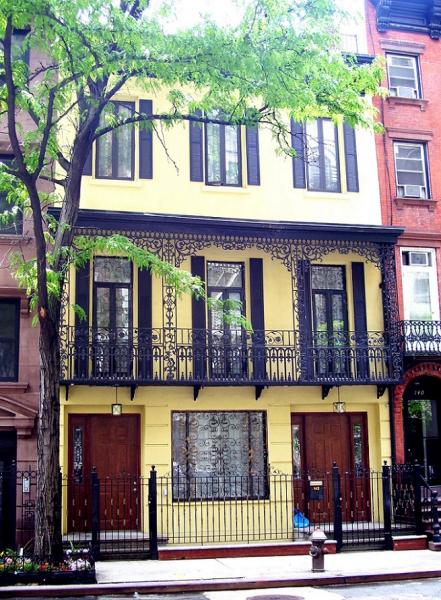

3-story Anglo-Italianate residential building completed in 1853. Designed by builder and developer Thomas Kilpatrick, it is clad in yellow-painted stone, with some light banding at the ground floor. In the rear was a separate 2-story carriage house. Both were first purchased by Andrew L. Vanvaler.
The house had two entrances, one intended for a section of the house separated from the main living spaces as rental quarters, first occupied by the Coffin family, although they had moved out by 1862. Various other families occupied both sides of the house throughout the next several decades. The building was purchased in 1895 by Dr. George W. Thompson. In December 1916 Dr. Thompson hired the well-known architectural firm of James B. Snook Sons to renovate the carriage house to a garage.
The house continued to house two families at a time until 1930 when it was converted by the architectural firm of Scott & Prescott for its offices. The rear building was now described as a tenement. Scott & Prescott remained for just over a decade, selling the property in 1941 to an investor. In 1945 the Gallery of Jewish Art opened in the building with an exhibition of paintings by Chagall entitled "Synagogues." The gallery remained at least through 1947.
In 1955 photographer Mark Shaw renovated the building, creating a photo workroom on the ground floor and a single family house above. The carriage house was converted to a photographic studio. Shaw is best known as the White House photographer for President John F. Kennedy, later filming commercials for television, and maintained his large studio, Mark Shaw International, until his death in 1969.
The house is set behind a wrought-iron fence with some gilded highlights, and two gates accessing two matching, 2-step porches. The wider west entrance has a paneled wooden door flanked by two paneled wood-and-glass sidelights; the east entrance has a sidelight only on its east end. In between the entries the ground floor has a square window with an ornate wrought-iron grille.
The upper floors have three bays of narrow double-windows, with upper transom panes at the 2nd floor, and narrow black wooden exterior shutters at each window. The 2nd floor is especially notable for its full-width cast-iron balcony with ornate patterns, including posts that support a cast-iron roof to the balcony. The facade is crowned by a black metal roof cornice with brackets and panels, and a metal railing across the roof line.
The house had two entrances, one intended for a section of the house separated from the main living spaces as rental quarters, first occupied by the Coffin family, although they had moved out by 1862. Various other families occupied both sides of the house throughout the next several decades. The building was purchased in 1895 by Dr. George W. Thompson. In December 1916 Dr. Thompson hired the well-known architectural firm of James B. Snook Sons to renovate the carriage house to a garage.
The house continued to house two families at a time until 1930 when it was converted by the architectural firm of Scott & Prescott for its offices. The rear building was now described as a tenement. Scott & Prescott remained for just over a decade, selling the property in 1941 to an investor. In 1945 the Gallery of Jewish Art opened in the building with an exhibition of paintings by Chagall entitled "Synagogues." The gallery remained at least through 1947.
In 1955 photographer Mark Shaw renovated the building, creating a photo workroom on the ground floor and a single family house above. The carriage house was converted to a photographic studio. Shaw is best known as the White House photographer for President John F. Kennedy, later filming commercials for television, and maintained his large studio, Mark Shaw International, until his death in 1969.
The house is set behind a wrought-iron fence with some gilded highlights, and two gates accessing two matching, 2-step porches. The wider west entrance has a paneled wooden door flanked by two paneled wood-and-glass sidelights; the east entrance has a sidelight only on its east end. In between the entries the ground floor has a square window with an ornate wrought-iron grille.
The upper floors have three bays of narrow double-windows, with upper transom panes at the 2nd floor, and narrow black wooden exterior shutters at each window. The 2nd floor is especially notable for its full-width cast-iron balcony with ornate patterns, including posts that support a cast-iron roof to the balcony. The facade is crowned by a black metal roof cornice with brackets and panels, and a metal railing across the roof line.
Nearby cities:
Coordinates: 40°44'36"N 73°58'51"W
- 14-09 - 14-37 33rd Road 4.6 km
- 33-10 - 33-26 21st Street 4.7 km
- 14-12 - 14-42 33rd Avenue 4.7 km
- Striver's Row 9 km
- Summarfield Dhalia circle dayton 60 km
- Bridal Club 61 km
- Vanderhaven Farms Village I 61 km
- Beacon Hill 61 km
- Lawrence Square Village 79 km
- WindyBush Development 102 km
- Kips Bay 0.4 km
- NoMad 0.4 km
- Midtown (South Central) 0.5 km
- Murray Hill 0.6 km
- Gramercy 0.8 km
- Lower (Downtown) Manhattan 2.7 km
- Manhattan 4.2 km
- Hudson County, New Jersey 7.9 km
- Brooklyn 11 km
- Queens 14 km