
Flatiron Building
| office building, high-rise, NRHP - National Register of Historic Places, interesting place, movie / film / TV location, historic landmark, 1902_construction, Beaux-Arts (architecture)
USA /
New Jersey /
West New York /
Fifth Avenue, 175
World
/ USA
/ New Jersey
/ West New York
World / United States / New York
office building, high-rise, flatiron building, NRHP - National Register of Historic Places, interesting place, movie / film / TV location, historic landmark, 1902_construction, Beaux-Arts (architecture)

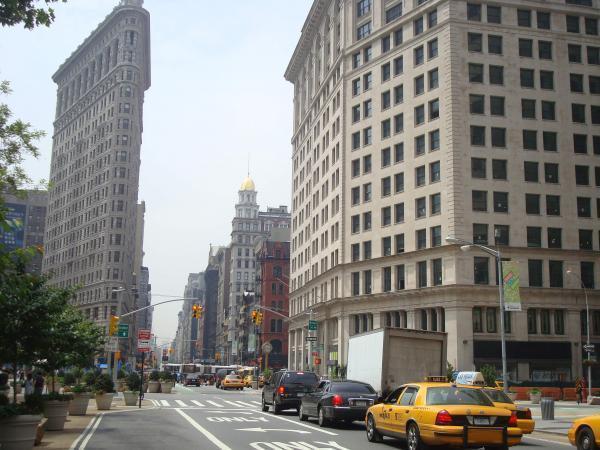
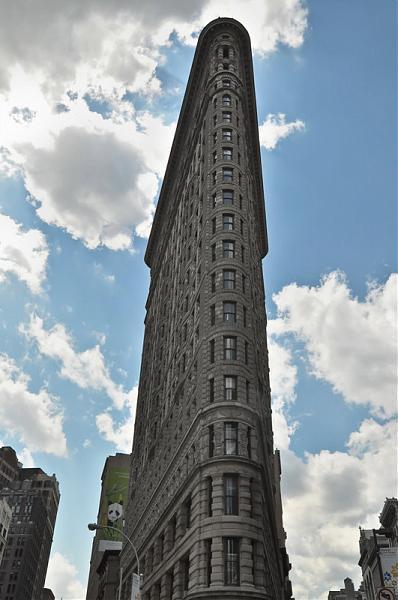
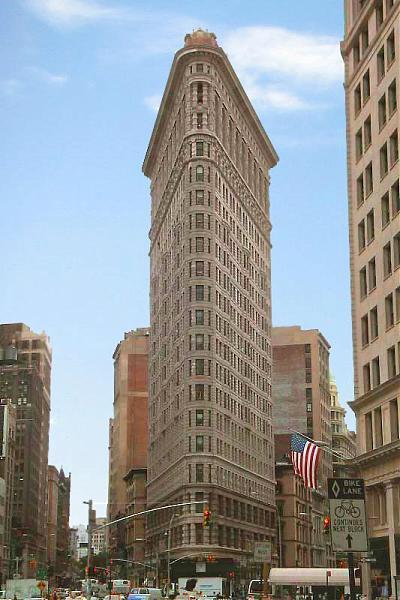
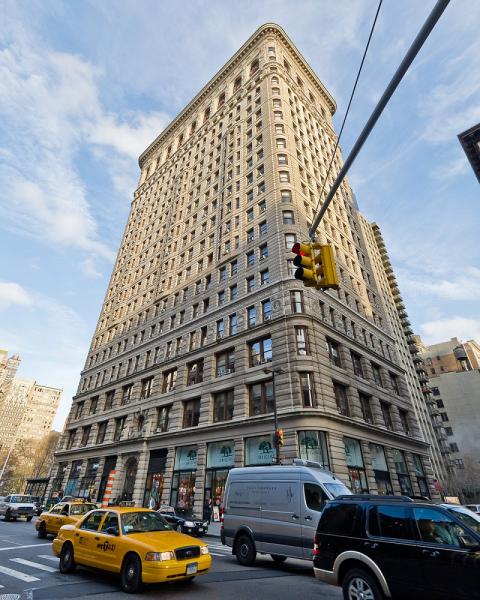
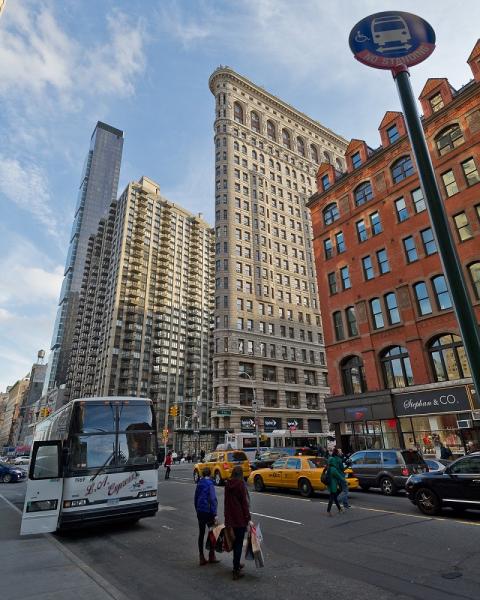
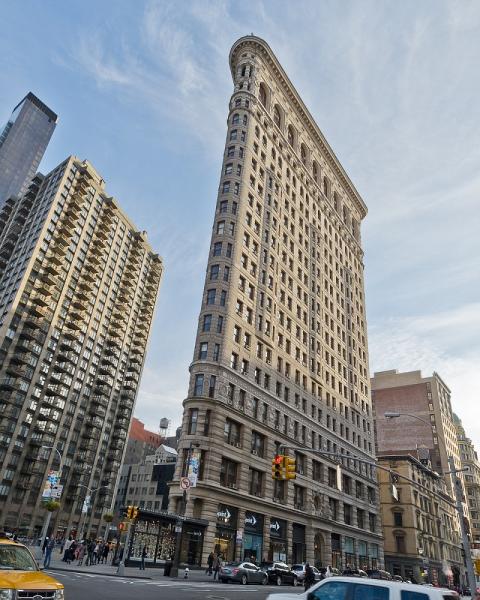
285-foot, 21-story Beaux-Arts office building completed in 1902. Designed by Daniel H. Burnham & Company, it was originally named the Fuller Building after the building's financier George Fuller and his Fuller Construction Company. At the time it was one of the tallest buildings in New York City. It sits on a triangular island block at 23rd Street, Fifth Avenue, and Broadway, facing Madison Square. Like a classical Greek column, its façade is separated into three parts horizontally. Since it was one of the first buildings to use a steel skeleton, the building could be constructed to 285 feet, which would have been very difficult with other construction methods of that time. The intricate, almost basket-weave detailing is largely terra cotta designed by Daniel Burnham and executed by Atlantic Terra Cotta Company.
The Fifth Avenue facade, organized in a tripartite scheme, is 18 window openings wide above the 3rd floor and composed of glazed tan terra-cotta, limestone, and buff-colored brick. The 3-story base of the building is faced in limestone. The ground floor contains an entrance in the center flanked by four show windows on each side. Except for the 2nd show window from the north end, all are projecting with original metal detail. The 2nd window from the southern end is topped by its original metal cresting. The windows are flanked by piers with alternating smooth and vermiculated bands of differing relief. The arched and vermiculated entrance contains a modern door and transom flanked by engaged, fluted columns covered in banding with foliate ornament supporting a projecting entablature with a frieze containing triglyphs and roundels. The projecting cornice is continued around the building. Above the entrance the 2nd floor contains a large oculus with a stylized Gibbs surround flanked by large consoles. Four window openings on each side flank the center opening containing paired windows. The 3rd floor continues this pattern with paired windows over the oculus and is crowned by a projecting dentiled cornice with a frieze containing bezant ornament.
The transitional and elaborately ornamented 4th floor contains 18 single-window openings. The flanking piers alternate between wide and narrow and are ornamented with terra-cotta panels containing foliate ornament, wreaths, lozenges, and masks on each end. The piers support an elaborate terra-cotta cornice with a roundel frieze.
The 5th & 6th floors form the base of the midsection of the facade. Continuing the window pattern of the 4th floor, the flanking piers are faced in less elaborately ornamented terra-cotta, with spandrel panels of alternating depth. Above the 6th floor is a frieze illustrating a Greek key motif. Floors 7 through 14 contain piers faced in rusticated buff-colored brick and three projecting bays of three window openings each, faced in terra-cotta. The bays are formed from the 3rd, 4th & 5th window openings from each end as well as the three center openings. The 15th floor is faced in simple rusticated brick; the 16th floor continues this pattern with arched window openings with voussoirs supporting a projecting terra-cotta cornice. The transitional 17th floor contains 18 window openings flanked by richly decorated piers of alternating width, containing lion's head masks and roundels supporting a projecting dentiled cornice.
The upper stories of the facade are boldly articulated on floors 18 and 19 with nine double-height window openings crowned by arches containing multi-pane windows with metal frames and spandrel panels. Each opening is flanked by elaborately decorated terra-cotta piers with wreaths and masks over the capitals. Above a projecting cornice the 20th floor contains 18 window openings flanked by stylized triglyphs supporting a dentiled and bracketed terra-cotta cornice. The building is surmounted by a penthouse and balustrade.
The Broadway facade is similar to the Fifth Avenue facade with a few exceptions. One of the projecting show windows on the ground floor near the southern end is set flush with the building line. There are two banded columns where the Broadway facade turns to join the Fifth Avenue facade, partially obscured by a 1-story extending kiosk with many extant original metal details. The "prow" of the building is six feet wide and contains three windows.
The narrow East 22nd Street facade contains eight window openings above the 4th floor. The four show windows on the ground floor are flush with the building line. The southwest corner has an early revolving door; the southeast corner originally had one too, but it has been replaced by a curved window. Above, each corner of the building contains a single opening per floor containing rounded glass panes. The ground floor is occupied by a Sprint store, City Market Cafe, Argo Tea, MAC cosmetics, and Origins skincare.
Today the Flatiron is a popular spot for tourist photographs, a National Historic Landmark, and a functioning office building, currently home to several book publishers, most of them under the umbrella of Holtzbrinck Publishers. The surrounding area of Manhattan is named the Flatiron District for its signature building.
Due to the canyon winds still found in New York City, ladies walking around the corner of the building would often have their skirts blown up revealing their legs. Men in the the 19th century would hang around these corners hoping to glance at some female limbs. Police officers wandering by would tell them to move along giving rise to the phrase "Twenty-three skidoo" (Twenty-third Street passes the Flat Iron Building). The exterior was used in the "Spiderman" movies as the Daily Bugle Building.
In 2023, the building was purchased by a consortium of GFP Real Estate, Brodsky Organization, and Sorgente Group which undertook a conversion to condominiums after being vacant for several years.
www.crainsnewyork.com/real-estate/flatiron-building-und...
archive.org/details/sim_architectural-record_1915-07_38...
www.youtube.com/watch?v=u9byCRM5Np4
The Fifth Avenue facade, organized in a tripartite scheme, is 18 window openings wide above the 3rd floor and composed of glazed tan terra-cotta, limestone, and buff-colored brick. The 3-story base of the building is faced in limestone. The ground floor contains an entrance in the center flanked by four show windows on each side. Except for the 2nd show window from the north end, all are projecting with original metal detail. The 2nd window from the southern end is topped by its original metal cresting. The windows are flanked by piers with alternating smooth and vermiculated bands of differing relief. The arched and vermiculated entrance contains a modern door and transom flanked by engaged, fluted columns covered in banding with foliate ornament supporting a projecting entablature with a frieze containing triglyphs and roundels. The projecting cornice is continued around the building. Above the entrance the 2nd floor contains a large oculus with a stylized Gibbs surround flanked by large consoles. Four window openings on each side flank the center opening containing paired windows. The 3rd floor continues this pattern with paired windows over the oculus and is crowned by a projecting dentiled cornice with a frieze containing bezant ornament.
The transitional and elaborately ornamented 4th floor contains 18 single-window openings. The flanking piers alternate between wide and narrow and are ornamented with terra-cotta panels containing foliate ornament, wreaths, lozenges, and masks on each end. The piers support an elaborate terra-cotta cornice with a roundel frieze.
The 5th & 6th floors form the base of the midsection of the facade. Continuing the window pattern of the 4th floor, the flanking piers are faced in less elaborately ornamented terra-cotta, with spandrel panels of alternating depth. Above the 6th floor is a frieze illustrating a Greek key motif. Floors 7 through 14 contain piers faced in rusticated buff-colored brick and three projecting bays of three window openings each, faced in terra-cotta. The bays are formed from the 3rd, 4th & 5th window openings from each end as well as the three center openings. The 15th floor is faced in simple rusticated brick; the 16th floor continues this pattern with arched window openings with voussoirs supporting a projecting terra-cotta cornice. The transitional 17th floor contains 18 window openings flanked by richly decorated piers of alternating width, containing lion's head masks and roundels supporting a projecting dentiled cornice.
The upper stories of the facade are boldly articulated on floors 18 and 19 with nine double-height window openings crowned by arches containing multi-pane windows with metal frames and spandrel panels. Each opening is flanked by elaborately decorated terra-cotta piers with wreaths and masks over the capitals. Above a projecting cornice the 20th floor contains 18 window openings flanked by stylized triglyphs supporting a dentiled and bracketed terra-cotta cornice. The building is surmounted by a penthouse and balustrade.
The Broadway facade is similar to the Fifth Avenue facade with a few exceptions. One of the projecting show windows on the ground floor near the southern end is set flush with the building line. There are two banded columns where the Broadway facade turns to join the Fifth Avenue facade, partially obscured by a 1-story extending kiosk with many extant original metal details. The "prow" of the building is six feet wide and contains three windows.
The narrow East 22nd Street facade contains eight window openings above the 4th floor. The four show windows on the ground floor are flush with the building line. The southwest corner has an early revolving door; the southeast corner originally had one too, but it has been replaced by a curved window. Above, each corner of the building contains a single opening per floor containing rounded glass panes. The ground floor is occupied by a Sprint store, City Market Cafe, Argo Tea, MAC cosmetics, and Origins skincare.
Today the Flatiron is a popular spot for tourist photographs, a National Historic Landmark, and a functioning office building, currently home to several book publishers, most of them under the umbrella of Holtzbrinck Publishers. The surrounding area of Manhattan is named the Flatiron District for its signature building.
Due to the canyon winds still found in New York City, ladies walking around the corner of the building would often have their skirts blown up revealing their legs. Men in the the 19th century would hang around these corners hoping to glance at some female limbs. Police officers wandering by would tell them to move along giving rise to the phrase "Twenty-three skidoo" (Twenty-third Street passes the Flat Iron Building). The exterior was used in the "Spiderman" movies as the Daily Bugle Building.
In 2023, the building was purchased by a consortium of GFP Real Estate, Brodsky Organization, and Sorgente Group which undertook a conversion to condominiums after being vacant for several years.
www.crainsnewyork.com/real-estate/flatiron-building-und...
archive.org/details/sim_architectural-record_1915-07_38...
www.youtube.com/watch?v=u9byCRM5Np4
Wikipedia article: http://en.wikipedia.org/wiki/Flatiron_Building
Nearby cities:
Coordinates: 40°44'27"N 73°59'22"W
This article is protected.
- Stern Brothers Store Building 0.2 km
- Fifth Avenue Building 0.2 km
- 11-25 Madison Avenue 0.2 km
- One Madison 0.2 km
- 1115 Broadway 0.3 km
- Shattuck & Company Building & Annex 0.3 km
- New York Life Building 0.4 km
- New York Life Insurance Company Annex 0.4 km
- 387-401 Park Avenue South 0.5 km
- Park Avenue Building 0.8 km
- Midtown (South Central) 0.3 km
- NoMad 0.6 km
- Gramercy 0.7 km
- Chelsea 1.1 km
- Greenwich Village 1.4 km
- Lower (Downtown) Manhattan 2.2 km
- Manhattan 4.7 km
- Hudson County, New Jersey 7.1 km
- Brooklyn 11 km
- Queens 14 km
Comments