
Scientific American Building
USA /
New Jersey /
West New York /
West 40th Street, 24-26
World
/ USA
/ New Jersey
/ West New York
office building
Add category
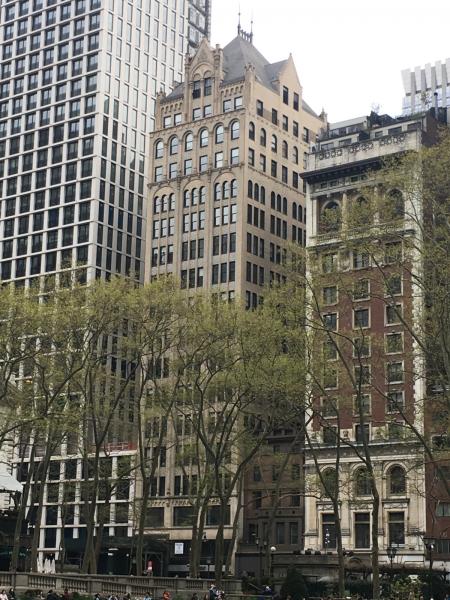


200-foot, 18-story Romanesque-revival office building completed in 1925. Designed by Buchman & Kahn, it was named for Scientific American magazine, which took space in the top five floors. It is three bays wide, clad in off-white brick and terra-cotta above a 3-story limestone base. The ground floor has the main entrance in the eastern bay, recessed behind a 2-story frame of grey granite. There is a high brass panel above the doors, and thin brass framing dividing the 2nd-story window into 12-over-3 panes. The rest of the ground floor has a storefront, and the 2nd floor has three wide show-windows, joined by two narrow panes with slender iron colonnettes on either side. The windows sit above a black iron spandrel, with two panels of foliate designs below the narrow panes. A dentiled stone band course sets off the 3rd floor, which has large tripartite windows in each bay, topped by blind arcades.
The verticality of the main shaft is emphasized by three 11-story side-by-side arches, each divided into three smaller arches, with pencil-thin colonnettes drawing the eye upward. Each of the brick spandrels has a pattern of eight small, projecting stones. The 15th-16th floors are divided into six equal 2-story arches separtated by engaged columns, and with a blind arcade across the top. There is a shallow setback to the 17th floor, with the end bays topped by deeper blind arches, and the center bay extending up to a final two windows at the 18th floor, framed by flat columns with stylized capitals. Both windows are topped by a round-arch, encompassed under a larger round-arch. Flanking the center bay are two larger engaged columns, extending up to frame a peaked French dormer that breaks the pyramidal metal roof that rises above the 17th floor. The dormer is crowned by three spiky finials.
The west elevation is plainer, clad in brick with four bays of three windows each. The floors with round-arched windows are repeated, and the pyramidal roof above the 17th floor is again pierced by a French dormer at the center; the east side also has a dormer.
he years following the Great Depression and leading up to the United States entering World War II were harsh on The Scientific American. In November 1943 the building was sold to investors. It continues to operate as office space today.
The verticality of the main shaft is emphasized by three 11-story side-by-side arches, each divided into three smaller arches, with pencil-thin colonnettes drawing the eye upward. Each of the brick spandrels has a pattern of eight small, projecting stones. The 15th-16th floors are divided into six equal 2-story arches separtated by engaged columns, and with a blind arcade across the top. There is a shallow setback to the 17th floor, with the end bays topped by deeper blind arches, and the center bay extending up to a final two windows at the 18th floor, framed by flat columns with stylized capitals. Both windows are topped by a round-arch, encompassed under a larger round-arch. Flanking the center bay are two larger engaged columns, extending up to frame a peaked French dormer that breaks the pyramidal metal roof that rises above the 17th floor. The dormer is crowned by three spiky finials.
The west elevation is plainer, clad in brick with four bays of three windows each. The floors with round-arched windows are repeated, and the pyramidal roof above the 17th floor is again pierced by a French dormer at the center; the east side also has a dormer.
he years following the Great Depression and leading up to the United States entering World War II were harsh on The Scientific American. In November 1943 the building was sold to investors. It continues to operate as office space today.
Nearby cities:
Coordinates: 40°45'9"N 73°58'59"W
- Amazon Hank Tech Hub 0.1 km
- Bank of America Tower 0.4 km
- B. Altman Department Store Building & Addition 0.4 km
- Empire State Building 0.5 km
- 1407 Broadway 0.5 km
- New York Telephone Building 0.7 km
- Manhattan Mall 0.7 km
- One Penn Plaza 0.8 km
- Two Penn Plaza 0.8 km
- Equitable Life Assurance Society Building 0.8 km
- Times Square – 42nd Street Subway Station (1,2,3,7,<7>,N,Q,R,S) 0.4 km
- Times Square Area 0.6 km
- Garment District 0.6 km
- Midtown (North Central) 0.6 km
- Theater District 0.7 km
- Murray Hill 0.9 km
- Hell's Kitchen (Clinton) 1.5 km
- Manhattan 3.3 km
- Hudson County, New Jersey 7.9 km
- Queens 15 km