
Granduc Mine site
USA /
Alaska /
Hyder /
World
/ USA
/ Alaska
/ Hyder
World / Canada / British Columbia / Stikine
mine
Add category


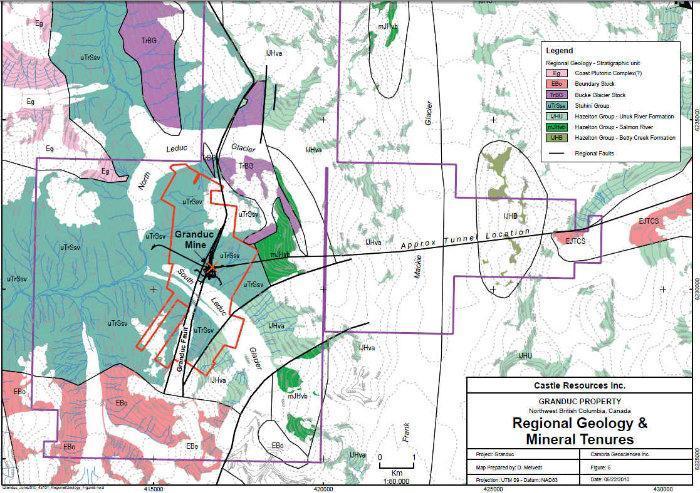


This property is now owned by Castle Resources Inc., and they plan to bring the mine back into production. One of the first major steps is to rehabilitate the 17km long tunnel that connects the Tide Lake Processing area to the Leduc Mine Site. Procon Mining Partnership started work beginning June 2011 with a proposed completion target of fall 2011.
Procon’s mandate is to re-establish tunnel ventilation, install bolts, mesh and shotecrete as required, determine quality of existing steel sets and replace where necessary, and prepare the tunnel for the efficient movement of men and equipment. In addition, Procon will be rehabilitating select areas of the mine workings in preparation for the underground drill program.
In addition to this Castle will start a 32,000 metre surface drill program which should commence June 1st 2011 and a robust underground drilling program to commence fall 2011 upon completion of the tunnel rehabilitation project.
The Granduc deposit is a large Besshi-style VMS copper deposit (with Au, Ag, and Fe credits) that was mined in the past across approximately 750 meters strike length. During historic mine development and production, access was via a 17km tunnel that connected underground workings at the Granduc mine site to the mill site at Tide Lake
The Granduc Mine was a brownfield site built and operated by Newmont and Esso Resources that produced 420 MM lbs Cu between 1971 and 1984 with a clean concentrate of 29% Cu, with Au/Ag credits. Nothing in the Granduc development was easy. The deep orebody was partially covered by a glacier, so open pit mining was not feasible. The terrain was too rugged, direct access to tidewater overland too difficult and the weather too treacherous to permit building a concentrator at the mine site. From the nearest feasible concentrator site, an 11 - mile tunnel had to be driven under intervening mountain ranges and glaciers to the mine, and a mountain road, subject to heavy snow-fall, had to be built to Stewart, the nearest port, 32 miles away.
Castle has identified new bluesky potential over a 4 km long strike and is currently in the process of rehabilitating the Tide Lake Tunnel and underground mine areas for production. Based on numerous non NI 43-101 in-situ resources calculations performed by Newmont and Esso there remains a significant copper and precious metal resource at the Granduc. Past operators primarily mined out ore above the 2600 foot elevation, however, historic estimates indicate mineralization extends down dip beneath that horizon and along strike. Results from 2010 18 hole (8,300 metre) drill program demonstrate widespread copper mineralization over 300 metres below previous mining operations and over 1,000 metres along strike.
Access between the underground workings at the Leduc Mine Site and the Mill and operations at Tide Lake was via the 17km (11 mile) long Tide Lake Tunnel. In September, 1964, tunnel driving began. The tunnel, through which ore travels from the mine at Leduc to the mill at Tide Lake, passed under three glaciers and three mountain ranges up to 7,000 feet high. Because this tunnel would be the life line of Granduc, it had to be designed for fast, large-scale, safe transportation of people, ore and supplies. Fifteen feet in diameter and carrying a high-speed railroad system, the tunnel was to be driven by two crews working from each end, planning to meet at the midpoint.
At the end of the shift, miners return to the terminal at Tide Lake, where they wash and change clothes.And so they would have, had not Nature stepped in. The Tide Lake heading at the planned site of the concentrator was no great problem insofar as supplying men and materials was concerned. However, at the mine end, at the Leduc Glacier, the tunnel crews faced real hardships. To reach the Leduc camp where the crews lived that first winter, one drove nine miles from Stewart to Cantu at the foot of the Salmon Glacier, then boarded tractor-drawn sled trains for a 22-mile run up the glacier and over a 5,500-foot ice-filled pass to Leduc.
By February, 1965, the men at Leduc had driven just 28 feet of tunnel. That month, an avalanche roared down on Leduc, killing 26 crew members and wrecking much of the camp at the tunnel portal. Work resumed on the tunnel not long after the avalanche, this time all of it done from Tide Lake. Using a sliding work floor at the tunnel face-essentially a movable rail switching yard-the tunnel crews set these world records for driving a tunnel this size in the 54-month rush to complete it.
Best single day advance 115 feet
Best six consecutive day advance 601 feet
Best one-mile advance 73 work days
Best month's advance 2,320 feet.
These records were set in spite of problems of encountering areas of weak rock that required extensive support and, at one point, heavy flows of water under high pressure that had to be sealed off by grouting. In December, 1968, the tunnel crews broke into the mine area, and the job was done.
Reference for Castle Resources:
www.castleresources.com/
Reference for Granduc Mine History (multiple links):
www.stewartbc.com/location.htm
Procon’s mandate is to re-establish tunnel ventilation, install bolts, mesh and shotecrete as required, determine quality of existing steel sets and replace where necessary, and prepare the tunnel for the efficient movement of men and equipment. In addition, Procon will be rehabilitating select areas of the mine workings in preparation for the underground drill program.
In addition to this Castle will start a 32,000 metre surface drill program which should commence June 1st 2011 and a robust underground drilling program to commence fall 2011 upon completion of the tunnel rehabilitation project.
The Granduc deposit is a large Besshi-style VMS copper deposit (with Au, Ag, and Fe credits) that was mined in the past across approximately 750 meters strike length. During historic mine development and production, access was via a 17km tunnel that connected underground workings at the Granduc mine site to the mill site at Tide Lake
The Granduc Mine was a brownfield site built and operated by Newmont and Esso Resources that produced 420 MM lbs Cu between 1971 and 1984 with a clean concentrate of 29% Cu, with Au/Ag credits. Nothing in the Granduc development was easy. The deep orebody was partially covered by a glacier, so open pit mining was not feasible. The terrain was too rugged, direct access to tidewater overland too difficult and the weather too treacherous to permit building a concentrator at the mine site. From the nearest feasible concentrator site, an 11 - mile tunnel had to be driven under intervening mountain ranges and glaciers to the mine, and a mountain road, subject to heavy snow-fall, had to be built to Stewart, the nearest port, 32 miles away.
Castle has identified new bluesky potential over a 4 km long strike and is currently in the process of rehabilitating the Tide Lake Tunnel and underground mine areas for production. Based on numerous non NI 43-101 in-situ resources calculations performed by Newmont and Esso there remains a significant copper and precious metal resource at the Granduc. Past operators primarily mined out ore above the 2600 foot elevation, however, historic estimates indicate mineralization extends down dip beneath that horizon and along strike. Results from 2010 18 hole (8,300 metre) drill program demonstrate widespread copper mineralization over 300 metres below previous mining operations and over 1,000 metres along strike.
Access between the underground workings at the Leduc Mine Site and the Mill and operations at Tide Lake was via the 17km (11 mile) long Tide Lake Tunnel. In September, 1964, tunnel driving began. The tunnel, through which ore travels from the mine at Leduc to the mill at Tide Lake, passed under three glaciers and three mountain ranges up to 7,000 feet high. Because this tunnel would be the life line of Granduc, it had to be designed for fast, large-scale, safe transportation of people, ore and supplies. Fifteen feet in diameter and carrying a high-speed railroad system, the tunnel was to be driven by two crews working from each end, planning to meet at the midpoint.
At the end of the shift, miners return to the terminal at Tide Lake, where they wash and change clothes.And so they would have, had not Nature stepped in. The Tide Lake heading at the planned site of the concentrator was no great problem insofar as supplying men and materials was concerned. However, at the mine end, at the Leduc Glacier, the tunnel crews faced real hardships. To reach the Leduc camp where the crews lived that first winter, one drove nine miles from Stewart to Cantu at the foot of the Salmon Glacier, then boarded tractor-drawn sled trains for a 22-mile run up the glacier and over a 5,500-foot ice-filled pass to Leduc.
By February, 1965, the men at Leduc had driven just 28 feet of tunnel. That month, an avalanche roared down on Leduc, killing 26 crew members and wrecking much of the camp at the tunnel portal. Work resumed on the tunnel not long after the avalanche, this time all of it done from Tide Lake. Using a sliding work floor at the tunnel face-essentially a movable rail switching yard-the tunnel crews set these world records for driving a tunnel this size in the 54-month rush to complete it.
Best single day advance 115 feet
Best six consecutive day advance 601 feet
Best one-mile advance 73 work days
Best month's advance 2,320 feet.
These records were set in spite of problems of encountering areas of weak rock that required extensive support and, at one point, heavy flows of water under high pressure that had to be sealed off by grouting. In December, 1968, the tunnel crews broke into the mine area, and the job was done.
Reference for Castle Resources:
www.castleresources.com/
Reference for Granduc Mine History (multiple links):
www.stewartbc.com/location.htm
Nearby cities:
Coordinates: 56°12'48"N 130°21'8"W
- Tennyson Project 12 km
- KSM Gold Project 41 km
- Clone Gold Property 50 km
- Red Chris Property 184 km
- Cascadero Toodoggone Project 236 km
- Greens Creek Project 345 km
- Tulsequah Chief Project 351 km
- Faro Mine site 707 km
- Pine Point mine 1042 km
- Thor Lake Rare Earth Elements Project 1199 km
- Salmon Glacier 16 km
- Snowfield Gold Project 35 km
- Bear Glacier Provincial Park 45 km
- Bell Island CN 77 km
- Hassler Island 88 km
- Revillagigedo Island 95 km
- Deer Island 106 km
- Wrangell Island 112 km
- Brownson Island 116 km
- Etolin Island 128 km