
Houghton Mifflin & Co. Building (New York City, New York)
USA /
New Jersey /
West New York /
New York City, New York /
Fifth Avenue, 85
World
/ USA
/ New Jersey
/ West New York
office building, 1901_construction, Renaissance Revival (architecture)
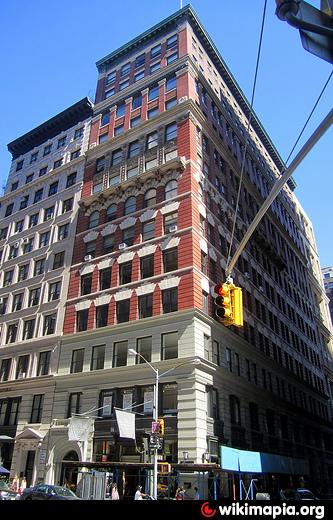
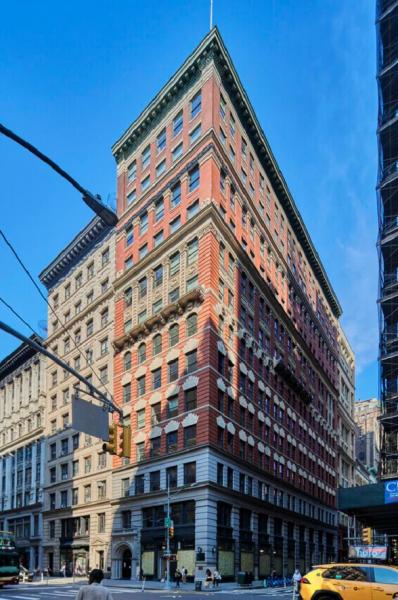
178-foot, 13-story Renaissance-revival office building originally completed in 1901. Designed by Louis Korn as a 9-story store-and-loft building, there were several later additions that raised it to 13 floors. Publisher Houghton Mifflin moved in beginning in 1906. The building was also known as the Annin Building, for its owners Annin & Co., in the 1920s.
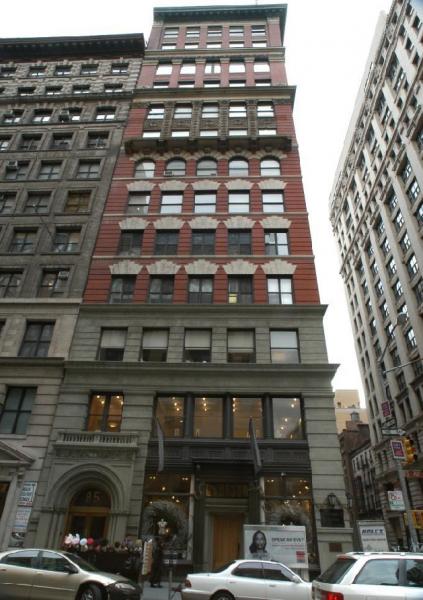
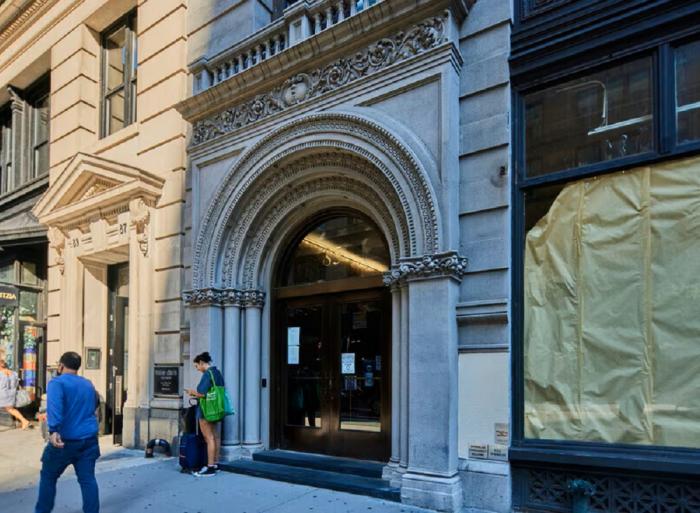
The 5th Avenue facade is organized into a 2-story base of rusticated stone, a transitional stone 3rd story, a 4-story midsection, and a 2-story top surmounted by four later stories. The 1st floor contains an entrance at each end. The round-arched northern entrance is a neo-Romanesque portal with stone jambs, surmounted by a balustrade. The southern entrance contains two engaged columns, set on pedestals, supporting an entablature. This is surrounded by a doorway sheathed in sheet metal with a lintel supported by consoles. Large original plate-glass display windows with frames also sheathed in black metal flank this doorway. Banded stone piers define the 2-story base. The 2nd floor contains four single-pane wood sash windows rising above a frieze and separated by colonnettes over the southern entrance, and paired one-over-one wood sash windows over the northern entrance. A stone cornice completes the base. The transitional 3rd floor, of rusticated stone, contains five window openings with one-over-one wood sash windows, capped by a slender cornice.
Floors 4-7 are faced in rusticated red brick, with each story separated by a white stone belt course. The five window openings of the 3rd floor are continued, each opening capped by oversized white stone voussoirs. The 7th-floor windows are round-arched and a projecting cornice marks the more heavily decorated 8th and 9th stories of the original top section of the facade where heavily decorated terra-cotta pilasters and spandrel panels mark the bays.
At the newer 10th & 11th floors, brick piers and pilasters with terra-cotta capitals define the bays; terra-cotta cartouches are set at the bases of the corner piers. A terra-cotta frieze and cornice separates the 11th floor from the 12th and 13th, the last addition to the building, which is capped by a metal cornice.
The south elevation is 9 and a half bays wide; each bay contains paired window openings and repeats the motifs of the Fifth Avenue facade. An extra bay rises above the service entrance. The cornice above the 7th floor is a repeat of that on the Fifth Avenue facade above the three central bays.
The 5th Avenue facade is organized into a 2-story base of rusticated stone, a transitional stone 3rd story, a 4-story midsection, and a 2-story top surmounted by four later stories. The 1st floor contains an entrance at each end. The round-arched northern entrance is a neo-Romanesque portal with stone jambs, surmounted by a balustrade. The southern entrance contains two engaged columns, set on pedestals, supporting an entablature. This is surrounded by a doorway sheathed in sheet metal with a lintel supported by consoles. Large original plate-glass display windows with frames also sheathed in black metal flank this doorway. Banded stone piers define the 2-story base. The 2nd floor contains four single-pane wood sash windows rising above a frieze and separated by colonnettes over the southern entrance, and paired one-over-one wood sash windows over the northern entrance. A stone cornice completes the base. The transitional 3rd floor, of rusticated stone, contains five window openings with one-over-one wood sash windows, capped by a slender cornice.
Floors 4-7 are faced in rusticated red brick, with each story separated by a white stone belt course. The five window openings of the 3rd floor are continued, each opening capped by oversized white stone voussoirs. The 7th-floor windows are round-arched and a projecting cornice marks the more heavily decorated 8th and 9th stories of the original top section of the facade where heavily decorated terra-cotta pilasters and spandrel panels mark the bays.
At the newer 10th & 11th floors, brick piers and pilasters with terra-cotta capitals define the bays; terra-cotta cartouches are set at the bases of the corner piers. A terra-cotta frieze and cornice separates the 11th floor from the 12th and 13th, the last addition to the building, which is capped by a metal cornice.
The south elevation is 9 and a half bays wide; each bay contains paired window openings and repeats the motifs of the Fifth Avenue facade. An extra bay rises above the service entrance. The cornice above the 7th floor is a repeat of that on the Fifth Avenue facade above the three central bays.
Nearby cities:
Coordinates: 40°44'14"N 73°59'31"W
- Stuyvesant-Schuyler Building 0.1 km
- 39 West 14th Street 0.3 km
- Cardozo School of Law 0.3 km
- Forbes Building 0.3 km
- 8 West 14th Street 0.3 km
- 34 West 14th Street 0.3 km
- The Foundling Center / The Sixth Avenue Elementary School PS 340 0.4 km
- Centennial Memorial Temple - The Salvation Army New York Division Headquarters 0.6 km
- 154 West 14th Street 0.7 km
- The Lesbian, Gay, Bisexual and Transgender Community Services Center 0.8 km
- West Village 1 km
- Greenwich Village 1 km
- Chelsea 1.2 km
- Midtown (Manhattan, NY) 1.5 km
- Lower (Downtown) Manhattan 1.8 km
- Manhattan 5.2 km
- Hudson County, New Jersey 6.9 km
- Brooklyn 11 km
- Queens 14 km
- The Palisades 25 km