
The Windermere
USA /
New Jersey /
West New York /
West 57th Street, 400
World
/ USA
/ New Jersey
/ West New York
apartment building
Add category


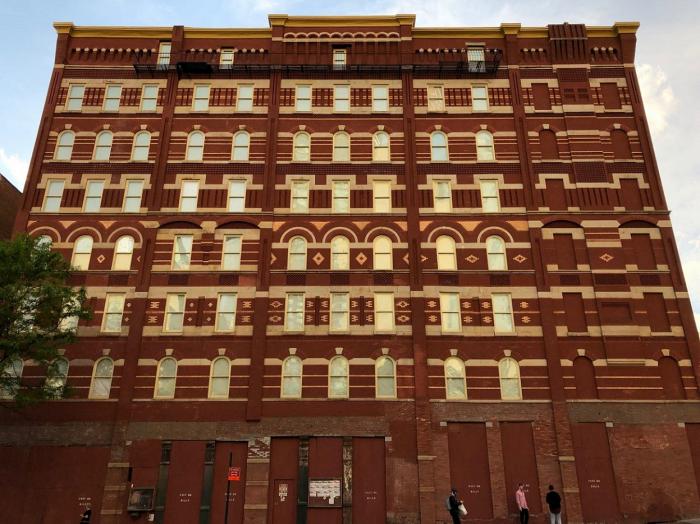
7-story Queen Anne-style residential building completed in 1881 as an apartment building for women artists and writers, called The Windermere. Designed by Theophilus G. Smith, it has an eclectic mix of styles that include elements found in Queen Anne, High Victorian Gothic and Romanesque architecture. The oldest apartment building on the west side of Manhattan, the landmarked building sank into disrepair in the 1980s, and has been vacant since 2009 and under renovation since 2013.
The Windermere is comprised of three separate buildings – a corner building and two narrower buildings to its west – all of which are faced with red Philadelphia brick and trimmed with tan and black Philadelphia brick, stone, and tile. Although these buildings vary in width and have distinctive facades, the use of the same materials on all facades and the display of common decorative features endow the Windermere with the appearance of a unified group.
No. 400 West 57th Street has a frontage of 50 feet on West 57th Street. Its façade is separated into three bays, each defined by channeled brick pilasters that run from the second story’s sill level to a point near the top of the cornice. As they approach their peak, the pilasters corbel outward to support two stone springers that serve as the foundation of a blind, tan-brick pointed arch with a stone keystone. This arch pierces the tympanum of a red-brick pediment projecting above the building’s cornice and topped with a large, stone cymatium. The 2nd and 6th floors feature round-arched window openings with brick voussoirs and stone springers and keystones, and with stone sills. Square-headed window openings are present at the 7th floor and in the 3rd, 4th, and 5th floors’ central bays. At the 4th floor, these square-headed window openings are paired beneath a segmental brick arch with stone springers. Between the 3rd and 5th floors, two 3-story, round oriel windows project from the façade, in the easternmost and westernmost bays. Each has three square-headed window openings per floor, and is supported by a single stone ancon and topped by a broad, stone cornice.
The façade is accented with tile, stone, tan-colored brick, black brick, and dogtoothed brickwork. A stone ledge extends across the façade at the 5th floor sill level; similar ledges at the fourth-floor sill level and at the base of the cornice are interrupted by the pilasters. Three single tan-brick courses, interrupted by the window openings and pilasters, are present at the second floor. A single tan-brick course runs across the façade at the 3rd floor, interrupted by the window openings and pilasters, except on the oriels, where two single tan-brick courses are present. At the 4th floor, a single tan-brick course is present in the easternmost and westernmost bays, running between the oriels and their flanking pilasters. In the 4th floor’s central bay, two single tan-brick courses are present; between each window opening and its flanking pilaster, these courses enframe a diamond-shaped element in tan brick. A tan-brick element between the two window openings is in the shape of a cross. Similar cross-shaped elements are present at the 3rd and 5th floors, between the window openings on the oriels. Running horizontally across the façade between two single tan-brick courses in the central bay of the 5th floor is a row of tile with and a white-and-light-blue diamond pattern, which is sandwiched between two single courses of black brick laid in stretcher bond. Horizontally aligned with the tile in the easternmost and westernmost bays is a course of stone.
Four single courses of tan-colored brick run across the façade between the sill and lintel levels of each of the two top floors. These courses are interrupted by the window openings and pilasters and, at the 7th floor, channeling; at the 6th floor, the tan-brick courses are paired, with each pair sandwiching a soldier course of dogtoothed red brick. An additional single course of tan brick runs across the façade, interrupted by the pilasters, above the 6th-floor window arches. Dogtoothed brickwork is present in the central bay of the 3rd floor, where it is laid in soldier course below the window sills; in panels below the 4rh-floor window openings in the central bay, and below all of the window openings on the oriels; and at the 4th floor, as infill between the paired square-headed window openings in the central bay and the segmental arch that spans them. Six dogtoothed courses alternating with five rows of stretcher bond appear in the central bay between the lintels of the 5th-floor window openings and the sills of the 6th-floor window openings. Sandwiched between the lintels of the 7th-story window openings and the ledges above are six dogtoothed brick courses alternating with five rows of brick laid in stretcher bond. Five dogtoothed courses appear below the same windows’ sills.
The façade corbels outward above the 7th floor to form a high cornice. Here, the easternmost and westernmost bays of No. 400 feature corbelled round brick arches (eight in easternmost bay and seven in the westernmost) with stone springers, and the central bay features two set of paired round arches with stone springers, which flank a round arch that spans two paired, round-headed, channeled brick elements. Circular openings are present below the arches in the eastern bay, and below the two easternmost and two westernmost arches in the central bay. In the central bay, a stone belt course runs between the springers of the pediment’s blind brick arch.
No. 404 West 57th Street has a 3-bay facade and a street frontage of 20 feet. It is separated from No. 400 to its east and No. 406 to its west above the ground floor by channeled brick pilasters that run from the 2nd story’s sill level to the top of the building’s brick and stone cornice. Below the 2nd story’s sill level, the eastern pilaster is of rough-faced stone. Topped, as No. 400’s cornice is, by a cymatium, No. 404’s cornice projects above those of 400 and 406 West 57th Street. At the 2nd and 6th floors are round-headed window openings that are similar to those on the corresponding floors of No. 400. No. 404’s 4th-floor round-headed window openings, like the others, have stone springers, but they lack keystones and have stone extrados trim. All of the round-headed openings have stone sills or are located above stone ledges. All of No. 404’s square-headed window openings, which are located at the 3rd, 5th, and 7th floors, have stone lintels. They also have stone sills or are located above stone ledges. At the square-headed windows, two additional courses of stone – one just below the lintel level, and another just above the sill level – are present, in between and flanking the windows. At the 5th floor, a stone course is present just above the sill level, in between and flanking the windows; and stone wraps the window heads in a form recalling that of a label molding. The upper floors, except in window spacing and number of window openings, are similar in design and use of materials, including brick dogtoothing, channeling, tan-brick courses, and stone, to the corresponding floors of No. 400. The cornice features corbelled brick supporting a stone belt course, which in turn supports six arches with brick voussoirs and no keystones. The arches’ extrados are trimmed in stone. The cornice, like that of No. 400, is crowned by a large cymatium.
No. 406 West 57th Street has a street frontage of 30 feet. Its roof line is at the same height as that of No. 400, but its window openings, belt courses, and horizontal banding elements are at a slightly lower vertical level than those of Nos. 400 and 404. No. 406’s façade is split into two symmetrical bays by a channeled brick pilaster that extends from the sill level of the 2nd story to just above a stone ledge above the 7th-floor window openings, where the pilaster terminates in a stone molding. The pilasters are pierced by a stone ledge at the sill level of the 5th floor. No. 406 has two pairs of window openings per floor. At the 2nd and 6th floors are round-headed window openings similar to those at the corresponding floors of No. 404. All of these windows have stone sills. All of No. 406’s square-headed window openings, which are located at the 3rd, 4th, 5th, and 7th floors, have stone lintels. They also have stone sills or are located above stone ledges. At the 3rd, 4th, and 7th floors, two additional courses of stone – one just below the lintel level, and another just above sill level – are present, in between and flanking the windows. At the 5th floor, a stone course is present just above the sill level, in between and flanking the windows; stone blocks wrap the window heads in a form
recalling that of a label molding.
Except in window spacing, number of window openings per floor, and the presence of the channeled brick pilaster in the center of No. 406’s façade, the design and use of materials – including brick dogtoothing, channeling, tan- and black-brick courses, stone, and tile – is similar at the 2nd, 5th, 6th, and 7th floors of No. 406 to the corresponding floors of No. 404, except that the 7th floor of No. 406 has single channels between and flanking the windows, while the 7th floor of No. 404 has paired channels between the windows and none flanking them. No. 406’s 4th floor, similar to No. 400’s 4th-floor central bay, features diamond-shaped elements in tan brick, located between the windows and their flanking pilasters. The cornice of No. 406, which begins above a stone ledge above the 7th floor windows, features corbelled brick supporting stone springers, which in turn support 19 round brick arches without keystones.
The cornice, like those of No. 400 and No. 404, is topped by a large stone cymatium.
The Windermere’s asymmetrical, 115-foot long Ninth Avenue façade is divided into five large bays. Each of these bays is essentially symmetrical, except for the 2nd-northernmost bay; there, the two windows per floor are slightly off center. Each of the five bays is defined by channeled brick pilasters. The northernmost three of these pilasters appear to have been removed below the 2nd floor’s sill level; the other three pilasters run from below the 2nd story’s stone sill course to the top of the Ninth Avenue cornice. The northernmost bay of the Ninth Avenue façade is split by a chimney, which projects from the façade and features channeling, dogtoothed brick panels and courses, and recessed brick panels. The central bay’s roof line rises slightly above the roof lines of the other bays.
The window openings are grouped in a pattern, from south to north, of 3-2-3-2-2. Round-arched window openings with brick voussoirs and stone springers and keystones, are present at the 2nd and 6th floors. Round-arched window openings with brick voussoirs, without keystones, and with stone extrados trim, are present in the southernmost, central, and 2nd-northernmost bays at the fourth floor. At the 2nd floor, these window openings are above a stone sill course; the round-headed openings at the 4th floor are above a stone ledge; and the windows at the 6th floor have stone sills. Square-headed window openings with stone lintels are present at the 3rd, 5th, and 7th floors, and at the 4th floor, where they are placed below segmental-arches with stone springers in the 2nd-southernmost and northernmost bays. At the 3rd and 7th floors, these windows have stone sills; at the 5th floor, they are above a stone ledge located at sill level. At the square-headed window openings, two additional courses of stone – one just below lintel level, and other just above sill level – are present in between and flanking the windows. At the 5th floor windows, a stone course is present just above sill level, in between and flanking the windows; stone blocks wrap the window heads in a form recalling that of a label molding. At the 3rd floor, in all of the bays except the northernmost, brick channeling is present between the windows. Zigzag, cross-shaped, diamond-shaped, and other decorative elements in tan brick flank, and are located between, the window openings in the three central bays. Cross-shaped elements in tan brick flank are located between the outer window openings and their flanking pilasters in the southernmost bay. Running across each of the bays below the 3rd-floor windows’ sills is a single soldier course of dogtoothed brick. At the 4th floor, in the northernmost and 2nd-southernmost bays, the Ninth Avenue façade features square-headed window openings, each of which is located below a segmental arch. The area between the windows’ lintels and the arches above is filled with dogtoothed brickwork. A stone ledge runs across the 4th floor, pierced by every pilaster and by the chimney. Below this ledge, beneath each window, is a dogtoothed brick panel. Triangular decorative elements in tan brick are present above the window openings, horizontally placed between the openings and abutting the pilasters. The 6th floor is similar in design and use of materials to the corresponding floor of the 57th Street façade, with five dogtoothed brick courses abutting the 7th-floor window sills above. Two pairs of tan-brick courses run horizontally between the sill and lintel levels, sandwiching two rows of brick dogtoothed soldier courses.
The Ninth Avenue façade is crowned by a broad stone and brick cornice, which is topped by a large cymatium. It is pierced by four window or door openings, one in each of the four southernmost bays. At the central bay, corbelled brickwork supports a stone belt course, from which ten arches with brick voussoirs spring. These arches’ extrados are trimmed with stone. The cornice at the southernmost bay has ten round arches with stone springers; below the two northernmost arches are circular openings. The cornice at the 2nd-southernmost bay has eight round arches with stone springers; below all except the northernmost arch are circular openings. The cornice at the 2nd-northernmost bay has nine round arches with stone springers; the cornice at the northernmost bay has eight round arches with stone springers; below all of these arches are circular openings.
The Windermere is comprised of three separate buildings – a corner building and two narrower buildings to its west – all of which are faced with red Philadelphia brick and trimmed with tan and black Philadelphia brick, stone, and tile. Although these buildings vary in width and have distinctive facades, the use of the same materials on all facades and the display of common decorative features endow the Windermere with the appearance of a unified group.
No. 400 West 57th Street has a frontage of 50 feet on West 57th Street. Its façade is separated into three bays, each defined by channeled brick pilasters that run from the second story’s sill level to a point near the top of the cornice. As they approach their peak, the pilasters corbel outward to support two stone springers that serve as the foundation of a blind, tan-brick pointed arch with a stone keystone. This arch pierces the tympanum of a red-brick pediment projecting above the building’s cornice and topped with a large, stone cymatium. The 2nd and 6th floors feature round-arched window openings with brick voussoirs and stone springers and keystones, and with stone sills. Square-headed window openings are present at the 7th floor and in the 3rd, 4th, and 5th floors’ central bays. At the 4th floor, these square-headed window openings are paired beneath a segmental brick arch with stone springers. Between the 3rd and 5th floors, two 3-story, round oriel windows project from the façade, in the easternmost and westernmost bays. Each has three square-headed window openings per floor, and is supported by a single stone ancon and topped by a broad, stone cornice.
The façade is accented with tile, stone, tan-colored brick, black brick, and dogtoothed brickwork. A stone ledge extends across the façade at the 5th floor sill level; similar ledges at the fourth-floor sill level and at the base of the cornice are interrupted by the pilasters. Three single tan-brick courses, interrupted by the window openings and pilasters, are present at the second floor. A single tan-brick course runs across the façade at the 3rd floor, interrupted by the window openings and pilasters, except on the oriels, where two single tan-brick courses are present. At the 4th floor, a single tan-brick course is present in the easternmost and westernmost bays, running between the oriels and their flanking pilasters. In the 4th floor’s central bay, two single tan-brick courses are present; between each window opening and its flanking pilaster, these courses enframe a diamond-shaped element in tan brick. A tan-brick element between the two window openings is in the shape of a cross. Similar cross-shaped elements are present at the 3rd and 5th floors, between the window openings on the oriels. Running horizontally across the façade between two single tan-brick courses in the central bay of the 5th floor is a row of tile with and a white-and-light-blue diamond pattern, which is sandwiched between two single courses of black brick laid in stretcher bond. Horizontally aligned with the tile in the easternmost and westernmost bays is a course of stone.
Four single courses of tan-colored brick run across the façade between the sill and lintel levels of each of the two top floors. These courses are interrupted by the window openings and pilasters and, at the 7th floor, channeling; at the 6th floor, the tan-brick courses are paired, with each pair sandwiching a soldier course of dogtoothed red brick. An additional single course of tan brick runs across the façade, interrupted by the pilasters, above the 6th-floor window arches. Dogtoothed brickwork is present in the central bay of the 3rd floor, where it is laid in soldier course below the window sills; in panels below the 4rh-floor window openings in the central bay, and below all of the window openings on the oriels; and at the 4th floor, as infill between the paired square-headed window openings in the central bay and the segmental arch that spans them. Six dogtoothed courses alternating with five rows of stretcher bond appear in the central bay between the lintels of the 5th-floor window openings and the sills of the 6th-floor window openings. Sandwiched between the lintels of the 7th-story window openings and the ledges above are six dogtoothed brick courses alternating with five rows of brick laid in stretcher bond. Five dogtoothed courses appear below the same windows’ sills.
The façade corbels outward above the 7th floor to form a high cornice. Here, the easternmost and westernmost bays of No. 400 feature corbelled round brick arches (eight in easternmost bay and seven in the westernmost) with stone springers, and the central bay features two set of paired round arches with stone springers, which flank a round arch that spans two paired, round-headed, channeled brick elements. Circular openings are present below the arches in the eastern bay, and below the two easternmost and two westernmost arches in the central bay. In the central bay, a stone belt course runs between the springers of the pediment’s blind brick arch.
No. 404 West 57th Street has a 3-bay facade and a street frontage of 20 feet. It is separated from No. 400 to its east and No. 406 to its west above the ground floor by channeled brick pilasters that run from the 2nd story’s sill level to the top of the building’s brick and stone cornice. Below the 2nd story’s sill level, the eastern pilaster is of rough-faced stone. Topped, as No. 400’s cornice is, by a cymatium, No. 404’s cornice projects above those of 400 and 406 West 57th Street. At the 2nd and 6th floors are round-headed window openings that are similar to those on the corresponding floors of No. 400. No. 404’s 4th-floor round-headed window openings, like the others, have stone springers, but they lack keystones and have stone extrados trim. All of the round-headed openings have stone sills or are located above stone ledges. All of No. 404’s square-headed window openings, which are located at the 3rd, 5th, and 7th floors, have stone lintels. They also have stone sills or are located above stone ledges. At the square-headed windows, two additional courses of stone – one just below the lintel level, and another just above the sill level – are present, in between and flanking the windows. At the 5th floor, a stone course is present just above the sill level, in between and flanking the windows; and stone wraps the window heads in a form recalling that of a label molding. The upper floors, except in window spacing and number of window openings, are similar in design and use of materials, including brick dogtoothing, channeling, tan-brick courses, and stone, to the corresponding floors of No. 400. The cornice features corbelled brick supporting a stone belt course, which in turn supports six arches with brick voussoirs and no keystones. The arches’ extrados are trimmed in stone. The cornice, like that of No. 400, is crowned by a large cymatium.
No. 406 West 57th Street has a street frontage of 30 feet. Its roof line is at the same height as that of No. 400, but its window openings, belt courses, and horizontal banding elements are at a slightly lower vertical level than those of Nos. 400 and 404. No. 406’s façade is split into two symmetrical bays by a channeled brick pilaster that extends from the sill level of the 2nd story to just above a stone ledge above the 7th-floor window openings, where the pilaster terminates in a stone molding. The pilasters are pierced by a stone ledge at the sill level of the 5th floor. No. 406 has two pairs of window openings per floor. At the 2nd and 6th floors are round-headed window openings similar to those at the corresponding floors of No. 404. All of these windows have stone sills. All of No. 406’s square-headed window openings, which are located at the 3rd, 4th, 5th, and 7th floors, have stone lintels. They also have stone sills or are located above stone ledges. At the 3rd, 4th, and 7th floors, two additional courses of stone – one just below the lintel level, and another just above sill level – are present, in between and flanking the windows. At the 5th floor, a stone course is present just above the sill level, in between and flanking the windows; stone blocks wrap the window heads in a form
recalling that of a label molding.
Except in window spacing, number of window openings per floor, and the presence of the channeled brick pilaster in the center of No. 406’s façade, the design and use of materials – including brick dogtoothing, channeling, tan- and black-brick courses, stone, and tile – is similar at the 2nd, 5th, 6th, and 7th floors of No. 406 to the corresponding floors of No. 404, except that the 7th floor of No. 406 has single channels between and flanking the windows, while the 7th floor of No. 404 has paired channels between the windows and none flanking them. No. 406’s 4th floor, similar to No. 400’s 4th-floor central bay, features diamond-shaped elements in tan brick, located between the windows and their flanking pilasters. The cornice of No. 406, which begins above a stone ledge above the 7th floor windows, features corbelled brick supporting stone springers, which in turn support 19 round brick arches without keystones.
The cornice, like those of No. 400 and No. 404, is topped by a large stone cymatium.
The Windermere’s asymmetrical, 115-foot long Ninth Avenue façade is divided into five large bays. Each of these bays is essentially symmetrical, except for the 2nd-northernmost bay; there, the two windows per floor are slightly off center. Each of the five bays is defined by channeled brick pilasters. The northernmost three of these pilasters appear to have been removed below the 2nd floor’s sill level; the other three pilasters run from below the 2nd story’s stone sill course to the top of the Ninth Avenue cornice. The northernmost bay of the Ninth Avenue façade is split by a chimney, which projects from the façade and features channeling, dogtoothed brick panels and courses, and recessed brick panels. The central bay’s roof line rises slightly above the roof lines of the other bays.
The window openings are grouped in a pattern, from south to north, of 3-2-3-2-2. Round-arched window openings with brick voussoirs and stone springers and keystones, are present at the 2nd and 6th floors. Round-arched window openings with brick voussoirs, without keystones, and with stone extrados trim, are present in the southernmost, central, and 2nd-northernmost bays at the fourth floor. At the 2nd floor, these window openings are above a stone sill course; the round-headed openings at the 4th floor are above a stone ledge; and the windows at the 6th floor have stone sills. Square-headed window openings with stone lintels are present at the 3rd, 5th, and 7th floors, and at the 4th floor, where they are placed below segmental-arches with stone springers in the 2nd-southernmost and northernmost bays. At the 3rd and 7th floors, these windows have stone sills; at the 5th floor, they are above a stone ledge located at sill level. At the square-headed window openings, two additional courses of stone – one just below lintel level, and other just above sill level – are present in between and flanking the windows. At the 5th floor windows, a stone course is present just above sill level, in between and flanking the windows; stone blocks wrap the window heads in a form recalling that of a label molding. At the 3rd floor, in all of the bays except the northernmost, brick channeling is present between the windows. Zigzag, cross-shaped, diamond-shaped, and other decorative elements in tan brick flank, and are located between, the window openings in the three central bays. Cross-shaped elements in tan brick flank are located between the outer window openings and their flanking pilasters in the southernmost bay. Running across each of the bays below the 3rd-floor windows’ sills is a single soldier course of dogtoothed brick. At the 4th floor, in the northernmost and 2nd-southernmost bays, the Ninth Avenue façade features square-headed window openings, each of which is located below a segmental arch. The area between the windows’ lintels and the arches above is filled with dogtoothed brickwork. A stone ledge runs across the 4th floor, pierced by every pilaster and by the chimney. Below this ledge, beneath each window, is a dogtoothed brick panel. Triangular decorative elements in tan brick are present above the window openings, horizontally placed between the openings and abutting the pilasters. The 6th floor is similar in design and use of materials to the corresponding floor of the 57th Street façade, with five dogtoothed brick courses abutting the 7th-floor window sills above. Two pairs of tan-brick courses run horizontally between the sill and lintel levels, sandwiching two rows of brick dogtoothed soldier courses.
The Ninth Avenue façade is crowned by a broad stone and brick cornice, which is topped by a large cymatium. It is pierced by four window or door openings, one in each of the four southernmost bays. At the central bay, corbelled brickwork supports a stone belt course, from which ten arches with brick voussoirs spring. These arches’ extrados are trimmed with stone. The cornice at the southernmost bay has ten round arches with stone springers; below the two northernmost arches are circular openings. The cornice at the 2nd-southernmost bay has eight round arches with stone springers; below all except the northernmost arch are circular openings. The cornice at the 2nd-northernmost bay has nine round arches with stone springers; the cornice at the northernmost bay has eight round arches with stone springers; below all of these arches are circular openings.
Nearby cities:
Coordinates: 40°46'4"N 73°59'10"W
- Parc Vendome (333-353 West 56th) 0.1 km
- Park Vendome South (333-353 West 56th) 0.1 km
- Time Warner Center 0.2 km
- One Columbus Place 0.2 km
- Mercedes House 0.6 km
- The MAX 0.7 km
- Via 57 West 0.8 km
- One Riverside Center 0.9 km
- Trump Place 1.3 km
- Lincoln Towers 1.3 km
- NYCTA Rail Control Center 0.3 km
- 59th Street – Columbus Circle Subway Station (1,2,A,B,C,D) 0.3 km
- Deutsche Bank Center 0.3 km
- Columbus Circle 0.4 km
- 250 West 55th Street 0.4 km
- Hell's Kitchen (Clinton) 0.9 km
- Theater District 1 km
- Midtown (North Central) 1.1 km
- Manhattan 1.9 km
- Upper West Side 2.3 km