
The Potter Building
USA /
New Jersey /
Hoboken /
Park Row, 38
World
/ USA
/ New Jersey
/ Hoboken
World / United States / New York
apartment building, Queen Anne style (architecture), 1886_construction, historical building, architectural heritage
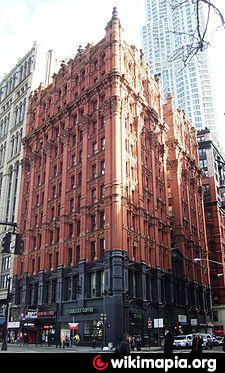
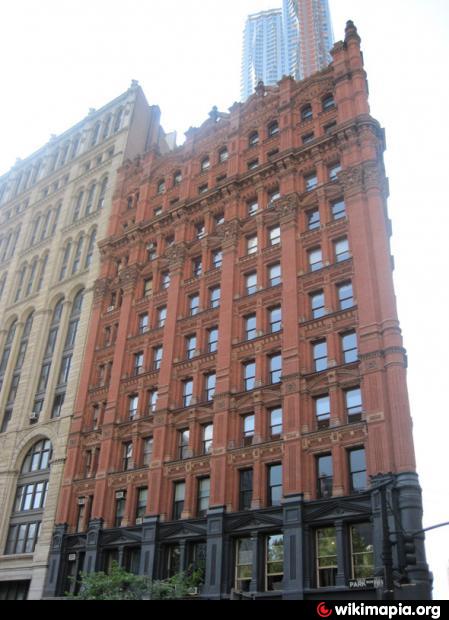

11-story Queen Anne/Neo-Grec-style residential building completed in 1886 as an office building. Designed by Norris G. Starkweather for Orlando B. Potter, it employed the most advanced fireproofing methods then available, including the use of rolled iron beams, cast-iron columns, brick exterior walls – the building's walls are 40 inches (100 cm) thick at ground level – tile arches and terra-cotta. Potter had owned the previous building on the site, which was destroyed by fire on January 31, 1882.
The Potter Building is C-shaped, with an open light court facing Beekman Street. The 2-story base is clad in black cast-iron. All of the shopfronts have been altered several times over the years. They are now framed in black metal, some with roll-down gates. On Park Row, the northernmost bay was originally the main lobby entrance; in 1941 it was converted to a storefront, topped by black granite panels. At the rest of the bays, the original segmental-arches at the ground floor were also covered by black cast-stone panels in 1941. On Beekman Street, the center of the base corresponds to the light court above. The ground story originally had an entrance through a triple-arched portico (the entrance was altered in 1912, later converted into a shop, and the portico was removed). The 2nd story has three windows flanked by colonnettes. The Beekman Street facade is the only one with its original ground-story spandrel panels with segmental arches exposed. On Nassau Street, the northernmost bay was originally another entrance to the elevator lobby; it is now the residential entrance. As on Park Row, the ground-floor bays had the original segmental-arches covered by black cast-stone panels in 1941. On all three facades, the 2nd floor has vertical grooves on the main piers, with paneled capitals, and triangular pediments above the smaller pilasters.
The midsection consists of seven stories, the 9th floor acting as a transition to the upper section. The spandrels above the 3rd, 5th, 6th,and 7th floors are ornamented by corbelling, and the 4th and 8th floors by segmental arches, all red of terra-cotta. The piers of the 8th floor have heavy terra-cotta stylized composite capitals, the corner column at Park Row andBeekman Street having an eagle. The 9th floor is capped by a bracketed terra-cotta cornice. Window sills are cast iron. The center section of the Beekman Street facade is the light court. On the 3rd story (below the court) are three windows flanked by cast-iron colonnettes, surmounted by a cast-iron pediment with an acroterion.
The 2-story upper section has corbelled spandrels above the 10th floor and segmental-arched windows with segmental terra-cotta hoods on the 11th floor. Alternate bays are surmounted by pediments. The roof line is punctuated by finials, broken scroll pediments with urns, and a prominent pinnacle above the primary corner column. The roof has later penthouse and service structures.
Upon its completion, the building was occupied by several newspaper and periodical publishers, insurance and other companies, and lawyers. O.B. Potter had his office on the top floor. After his death in 1894, the building was owned by his estate trust, and sold to an investing company in 1920. It changed hands many times during the next several decades, with most of the tenants consisting of lawyers and accountants. In 1973 it was sold to Pace College, which intended to demolish four adjacent buildings for the construction of a large office tower on Park Row. After this scheme fell through, Pace sold the Potter Building in 1979 to 38 Park Row Associates. it was converted to apartments in 1981, and was designated a New York City landmark in 1996. The ground floor is occupied by Optimo Cigars, Starbucks Coffee, Antonella's Salon, and Timberland Shoes.
The Potter Building is C-shaped, with an open light court facing Beekman Street. The 2-story base is clad in black cast-iron. All of the shopfronts have been altered several times over the years. They are now framed in black metal, some with roll-down gates. On Park Row, the northernmost bay was originally the main lobby entrance; in 1941 it was converted to a storefront, topped by black granite panels. At the rest of the bays, the original segmental-arches at the ground floor were also covered by black cast-stone panels in 1941. On Beekman Street, the center of the base corresponds to the light court above. The ground story originally had an entrance through a triple-arched portico (the entrance was altered in 1912, later converted into a shop, and the portico was removed). The 2nd story has three windows flanked by colonnettes. The Beekman Street facade is the only one with its original ground-story spandrel panels with segmental arches exposed. On Nassau Street, the northernmost bay was originally another entrance to the elevator lobby; it is now the residential entrance. As on Park Row, the ground-floor bays had the original segmental-arches covered by black cast-stone panels in 1941. On all three facades, the 2nd floor has vertical grooves on the main piers, with paneled capitals, and triangular pediments above the smaller pilasters.
The midsection consists of seven stories, the 9th floor acting as a transition to the upper section. The spandrels above the 3rd, 5th, 6th,and 7th floors are ornamented by corbelling, and the 4th and 8th floors by segmental arches, all red of terra-cotta. The piers of the 8th floor have heavy terra-cotta stylized composite capitals, the corner column at Park Row andBeekman Street having an eagle. The 9th floor is capped by a bracketed terra-cotta cornice. Window sills are cast iron. The center section of the Beekman Street facade is the light court. On the 3rd story (below the court) are three windows flanked by cast-iron colonnettes, surmounted by a cast-iron pediment with an acroterion.
The 2-story upper section has corbelled spandrels above the 10th floor and segmental-arched windows with segmental terra-cotta hoods on the 11th floor. Alternate bays are surmounted by pediments. The roof line is punctuated by finials, broken scroll pediments with urns, and a prominent pinnacle above the primary corner column. The roof has later penthouse and service structures.
Upon its completion, the building was occupied by several newspaper and periodical publishers, insurance and other companies, and lawyers. O.B. Potter had his office on the top floor. After his death in 1894, the building was owned by his estate trust, and sold to an investing company in 1920. It changed hands many times during the next several decades, with most of the tenants consisting of lawyers and accountants. In 1973 it was sold to Pace College, which intended to demolish four adjacent buildings for the construction of a large office tower on Park Row. After this scheme fell through, Pace sold the Potter Building in 1979 to 38 Park Row Associates. it was converted to apartments in 1981, and was designated a New York City landmark in 1996. The ground floor is occupied by Optimo Cigars, Starbucks Coffee, Antonella's Salon, and Timberland Shoes.
Wikipedia article: http://en.wikipedia.org/wiki/Potter_Building
Nearby cities:
Coordinates: 40°42'41"N 74°0'23"W
- Building B 7.6 km
- Oyster Bay High School 44 km
- Smithtown Public Schools Administration Building 70 km
- Michter's Distillery 202 km
- Dranesville Tavern 344 km
- Chantilly Place 355 km
- Liberia 366 km
- Omni Bedford Springs Resort - Hotel Building 390 km
- Dalkeith 603 km
- Tusculum 604 km
- City Hall Park 0.2 km
- Civic Center 0.4 km
- NYPD Civic Center Security Zone 0.4 km
- Financial District 0.5 km
- TriBeCa 0.8 km
- Lower (Downtown) Manhattan 1.4 km
- Hudson County, New Jersey 6.1 km
- Manhattan 8.3 km
- Brooklyn 9 km
- Queens 13 km