
Lazarevsky Bridge (Saint Petersburg)
Russia /
Sankt Petersburg /
Saint Petersburg
World
/ Russia
/ Sankt Petersburg
/ Saint Petersburg
, 6 km from center (Санкт-Петербург)
World / Russia / Leningrad
road bridge, 2009_construction, cable-stayed bridge


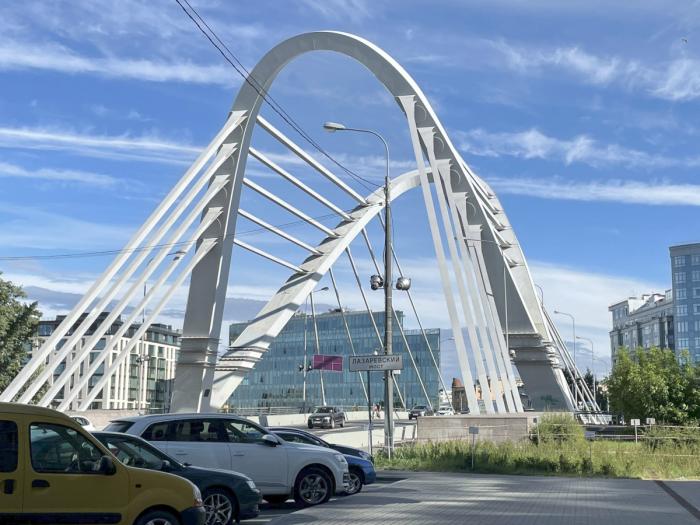

Lazarevsky Bridge spans the Malaya Nevka River in the alignment of Pionerskaya and Sportivnaya Streets in the Petrogradsky district of St. Petersburg. It connects Petrogradsky and Krestovsky Islands. This is a single-span metal cable-stayed structure with a length of 172.4 meters and a width of 22.5 meters.
The superstructure is supported by two rows of shrouds with five shrouds in each row. The pylon is metal, consisting of two inclined arches with longitudinal links. The pylon is located on the side of Krestovsky Island.
The need to build a bridge in this place was associated with the construction of the Kirov Stadium, located in Primorsky Victory Park on the western tip of Krestovsky Island.
The opening of the stadium took place on July 30, 1950, and in 1947-1949, an 11-span wooden bridge of a beam-split system with a draw span in the middle was built according to the project of the engineer of "Lengiproinzhproekt" V.V. Blazhevich. Initially, the bridge was called Koltovsky by the name of the adjacent embankments and streets, and in 1953 it was renamed in honor of the outstanding Russian scientist-researcher of Antarctica Admiral M.P. Lazarev.
The permanent spans of the bridge were covered with metal I-beams of constant height with cross links. The draw span was a single-wing, opening system, with a fixed axis of rotation with a rigidly attached counterweight. The drive is electromechanical.
The abutments of the bridge were with wooden fence walls on wooden piles, and then rebuilt into reinforced concrete with metal tubular piles.
The intermediate supports of the permanent superstructures were wooden, tower-type, on wooden piles. The supports of the draw span are metal, frame, on wooden piles. The supports were protected from the bulk of ships and ice by special wooden bushes.
The pavement on the bridge was plank on cobblestone crossbars, and the sidewalk was separated from the tram lane by a metal railing.
Lighting on the bridge was carried out with the help of standard street lamps suspended one by one from metal pillars of tubular cross-section.
In 1976, the bridge underwent major repairs, during which the wooden fence walls were replaced with reinforced concrete slabs and metal piles.
In 1998, a major overhaul of the upper structure of the track was carried out with the replacement of crossbars, wooden railing, drain, sidewalk flooring and interway. Trams ran on the bridge until 2002.
In 2008-2009, a complete reconstruction of the bridge was carried out. The new bridge was built according to the project of CJSC Stroyproekt Institute. Creating an original figurative solution, architect I.E. Serebrennikov proposed to use arches divorced from the vertical instead of the originally planned forty-meter pillars, which allowed, while maintaining the angles of the installation of the shrouds, to reduce the overall height by 10 meters.
To connect the name of the bridge with the name of Admiral Lazarev, Serebrennikov proposed to build a round observation deck in the form of a bastion next to the pylon. In the center of the bastion there was to be a bowl-pool and a fountain in the form of a cone topped with a large globe. However, this idea had to be abandoned due to lack of funds.
The new Lazarevsky Bridge has become a single-span cable-stayed bridge designed for the movement of cars and pedestrians. It was inaugurated for traffic on May 23, 2009.
The construction of the new Lazarevsky Bridge was one of the stages in the preparation of transport links with the new Gazprom Arena stadium, which opened on Krestovsky Island in 2017 and became the main football stadium of the city.
en.mostotrest-spb.ru/bridges/lazarevskij
The superstructure is supported by two rows of shrouds with five shrouds in each row. The pylon is metal, consisting of two inclined arches with longitudinal links. The pylon is located on the side of Krestovsky Island.
The need to build a bridge in this place was associated with the construction of the Kirov Stadium, located in Primorsky Victory Park on the western tip of Krestovsky Island.
The opening of the stadium took place on July 30, 1950, and in 1947-1949, an 11-span wooden bridge of a beam-split system with a draw span in the middle was built according to the project of the engineer of "Lengiproinzhproekt" V.V. Blazhevich. Initially, the bridge was called Koltovsky by the name of the adjacent embankments and streets, and in 1953 it was renamed in honor of the outstanding Russian scientist-researcher of Antarctica Admiral M.P. Lazarev.
The permanent spans of the bridge were covered with metal I-beams of constant height with cross links. The draw span was a single-wing, opening system, with a fixed axis of rotation with a rigidly attached counterweight. The drive is electromechanical.
The abutments of the bridge were with wooden fence walls on wooden piles, and then rebuilt into reinforced concrete with metal tubular piles.
The intermediate supports of the permanent superstructures were wooden, tower-type, on wooden piles. The supports of the draw span are metal, frame, on wooden piles. The supports were protected from the bulk of ships and ice by special wooden bushes.
The pavement on the bridge was plank on cobblestone crossbars, and the sidewalk was separated from the tram lane by a metal railing.
Lighting on the bridge was carried out with the help of standard street lamps suspended one by one from metal pillars of tubular cross-section.
In 1976, the bridge underwent major repairs, during which the wooden fence walls were replaced with reinforced concrete slabs and metal piles.
In 1998, a major overhaul of the upper structure of the track was carried out with the replacement of crossbars, wooden railing, drain, sidewalk flooring and interway. Trams ran on the bridge until 2002.
In 2008-2009, a complete reconstruction of the bridge was carried out. The new bridge was built according to the project of CJSC Stroyproekt Institute. Creating an original figurative solution, architect I.E. Serebrennikov proposed to use arches divorced from the vertical instead of the originally planned forty-meter pillars, which allowed, while maintaining the angles of the installation of the shrouds, to reduce the overall height by 10 meters.
To connect the name of the bridge with the name of Admiral Lazarev, Serebrennikov proposed to build a round observation deck in the form of a bastion next to the pylon. In the center of the bastion there was to be a bowl-pool and a fountain in the form of a cone topped with a large globe. However, this idea had to be abandoned due to lack of funds.
The new Lazarevsky Bridge has become a single-span cable-stayed bridge designed for the movement of cars and pedestrians. It was inaugurated for traffic on May 23, 2009.
The construction of the new Lazarevsky Bridge was one of the stages in the preparation of transport links with the new Gazprom Arena stadium, which opened on Krestovsky Island in 2017 and became the main football stadium of the city.
en.mostotrest-spb.ru/bridges/lazarevskij
Wikipedia article: http://en.wikipedia.org/wiki/Lazarevsky_Bridge
Nearby cities:
Coordinates: 59°57'54"N 30°16'25"E
- Betancourt Bridge 0.7 km
- Bolshoy Petrovsky Bridge 1.1 km
- Tuchkov Bridge 1.8 km
- Kamennostrovsky Bridge 2.1 km
- Kantemirovsky Bridge 3 km
- Palace Bridge 3.1 km
- Troitsky ('Trinity') (bridge 3.2 km
- Annunciation Bridge (Blagoveschensky Bridge) 3.3 km
- Alexander Nevsky Bridge 7.7 km
- Belyayevsky bridge 12 km
- Petrogradsky District 0.1 km
- Dinamo sports complex 0.5 km
- Petrovsky municipal district 0.9 km
- Petrovsky Island 1 km
- Krestovsky Island 1.7 km
- Petrogradsky Island 1.7 km
- Ostrov Dekabristov Municipal Okrug 2.6 km
- Dekabristov island 2.6 km
- Vasileostrovsky District 3.1 km
- Vyborgsky District 8.5 km