
Betancourt Bridge (Saint Petersburg)
Russia /
Sankt Petersburg /
Saint Petersburg
World
/ Russia
/ Sankt Petersburg
/ Saint Petersburg
, 6 km from center (Санкт-Петербург)
road bridge, cable-stayed bridge, 2018 construction
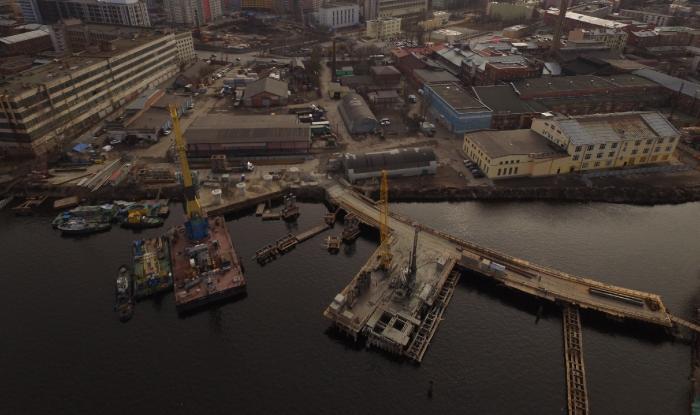
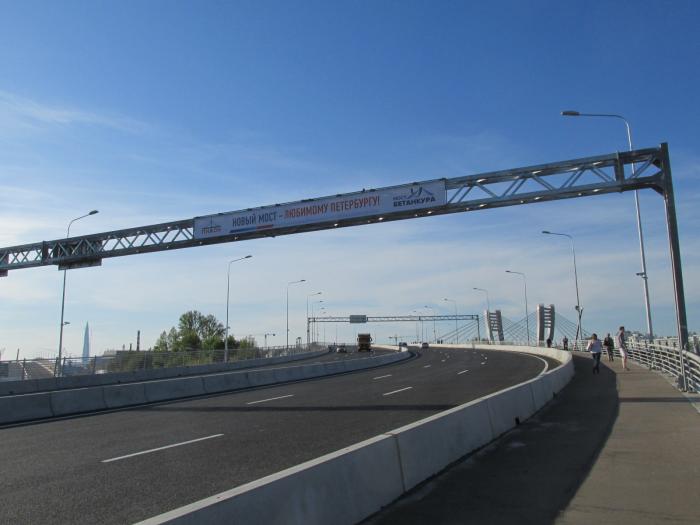
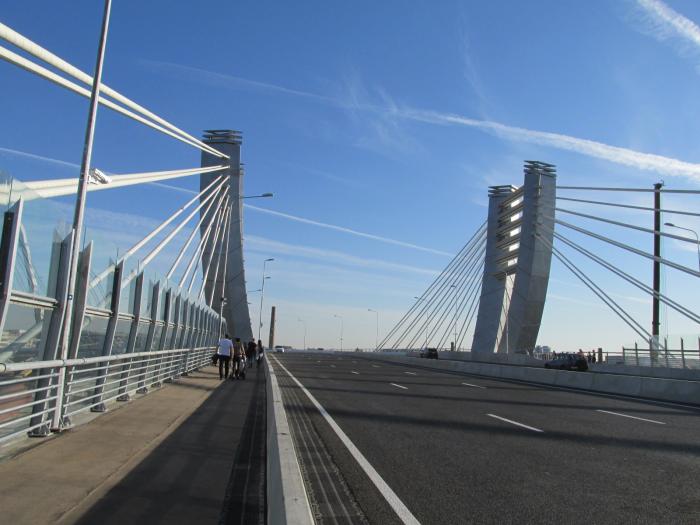
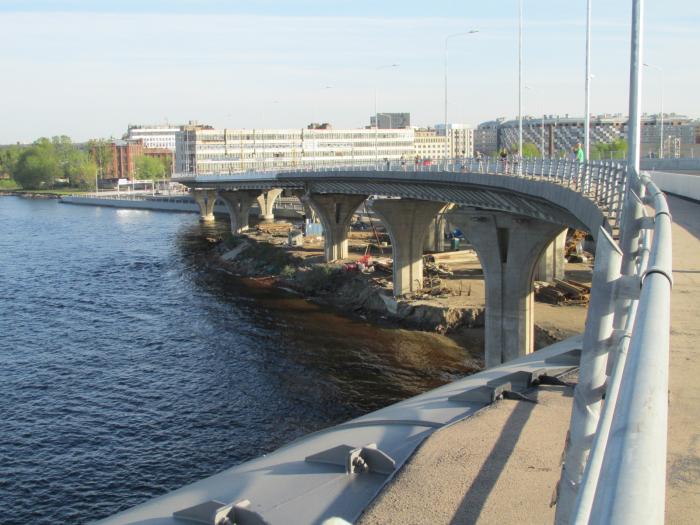
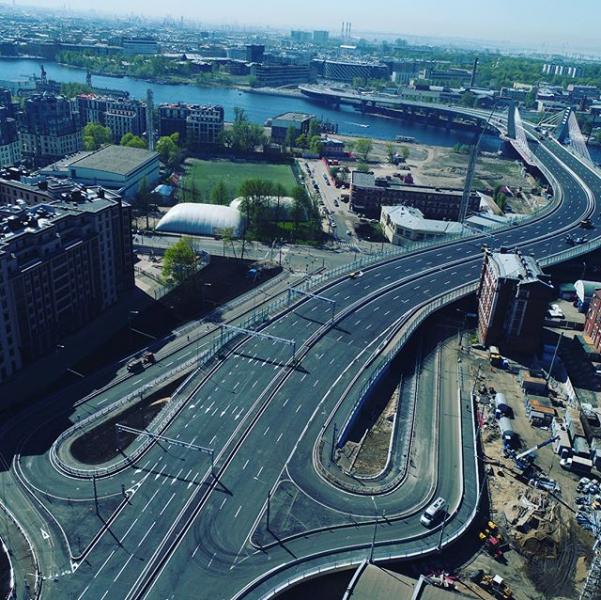

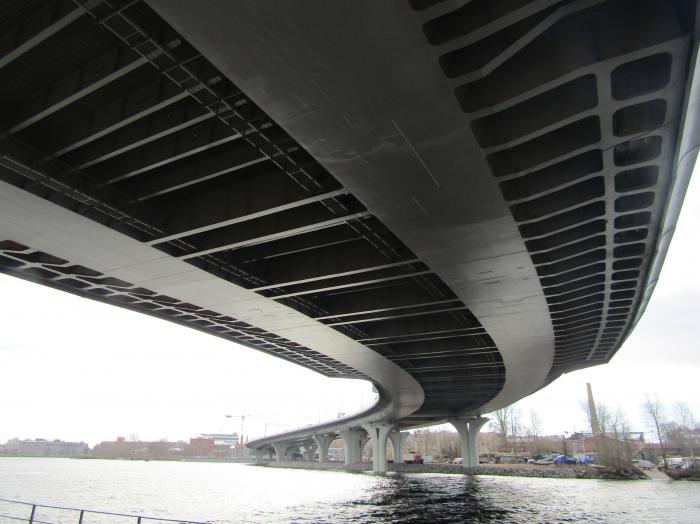
An unbroken 15-span bridge of beam-continuous and beam-cable-stayed systems is thrown across the Malaya Neva River between Petrovsky Island and the island of the Decembrists over the island of Sulfur. The total length of the crossing is 970 m, the width is variable – from 38.2 to 44.7 m.
The superstructures from support 1 to support 5 and from support 10 to support 15 are steel-reinforced concrete, beam—continuous, and from support 5 to support 10 is a beam-cable system: each of the 2 cable-stayed trusses consists of 6 double pairs of shrouds located behind the railing of the superstructure.
The abutments and supports of the bridge are reinforced concrete on bored piles, of different designs. Support 2 —4x-rack, supports 3, 4, 5, 5.1, 6, 8 ÷ 14 – 2x-rack. Support 7 is a pylon of a frame-monolithic structure, made in the form of four branches of parabolic outlines, the branches of the parabolas are connected in pairs by six horizontal metal longitudinal ties, the lower part (basement) is filled with concrete.
Metal handrails of individual construction with a height of 110 cm on the upper side and 160 cm on the lower side. Noise protection screens with a height of 3 m are installed from support 7 to support 15. 68 galvanized metal lighting poles are installed on the bridge.
The bridge has 6 lanes for automobile traffic, a sidewalk and a bicycle path. The width of the sidewalk on the upper side is 3.0 m. On the lower side there is a 3.5 m wide bike path . The pavement of sidewalks and carriageways is asphalt concrete.
The ferry, being non-navigable, provides round-the-clock and year-round transport connection of Vasilievsky Island with the central districts of the city.
The Betancourt Bridge was being built for the 2018 FIFA World Cup, as part of the work, the reconstruction of the old Malo-Petrovsky Bridge was also carried out (it was dismantled). The project of the new bridge was developed by specialists of JSC "Stroyproekt Institute", the construction was carried out by the general contractor CJSC "Pylon". The design and construction works were carried out in 2003-2018.
The construction of the bridge in the area of the island of Sulfur allowed to unload the Tuchkov Bridge and provide additional motor transport connection of the Vasileostrovsky district with the Petrograd side and the north-eastern districts of the city.
The Betancourt Bridge has become one of the ways to bypass the city center, and together with the Western High—Speed Diameter and the Makarov Embankment, it is part of the shortest route from Pulkovo Airport to the Gazprom Arena stadium.
In 2018, the bridge was named the Betancourt Bridge in honor of the outstanding Spanish and Russian engineer Augustine de Betancourt (1758-1824), scientist and statesman, builder of bridges in St. Petersburg, organizer of the transport system of the Russian Empire. Betancourt was the organizer of engineering education in Russia and the author of projects of many engineering structures in our country in the XIX century.
There are two viewing platforms on the Betancourt Bridge with views of the Gulf of Finland and the city: St. Isaac's Cathedral, Catherine Church, Lakhta Center and the spire of the Peter and Paul Cathedral are visible from them. From the bridge upstream of the Malaya Neva, there is a magnificent view of the Petrograd side and Vasilievsky Island.
It is interesting that at the beginning of the XIX century in St. Petersburg there was already a Betancurovsky Bridge - a wooden arch bridge over the Malaya Nevka bore this name. The bridge was built according to Betancourt's project and connected Aptekarsky and Kamenny Islands. Today, the Kamennoostrovsky Bridge is located in its place.
The superstructures from support 1 to support 5 and from support 10 to support 15 are steel-reinforced concrete, beam—continuous, and from support 5 to support 10 is a beam-cable system: each of the 2 cable-stayed trusses consists of 6 double pairs of shrouds located behind the railing of the superstructure.
The abutments and supports of the bridge are reinforced concrete on bored piles, of different designs. Support 2 —4x-rack, supports 3, 4, 5, 5.1, 6, 8 ÷ 14 – 2x-rack. Support 7 is a pylon of a frame-monolithic structure, made in the form of four branches of parabolic outlines, the branches of the parabolas are connected in pairs by six horizontal metal longitudinal ties, the lower part (basement) is filled with concrete.
Metal handrails of individual construction with a height of 110 cm on the upper side and 160 cm on the lower side. Noise protection screens with a height of 3 m are installed from support 7 to support 15. 68 galvanized metal lighting poles are installed on the bridge.
The bridge has 6 lanes for automobile traffic, a sidewalk and a bicycle path. The width of the sidewalk on the upper side is 3.0 m. On the lower side there is a 3.5 m wide bike path . The pavement of sidewalks and carriageways is asphalt concrete.
The ferry, being non-navigable, provides round-the-clock and year-round transport connection of Vasilievsky Island with the central districts of the city.
The Betancourt Bridge was being built for the 2018 FIFA World Cup, as part of the work, the reconstruction of the old Malo-Petrovsky Bridge was also carried out (it was dismantled). The project of the new bridge was developed by specialists of JSC "Stroyproekt Institute", the construction was carried out by the general contractor CJSC "Pylon". The design and construction works were carried out in 2003-2018.
The construction of the bridge in the area of the island of Sulfur allowed to unload the Tuchkov Bridge and provide additional motor transport connection of the Vasileostrovsky district with the Petrograd side and the north-eastern districts of the city.
The Betancourt Bridge has become one of the ways to bypass the city center, and together with the Western High—Speed Diameter and the Makarov Embankment, it is part of the shortest route from Pulkovo Airport to the Gazprom Arena stadium.
In 2018, the bridge was named the Betancourt Bridge in honor of the outstanding Spanish and Russian engineer Augustine de Betancourt (1758-1824), scientist and statesman, builder of bridges in St. Petersburg, organizer of the transport system of the Russian Empire. Betancourt was the organizer of engineering education in Russia and the author of projects of many engineering structures in our country in the XIX century.
There are two viewing platforms on the Betancourt Bridge with views of the Gulf of Finland and the city: St. Isaac's Cathedral, Catherine Church, Lakhta Center and the spire of the Peter and Paul Cathedral are visible from them. From the bridge upstream of the Malaya Neva, there is a magnificent view of the Petrograd side and Vasilievsky Island.
It is interesting that at the beginning of the XIX century in St. Petersburg there was already a Betancurovsky Bridge - a wooden arch bridge over the Malaya Nevka bore this name. The bridge was built according to Betancourt's project and connected Aptekarsky and Kamenny Islands. Today, the Kamennoostrovsky Bridge is located in its place.
Wikipedia article: http://en.wikipedia.org/wiki/Betancourt_Bridge
Nearby cities:
Coordinates: 59°57'23"N 30°16'5"E
- Tuchkov Bridge 1.1 km
- Bolshoy Petrovsky Bridge 1.4 km
- Annunciation Bridge (Blagoveschensky Bridge) 2.5 km
- Palace Bridge 2.7 km
- Kamennostrovsky Bridge 3 km
- Troitsky ('Trinity') (bridge 3.2 km
- Sampsoniyevsky Bridge 3.7 km
- Kantemirovsky Bridge 3.8 km
- Alexander Nevsky Bridge 7.5 km
- Belyayevsky bridge 13 km
- Petrovsky municipal district 0.2 km
- Petrovsky Island 0.4 km
- Familia residental complex 0.5 km
- “Almaz” (Dekabrisov) Ship Yard 0.6 km
- Petrogradsky District 1 km
- Petrogradsky Island 1.8 km
- Dekabristov island 2 km
- Ostrov Dekabristov Municipal Okrug 2.1 km
- Vasileostrovsky District 2.1 km
- Vyborgsky District 9 km