
Tuchkov Bridge (Saint Petersburg)
Russia /
Sankt Petersburg /
Saint Petersburg
World
/ Russia
/ Sankt Petersburg
/ Saint Petersburg
, 4 km from center (Санкт-Петербург)
World / Russia / Leningrad
moveable bridge, road bridge, 1965_construction, bascule bridge


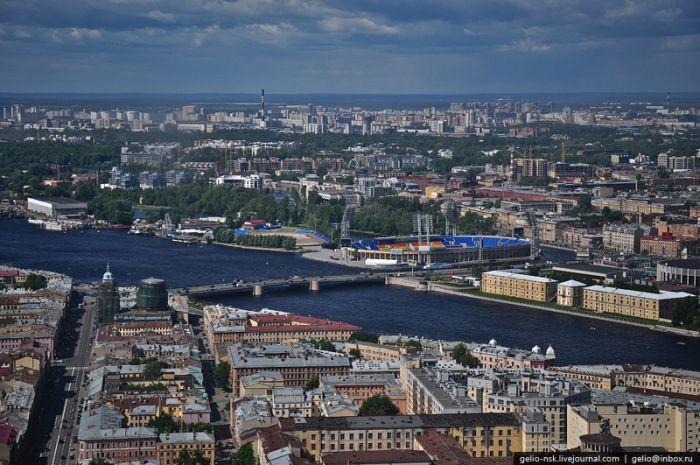
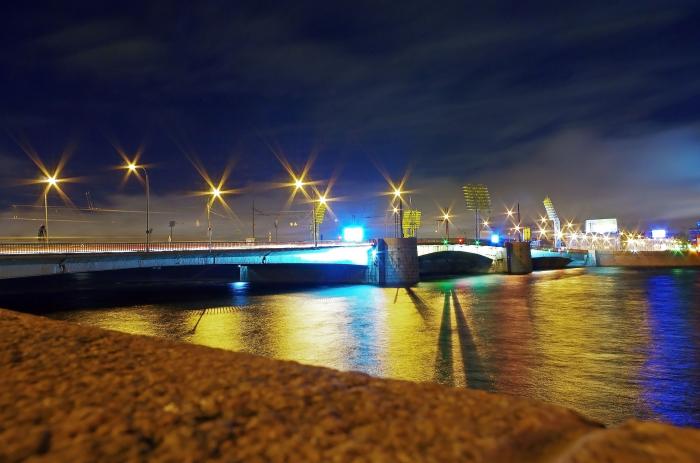

The Tuchkov Bridge over the Malaya Neva River is located in the alignment of Bolshoy Prospekt of the Petrogradskaya side and the First /Cadet Lines of Vasilievsky Island.
This is a three-span reinforced concrete bridge with a drawbridge in the middle. Permanent superstructures made of prestressed reinforced concrete are constructed in the form of a cantilever-beam system with a suspension in the middle. The lower belts of consoles and suspended beams have a curved outline. The suspensions are supported by consoles embedded in the supports.
The adjustable span is a two-winged opening system with a fixed axis of rotation, with rigidly attached counterweights. The superstructure is an all—welded metal structure, in a closed state — a beam-cantilever system. The peculiarity of the wings of the Tuchkov bridge is that in the divorced and induced position they are not fixed by any additional devices, except for the locked spool.
The bridge is raised by means of a hydraulic drive, a pavilion with a control panel is located on the right bank from the upper part of the bridge.
The abutments of the bridge are massive reinforced concrete on a pile foundation, lined with granite. The railing is a metal welded lattice made of square cross—section rods, which are placed at an angle and intertwined in such a way that they create an unusual three-dimensional picture throughout the bridge, not previously encountered in the practice of bridge construction.
Granite parapets are installed at the entrances to the bridge from all four sides, stairs to the water lined with granite are located on the embankment. The lighting on the bridge is typical street lighting.
Bridges across the Malaya Neva were not built for a long time, as they were an obstacle on the way of ships to the pier of the Commercial port, then located in the area of the Arrow of Vasilyevsky Island.
In 1758, the first bridge was built on which it was possible to get from Vasilievsky Island to the Petersburg side. At that time, the construction was called the "Nikolsky Bridge", it was created on the initiative and at the expense of St. Petersburg merchants who petitioned the Senate to give them "eternal and hereditary maintenance" of several bridges in St. Petersburg, while committing to build a new bridge across the Malaya Neva.
The length of the bridge was 890 meters, which made this bridge the longest for that time. The wooden bridge consisted of two parts: a flatbed bridge in the deep part of the riverbed and a pile bridge in shallow water. The structure was located upstream of the Malaya Neva, near the islands of Tuchkov, hemp buyan and Cotton Wool, where the warehouses of the merchant Avraham Tuchkov were located. The bridge was soon named after the timber merchant.
In 1833-1835, the flat-bed crossing was replaced by a multi-span wooden bridge of a girder-strut system on wooden pile supports with a double-wing draw span in the middle.
The bridge was built in the alignment of the Bolshoy Prospekt of the Petersburg side with the construction of an earthen dam from the Malaya Neva River to the future Alexandrovsky Avenue (now Dobrolyubov Avenue). The draw span consisted of four wooden frames and was bred using hand winches. The roadway is wooden, made up of crossbars and a double boardwalk. At the entrances to the bridge, railings made of cast iron gratings of artistic casting with rectangular bollards were installed. In 1839, for the first time in Russia, artificial asphalt was laid at the Tuchkov Bridge.
In 1870, the bridge burned down from an unopened cigarette, it was restored and rebuilt several times in wood, by 1920 it was 20-span with a length of 258 meters.
In 1948, after another major overhaul, the permanent spans were covered with metal I-beams with longitudinal and transverse links. Wooden frames in the draw span have been replaced with metal ones, and manual winches have been replaced with electric ones. The supports of the draw span were built again on a wooden pile base with a rigid metal grillage and a metal frame structure. The left—bank mouth of the bridge was made of stone on a pile foundation, and all the other supports were wooden on a pile foundation. The bridge was 258 meters long and 19 meters wide.
In 1964, due to the completion of the construction of the Volga-Baltic Waterway, large-sized and large-tonnage vessels began to enter the Neva and its branches. The moment came when the dimensions and carrying capacity of the bridge ceased to meet the requirements of land and water transport, and the question arose about its full-scale reconstruction.
In 1962-1965, a three-span reinforced concrete bridge with a draw span in the middle was constructed by engineers of the Institute "Lengiproinzhproekt" V.V. Demchenko, B.B. Levin and architects L.A. Noskov and P.A. Areshev.
The construction of the bridge was carried out under the supervision of engineers O.S. Charnotsky and L.F. Polyakov. Technical supervision was conducted by engineers of the Lenmosttrest Directorate D.V. Snyatkovsky and G.F. Shishlov.
The longitudinal axis of the new bridge was shifted downstream by three meters from the axis of the previously existing crossing. The design of permanent superstructures before the construction of the Tuchkov Bridge was applied in 1962 on the single-span reinforced concrete bridge of the Red Cadet across the Zhdanovka River.
In 1997-1998, major repairs were carried out on the pavement, orthotropic plate on the draw span and tram tracks.
In 2003, work was carried out on the anti-corrosion treatment of the surfaces of the draw span. In 2006, fixed superstructures were repaired. In 2008-2009, work was carried out to repair the supports of the draw span.
In recent years, surveys of the Tuchkov Bridge have been carried out. They showed a significant increase in the transport load on the crossing and the need for its reconstruction. In the first place, the counterweights of the draw span need major repairs, it is also necessary to eliminate corrosion on metal structures, perform other work.
On July 4, 2016, the bridge was closed for reconstruction and opened to traffic on November 18, 2017. All works were completed in 2018.
During the reconstruction, the stationary reinforced concrete spans of the Tuchkov Bridge were replaced with metal ones. The supports of the draw span have been repaired, new pavilions with a modern control panel and security have been built. The equipment of the draw span has been completely replaced. Alarm systems, lighting and control of the draw span have been updated, a new video review system has been installed. In addition, tram boxes and lighting poles have been replaced on the draw span.
The new equipment provides smooth acceleration and braking of the wings of the adjustable span, accurate entry into the locks when the wings are aimed, allows you to quickly adjust the hydraulic drive control settings and analyze their operation during the wiring-guidance.
en.mostotrest-spb.ru/bridges/tuchkov
This is a three-span reinforced concrete bridge with a drawbridge in the middle. Permanent superstructures made of prestressed reinforced concrete are constructed in the form of a cantilever-beam system with a suspension in the middle. The lower belts of consoles and suspended beams have a curved outline. The suspensions are supported by consoles embedded in the supports.
The adjustable span is a two-winged opening system with a fixed axis of rotation, with rigidly attached counterweights. The superstructure is an all—welded metal structure, in a closed state — a beam-cantilever system. The peculiarity of the wings of the Tuchkov bridge is that in the divorced and induced position they are not fixed by any additional devices, except for the locked spool.
The bridge is raised by means of a hydraulic drive, a pavilion with a control panel is located on the right bank from the upper part of the bridge.
The abutments of the bridge are massive reinforced concrete on a pile foundation, lined with granite. The railing is a metal welded lattice made of square cross—section rods, which are placed at an angle and intertwined in such a way that they create an unusual three-dimensional picture throughout the bridge, not previously encountered in the practice of bridge construction.
Granite parapets are installed at the entrances to the bridge from all four sides, stairs to the water lined with granite are located on the embankment. The lighting on the bridge is typical street lighting.
Bridges across the Malaya Neva were not built for a long time, as they were an obstacle on the way of ships to the pier of the Commercial port, then located in the area of the Arrow of Vasilyevsky Island.
In 1758, the first bridge was built on which it was possible to get from Vasilievsky Island to the Petersburg side. At that time, the construction was called the "Nikolsky Bridge", it was created on the initiative and at the expense of St. Petersburg merchants who petitioned the Senate to give them "eternal and hereditary maintenance" of several bridges in St. Petersburg, while committing to build a new bridge across the Malaya Neva.
The length of the bridge was 890 meters, which made this bridge the longest for that time. The wooden bridge consisted of two parts: a flatbed bridge in the deep part of the riverbed and a pile bridge in shallow water. The structure was located upstream of the Malaya Neva, near the islands of Tuchkov, hemp buyan and Cotton Wool, where the warehouses of the merchant Avraham Tuchkov were located. The bridge was soon named after the timber merchant.
In 1833-1835, the flat-bed crossing was replaced by a multi-span wooden bridge of a girder-strut system on wooden pile supports with a double-wing draw span in the middle.
The bridge was built in the alignment of the Bolshoy Prospekt of the Petersburg side with the construction of an earthen dam from the Malaya Neva River to the future Alexandrovsky Avenue (now Dobrolyubov Avenue). The draw span consisted of four wooden frames and was bred using hand winches. The roadway is wooden, made up of crossbars and a double boardwalk. At the entrances to the bridge, railings made of cast iron gratings of artistic casting with rectangular bollards were installed. In 1839, for the first time in Russia, artificial asphalt was laid at the Tuchkov Bridge.
In 1870, the bridge burned down from an unopened cigarette, it was restored and rebuilt several times in wood, by 1920 it was 20-span with a length of 258 meters.
In 1948, after another major overhaul, the permanent spans were covered with metal I-beams with longitudinal and transverse links. Wooden frames in the draw span have been replaced with metal ones, and manual winches have been replaced with electric ones. The supports of the draw span were built again on a wooden pile base with a rigid metal grillage and a metal frame structure. The left—bank mouth of the bridge was made of stone on a pile foundation, and all the other supports were wooden on a pile foundation. The bridge was 258 meters long and 19 meters wide.
In 1964, due to the completion of the construction of the Volga-Baltic Waterway, large-sized and large-tonnage vessels began to enter the Neva and its branches. The moment came when the dimensions and carrying capacity of the bridge ceased to meet the requirements of land and water transport, and the question arose about its full-scale reconstruction.
In 1962-1965, a three-span reinforced concrete bridge with a draw span in the middle was constructed by engineers of the Institute "Lengiproinzhproekt" V.V. Demchenko, B.B. Levin and architects L.A. Noskov and P.A. Areshev.
The construction of the bridge was carried out under the supervision of engineers O.S. Charnotsky and L.F. Polyakov. Technical supervision was conducted by engineers of the Lenmosttrest Directorate D.V. Snyatkovsky and G.F. Shishlov.
The longitudinal axis of the new bridge was shifted downstream by three meters from the axis of the previously existing crossing. The design of permanent superstructures before the construction of the Tuchkov Bridge was applied in 1962 on the single-span reinforced concrete bridge of the Red Cadet across the Zhdanovka River.
In 1997-1998, major repairs were carried out on the pavement, orthotropic plate on the draw span and tram tracks.
In 2003, work was carried out on the anti-corrosion treatment of the surfaces of the draw span. In 2006, fixed superstructures were repaired. In 2008-2009, work was carried out to repair the supports of the draw span.
In recent years, surveys of the Tuchkov Bridge have been carried out. They showed a significant increase in the transport load on the crossing and the need for its reconstruction. In the first place, the counterweights of the draw span need major repairs, it is also necessary to eliminate corrosion on metal structures, perform other work.
On July 4, 2016, the bridge was closed for reconstruction and opened to traffic on November 18, 2017. All works were completed in 2018.
During the reconstruction, the stationary reinforced concrete spans of the Tuchkov Bridge were replaced with metal ones. The supports of the draw span have been repaired, new pavilions with a modern control panel and security have been built. The equipment of the draw span has been completely replaced. Alarm systems, lighting and control of the draw span have been updated, a new video review system has been installed. In addition, tram boxes and lighting poles have been replaced on the draw span.
The new equipment provides smooth acceleration and braking of the wings of the adjustable span, accurate entry into the locks when the wings are aimed, allows you to quickly adjust the hydraulic drive control settings and analyze their operation during the wiring-guidance.
en.mostotrest-spb.ru/bridges/tuchkov
Wikipedia article: http://en.wikipedia.org/wiki/Tuchkov_Bridge
Nearby cities:
Coordinates: 59°56'56"N 30°17'7"E
- Troitsky ('Trinity') (bridge 2.2 km
- Kantemirovsky Bridge 4 km
- Alexander Nevsky Bridge 6.3 km
- Suvantosilta bridge 296 km
- Automobile and Railway Bridge 735 km
- Göta älvbron 1081 km
- Amurskyi ('Old') Bridge 1311 km
- Varvarovsky bridge 1447 km
- El Ferdan Railway Bridge 3264 km
- boat bridge 4587 km
- Vvedensky Municipal Okrug 0.7 km
- Petrovsky municipal district 1.3 km
- Petrogradsky Island 1.4 km
- Vasilyevsky Municipal Okrug 1.4 km
- Municipal Okrug 7 1.9 km
- Petrogradsky District 1.9 km
- Vasileostrovsky District 2.4 km
- Vasil'yevsky island 2.8 km
- Ostrov Dekabristov Municipal Okrug 3.1 km
- Bezymyanny island 3.1 km