
Voznesensky Bridge (Saint Petersburg)
Russia /
Sankt Petersburg /
Saint Petersburg
World
/ Russia
/ Sankt Petersburg
/ Saint Petersburg
, 1 km from center (Санкт-Петербург)
World / Russia / Leningrad
road bridge, 1958_construction


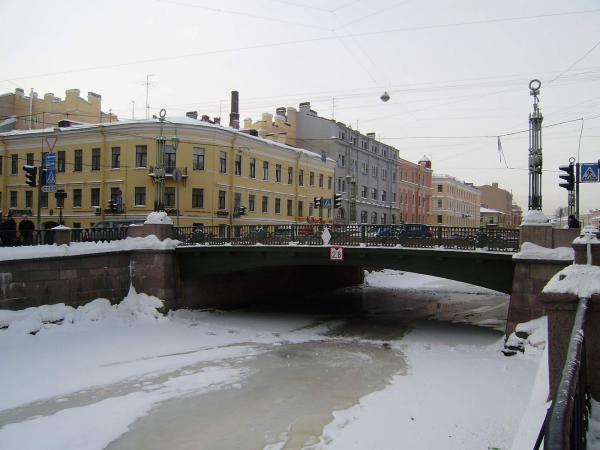
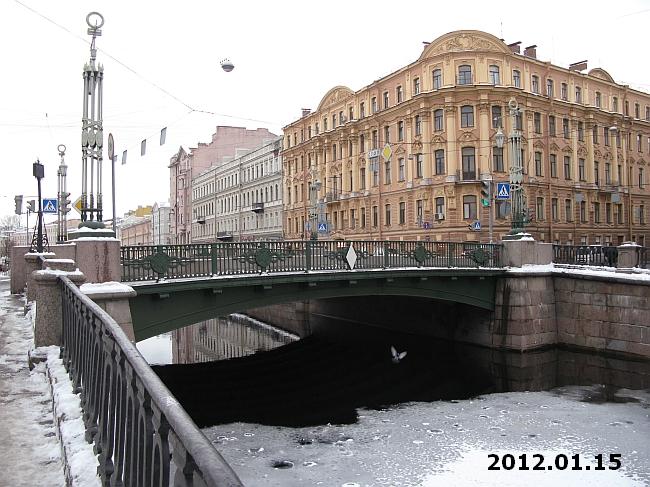
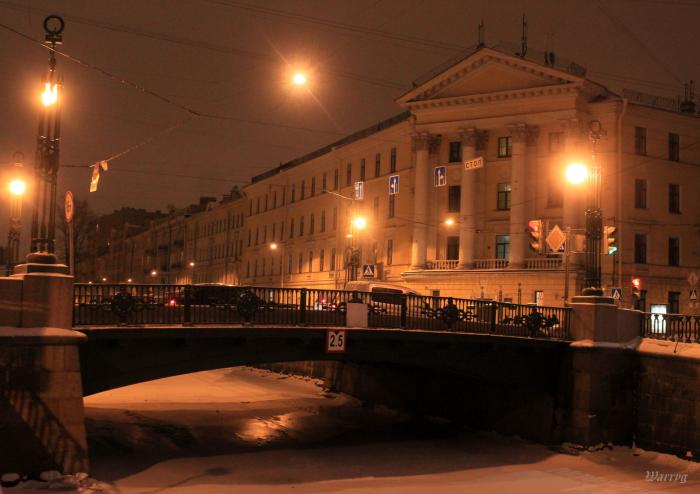
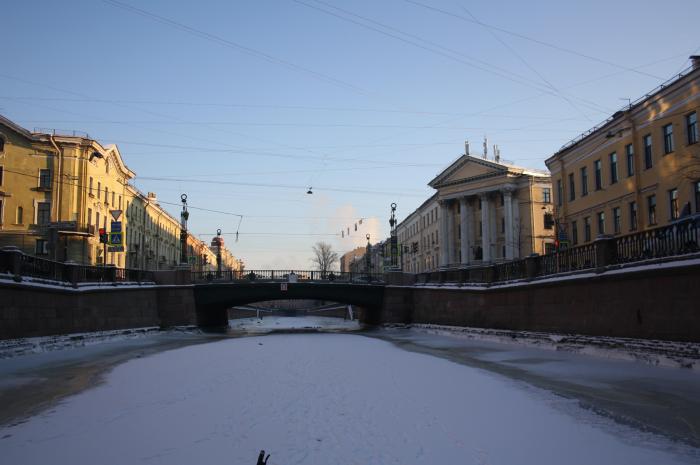
The Voznesensky Bridge was thrown over the Griboyedov Canal in the alignment of the avenue of the same name, connecting the Kazan and Spassky Islands. The length of the structure is 19.3 meters, width — 20.5 meters. This is a single-span metal bridge of frame construction. The abutments are reinforced concrete, on a pile foundation, lined with granite. Frame 2-hinge construction: metal crossbar and reinforced concrete leg of the frame.
The railings of the bridge are cast iron gratings of artistic casting. Their sections consist of round rods with capitals in the form of opening buds, cast—iron bollards of the fence are oval in shape with overhead elements in the form of shields with crossed swords and longitudinal peaks on which acacia twigs are strung. A similar railing can also be seen on the Italian Bridge spanning the Griboyedov Canal in its upper course.
The bridge is illuminated by lanterns installed at the entrances. Cast-iron floor lamps on granite pedestals are stylized for the beginning of the XIX century, according to the type of floor lamps of the 1st Garden, 2nd Garden, Mogilev and Baltic bridges.
In 1735 there was a wooden bridge here. It received its name in 1739 in honor of the Ascension Church, built next to the bridge in the XVIII century by Antonio Rinaldi and destroyed in 1936.
In 1790, with the completion of the construction of the retaining walls of the embankment of the Griboyedov Canal, the bridge was a single-span structure with a wooden beam span on stone abutments lined with granite, built according to the project of architect G.H. Paulsen.
In 1901, the superstructure consisted of 13 girder trusses. The length of the bridge was 12 m, width -10.8 m.
In 1919, the bridge was overhauled, and with the previous width, the span structure began to consist of 9 girders of a crossbar-bracing system.
In connection with the laying of tram tracks along Mayorov Avenue in 1930, the bridge was strengthened and expanded to 22 meters with the preservation of the old abutments, on both sides of which wooden supports were built. The superstructure remained wooden.
During the Great Patriotic War, the span of the bridge was damaged. Some of the wooden girders were replaced with metal I-beams.
In 1957-1958, according to the project of engineer B.B. Levin and architect L.A. Noskov, the bridge was rebuilt into a single-span, metal, frame structure. The superstructure consists of 10 frames interconnected by pairwise cross-links. Metal "legs" are reinforced and homologated with the front wall of the abutment. The abutments of the bridge are reinforced concrete, on a pile foundation, lined with granite. A cast-iron railing is installed on the bridge according to the type of the Italian bridge. The railing sections consist of round rods with peculiar capitals in the form of opening buds between cast-iron oval bollards with overhead elements resembling shields with overlapping stylized swords and longitudinal peaks with acacia twigs strung on them. At the entrances to the bridge, floor lamps in the form of tied bundles of copies with hexagonal lanterns on brackets (according to the type of the 1st Garden, Mogilev and Baltic bridges) are installed on granite bollards.
In 1978, the granite curb was replaced with an elevated reinforced concrete counterpart.
In 2003, the floor lamps with lanterns were restored.
In 2006, the roadway fence was replaced with granite, 62 cm high. Waterproofing and pavement covering were replaced.
It is noteworthy that it is around the Voznesensky Bridge that many events unfold in F.M. Dostoevsky's novel "Crime and Punishment". Raskolnikov likes to dwell on it, indulging in reflections. Here he also witnesses the suicide of a woman who threw herself from the bridge into the Catherine Canal. At the Voznesensky Bridge, a scene of Katerina Marmeladova's madness unfolds, forcing her young children to dance and sing in front of passers-by for alms.
en.mostotrest-spb.ru/bridges/voznesenskij
The railings of the bridge are cast iron gratings of artistic casting. Their sections consist of round rods with capitals in the form of opening buds, cast—iron bollards of the fence are oval in shape with overhead elements in the form of shields with crossed swords and longitudinal peaks on which acacia twigs are strung. A similar railing can also be seen on the Italian Bridge spanning the Griboyedov Canal in its upper course.
The bridge is illuminated by lanterns installed at the entrances. Cast-iron floor lamps on granite pedestals are stylized for the beginning of the XIX century, according to the type of floor lamps of the 1st Garden, 2nd Garden, Mogilev and Baltic bridges.
In 1735 there was a wooden bridge here. It received its name in 1739 in honor of the Ascension Church, built next to the bridge in the XVIII century by Antonio Rinaldi and destroyed in 1936.
In 1790, with the completion of the construction of the retaining walls of the embankment of the Griboyedov Canal, the bridge was a single-span structure with a wooden beam span on stone abutments lined with granite, built according to the project of architect G.H. Paulsen.
In 1901, the superstructure consisted of 13 girder trusses. The length of the bridge was 12 m, width -10.8 m.
In 1919, the bridge was overhauled, and with the previous width, the span structure began to consist of 9 girders of a crossbar-bracing system.
In connection with the laying of tram tracks along Mayorov Avenue in 1930, the bridge was strengthened and expanded to 22 meters with the preservation of the old abutments, on both sides of which wooden supports were built. The superstructure remained wooden.
During the Great Patriotic War, the span of the bridge was damaged. Some of the wooden girders were replaced with metal I-beams.
In 1957-1958, according to the project of engineer B.B. Levin and architect L.A. Noskov, the bridge was rebuilt into a single-span, metal, frame structure. The superstructure consists of 10 frames interconnected by pairwise cross-links. Metal "legs" are reinforced and homologated with the front wall of the abutment. The abutments of the bridge are reinforced concrete, on a pile foundation, lined with granite. A cast-iron railing is installed on the bridge according to the type of the Italian bridge. The railing sections consist of round rods with peculiar capitals in the form of opening buds between cast-iron oval bollards with overhead elements resembling shields with overlapping stylized swords and longitudinal peaks with acacia twigs strung on them. At the entrances to the bridge, floor lamps in the form of tied bundles of copies with hexagonal lanterns on brackets (according to the type of the 1st Garden, Mogilev and Baltic bridges) are installed on granite bollards.
In 1978, the granite curb was replaced with an elevated reinforced concrete counterpart.
In 2003, the floor lamps with lanterns were restored.
In 2006, the roadway fence was replaced with granite, 62 cm high. Waterproofing and pavement covering were replaced.
It is noteworthy that it is around the Voznesensky Bridge that many events unfold in F.M. Dostoevsky's novel "Crime and Punishment". Raskolnikov likes to dwell on it, indulging in reflections. Here he also witnesses the suicide of a woman who threw herself from the bridge into the Catherine Canal. At the Voznesensky Bridge, a scene of Katerina Marmeladova's madness unfolds, forcing her young children to dance and sing in front of passers-by for alms.
en.mostotrest-spb.ru/bridges/voznesenskij
Nearby cities:
Coordinates: 59°55'35"N 30°18'29"E
- Annunciation Bridge (Blagoveschensky Bridge) 1.6 km
- Palace Bridge 1.8 km
- Troitsky ('Trinity') (bridge 2.9 km
- Tuchkov Bridge 2.9 km
- Alexander Nevsky Bridge 4.5 km
- Betancourt Bridge 4.6 km
- Bolshoy Petrovsky Bridge 5.4 km
- Kamennostrovsky Bridge 5.8 km
- Kantemirovsky Bridge 6.1 km
- Belyayevsky bridge 12 km
- Kazanskiy Island 0.6 km
- Admiralteysky Municipal Okrug 0.7 km
- Spassky Island 0.8 km
- Admiralteysky District 1.1 km
- Bezymyanny island 1.4 km
- Kolomna Municipal Okrug 1.5 km
- Municipal Okrug 7 1.6 km
- Tsentralny District 2.8 km
- Vasil'yevsky island 3.8 km
- Vasileostrovsky District 3.8 km