
NAQSH E RUSTAM
Iran /
Fars /
Marv Dasht /
World
/ Iran
/ Fars
/ Marv Dasht
, 14 km from center (مرودشت)
World / Iran / Fars
ancient, place with historical importance, archaeological site, interesting place

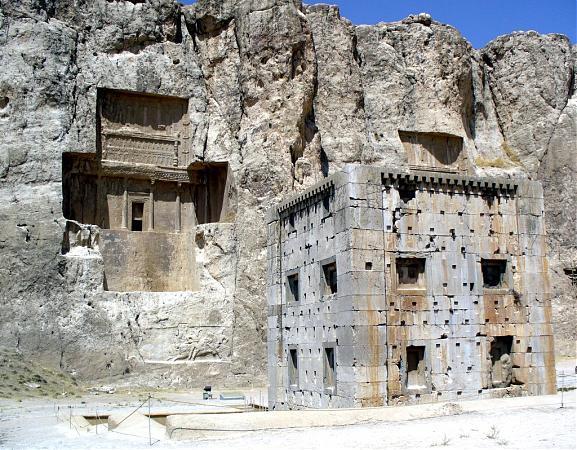


Naqsh-e Rustam (Persian: نقش رستم, Nāqš-e Rostām) is an archaeological site, containing mainly 4 ancient tombs belonging to Achaemenid kings, a cube shaped construction called "Ka'ba-ye Zartosht" from Achaemenid era, as well as seven rock reliefs depicting Sassanid kings. It is located some 12 km northwest of Persepolis, a few hundred meters from Sassanid reliefs in Naqsh-e Rajab, in Fars province, Iran.
The four tombs are carved out of the rock face, at a considerable height above the ground. The tombs are known locally as the 'Persian crosses', after the shape of the facades of the tombs. The entrance to each tomb is at the center of each cross, which opens into a small chamber, where the king lays. The horizontal beam of each of the tomb's facades is believed to be a replica of the entrance of the palace at Persepolis.
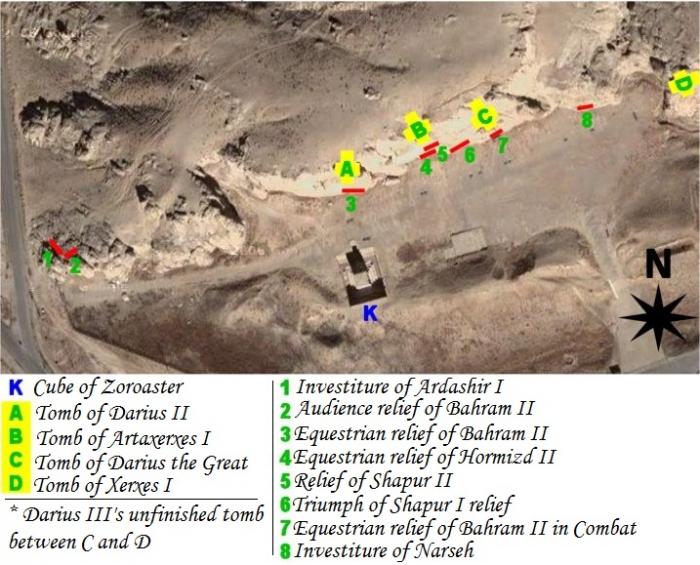
One of the tombs is explicitly identified by an accompanying inscription to be the tomb of Darius I the Great(522-486 BC). The other three tombs are believed to be those of Xerxes I (486-465 BC), Artaxerxes I (465-424 BC), and Darius II (423-404 BC). There is also a fifth unfinished tomb which is believed to be that of Artaxerxes III, who reigned at the longest two years, or Darius III (336-330 BC), last of the Achaemenid kings.
There are also Seven over-sized rock reliefs at Naqsh-e Rustam depicting monarchs of the Sassanid period. These reliefs are located in the eastern side of the site.
1- The investiture relief of Ardashir I (226-242 AD): The founder of the Sassanid Empire is seen being handed the ring of kingship by Ahura Mazda. Its inscription bears the oldest attested use of the term 'Iran'. Both Ardashir I and Ahura Mazda are on their horses, with two figures underneath their hooves. These two figures are believed to be that of Artabanus IV, the last king of Arsacid dynasty and Satan.
2- The triumph of Shapur I (241-272 AD): This is the most famous of the Sassanid rock reliefs, and depicts Shapur's victory over two Roman emperors, Valerian and Philip the Arab. King Shapur is on his horse with Philip the Arab in front of him, on his knees begging the king for his forgiveness, while Valerian's hand is tied and hold up as a sign of submission. A more elaborate version of this rock relief is at Bishapur.
3- The "grandee" relief of Bahram II (276-293 AD): On each side of the king, who is depicted with an over-sized sword, figures face the king. On the left, stand five figures perhaps members of the king's family. On the right stand three courtiers, one of which may be Kartir. This relief is to the immediate right of the investiture inscription of Ardashir.
4, 5- The two equestrian reliefs of Bahram II (276-293 AD): The first equestrian relief, located immediately below the tomb of Darius II, depicts the king battling a mounted Roman soldier; while the second relief, located immediately below the tomb of Darius I, is divided into two registers, an upper and a lower one. In the upper register, the king appears to be forcing a Roman enemy from his horse, while in the lower register, the king is again battling a mounted Roman soldier. Both reliefs depict a dead enemy under the hooves of the king's horse.
6- The investiture of Narseh (293-303 AD): In this relief, the king is depicted as receiving the ring of kingship from a female figure that is frequently assumed to be the divinity Anahita.
7- The equestrian relief of Hormizd II (r. 303-309): This relief is below tomb of Artaxerxes I, and depicts Hormizd forcing an enemy from his horse. Immediately above the relief and below the tomb is a badly damaged relief of what appears to be Shapur II accompanied by courtiers.
In addition, the Ka'ba-ye Zartosht, meaning the "Cube of Zoroaster", is located here. It is a 5th century BCE Achaemenid-era tower-like construction. The name probably dates to the 14th century, when many pre-Islamic sites were identified with figures and events of the Koran or the Shahnameh. In reality, the structure is not actually a Zoroastrian shrine, nor are there reports of it ever having been a pilgrimage site. The structure, which is a copy of a sister building at Pasargadae, was built either by Darius I when he moved to Persepolis, or by Artaxerxes II, while the walls surrounding it dates to Sassanid era.
From a reference to fire altars, in a Sassanid-era inscription on the building, it was inferred that the structure was once a fire altar, or perhaps used as an eternal-flame memorial to the emperors whose tombs are located a few meters away. However, many scholars consider the structure to be an Achaemenid royal tomb, and it has been observed that both the Ka'ba and the sister building at Pasargadae correspond more closely to the description of Cyrus's tomb by Arrian(6.29) and Strabo(15.3.7) than does the monument in Pasargadae which is commonly attributed to this king.
The four tombs are carved out of the rock face, at a considerable height above the ground. The tombs are known locally as the 'Persian crosses', after the shape of the facades of the tombs. The entrance to each tomb is at the center of each cross, which opens into a small chamber, where the king lays. The horizontal beam of each of the tomb's facades is believed to be a replica of the entrance of the palace at Persepolis.
One of the tombs is explicitly identified by an accompanying inscription to be the tomb of Darius I the Great(522-486 BC). The other three tombs are believed to be those of Xerxes I (486-465 BC), Artaxerxes I (465-424 BC), and Darius II (423-404 BC). There is also a fifth unfinished tomb which is believed to be that of Artaxerxes III, who reigned at the longest two years, or Darius III (336-330 BC), last of the Achaemenid kings.
There are also Seven over-sized rock reliefs at Naqsh-e Rustam depicting monarchs of the Sassanid period. These reliefs are located in the eastern side of the site.
1- The investiture relief of Ardashir I (226-242 AD): The founder of the Sassanid Empire is seen being handed the ring of kingship by Ahura Mazda. Its inscription bears the oldest attested use of the term 'Iran'. Both Ardashir I and Ahura Mazda are on their horses, with two figures underneath their hooves. These two figures are believed to be that of Artabanus IV, the last king of Arsacid dynasty and Satan.
2- The triumph of Shapur I (241-272 AD): This is the most famous of the Sassanid rock reliefs, and depicts Shapur's victory over two Roman emperors, Valerian and Philip the Arab. King Shapur is on his horse with Philip the Arab in front of him, on his knees begging the king for his forgiveness, while Valerian's hand is tied and hold up as a sign of submission. A more elaborate version of this rock relief is at Bishapur.
3- The "grandee" relief of Bahram II (276-293 AD): On each side of the king, who is depicted with an over-sized sword, figures face the king. On the left, stand five figures perhaps members of the king's family. On the right stand three courtiers, one of which may be Kartir. This relief is to the immediate right of the investiture inscription of Ardashir.
4, 5- The two equestrian reliefs of Bahram II (276-293 AD): The first equestrian relief, located immediately below the tomb of Darius II, depicts the king battling a mounted Roman soldier; while the second relief, located immediately below the tomb of Darius I, is divided into two registers, an upper and a lower one. In the upper register, the king appears to be forcing a Roman enemy from his horse, while in the lower register, the king is again battling a mounted Roman soldier. Both reliefs depict a dead enemy under the hooves of the king's horse.
6- The investiture of Narseh (293-303 AD): In this relief, the king is depicted as receiving the ring of kingship from a female figure that is frequently assumed to be the divinity Anahita.
7- The equestrian relief of Hormizd II (r. 303-309): This relief is below tomb of Artaxerxes I, and depicts Hormizd forcing an enemy from his horse. Immediately above the relief and below the tomb is a badly damaged relief of what appears to be Shapur II accompanied by courtiers.
In addition, the Ka'ba-ye Zartosht, meaning the "Cube of Zoroaster", is located here. It is a 5th century BCE Achaemenid-era tower-like construction. The name probably dates to the 14th century, when many pre-Islamic sites were identified with figures and events of the Koran or the Shahnameh. In reality, the structure is not actually a Zoroastrian shrine, nor are there reports of it ever having been a pilgrimage site. The structure, which is a copy of a sister building at Pasargadae, was built either by Darius I when he moved to Persepolis, or by Artaxerxes II, while the walls surrounding it dates to Sassanid era.
From a reference to fire altars, in a Sassanid-era inscription on the building, it was inferred that the structure was once a fire altar, or perhaps used as an eternal-flame memorial to the emperors whose tombs are located a few meters away. However, many scholars consider the structure to be an Achaemenid royal tomb, and it has been observed that both the Ka'ba and the sister building at Pasargadae correspond more closely to the description of Cyrus's tomb by Arrian(6.29) and Strabo(15.3.7) than does the monument in Pasargadae which is commonly attributed to this king.
Wikipedia article: http://en.wikipedia.org/wiki/Naqsh-e_Rustam
Nearby cities:
Coordinates: 29°59'20"N 52°52'28"E
- Pasargadae 38 km
- Shiraz 52 km
- Shiraz City Center 53 km
- Firouzabad 127 km
- Abarkuh 132 km
- The 1800-plus-year-old towns - The ancient Sassanid 136 km
- The ruins of the ancient Sassanid baham ıı - بزرگترین شهر باستانی ساسانی bahram dovom 137 km
- Nersiabad (Nasrabad ) 219 km
- Yazd 255 km
- Bandar Abbas 429 km
- Possible area of the ancient city of Pars 5.7 km
- Persepolis 6.5 km
- Azemayesh Industrial Inc. 10 km
- koshk 11 km
- rashmijan 13 km
- محله فردوسي ferdosi neighbourhood 16 km
- رجا آباد 16 km
- SHiraz Petrochemical Industry 18 km
- Rahmat Mount 24 km
- Bamoo National Park 33 km
Comments