
Stone Bridge (Saint Petersburg)
Russia /
Sankt Petersburg /
Saint Petersburg
World
/ Russia
/ Sankt Petersburg
/ Saint Petersburg
, 0 km from center (Санкт-Петербург)
World / Russia / Leningrad
road bridge, 1770s construction
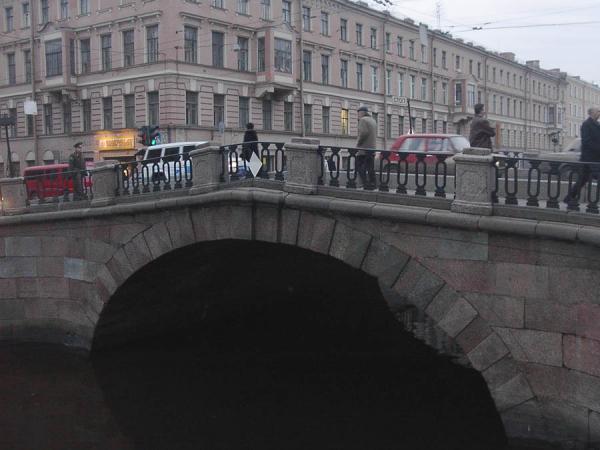


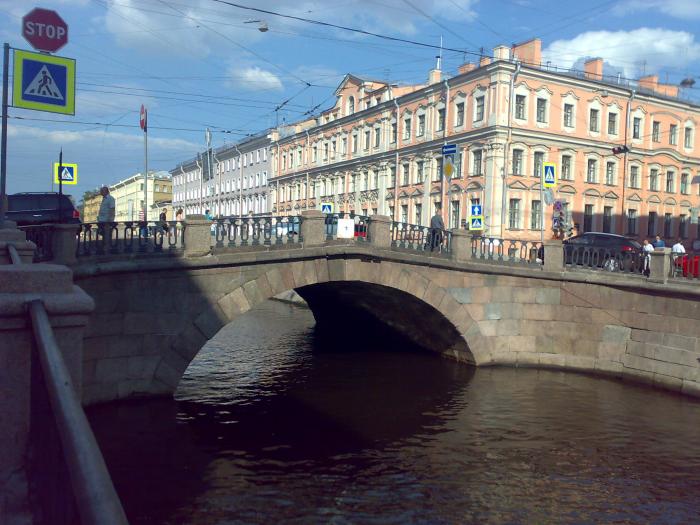
The stone bridge spans the Griboyedov Canal along the axis of Gorokhovaya Street and connects the Kazan and Spassky Islands, the bridge marks the border between the Admiralty and Central districts of St. Petersburg.
The stone Bridge is a single—span arched structure with a length of 19.7 meters and a width of 15.08 meters. The superstructure is a solid arch of parabolic outline, lined with granite from the facades.
The arch of the bridge is made of granite, the abutments are made of rubble slab. The Stone Bridge was lined with smooth granite blocks alternating with blocks in the form of tetrahedral pyramids — the so-called "diamond rust". With this treatment, the protruding edges, being polished, sparkle brightly in the sun, resembling cut diamonds.
The drawing of the bridge railing repeats the pattern of the canal embankment railings — cast-iron balusters with massive granite bollards and a metal handrail. The pavement on the bridge is asphalt concrete. The sidewalk is separated from the roadway by a granite parapet fence.
The bridge is one of the few such oldest buildings in St. Petersburg that have not undergone a radical reconstruction. Due to this, in the construction of the Stone Bridge, one can see the preserved characteristic technological feature of bridge construction of the XVIII century – a rather steep bend of the structure, often found in arched stone structures of that time.
There has been a wooden pile crossing here since 1752, called the Middle Bridge — after the name of the street: the current Gorokhovaya Street in the 1730s -1750s was called the Middle Perspectiva.
A permanent stone bridge designed by engineer V. Nazimov was built from 1767 to 1776.
Initially, the bridge had four semicircular staircases to the water, but at the turn of the XIX–XX centuries, the descents were eliminated. At the same time, the steepness of the entrances to the bridge was somewhat reduced.
The history of the Stone Bridge is connected with the history of the political struggle of the last quarter of the XIX century. In 1880, terrorists from the Narodnaya Volya society, preparing another attempt on Emperor Alexander II, laid 7 pounds of dynamite under the bridge. The attempt did not take place at that time: the people's volunteers were not sure of the power of the explosives laid and canceled the action. The bomb was found at the bottom of the Catherine Canal in the spring of 1881, after the assassination of the tsar, during the investigation of the "case of sixteen".
At the beginning of the XX century, the steep ascent to the Stone Bridge proved to be a difficult obstacle for the first St. Petersburg buses. According to eyewitnesses, during rush hour, the conductors had to drop off passengers in front of the bridge, they crossed the crossing on foot, and the bus was traveling light. On the other side of the canal, passengers resumed their seats, and the bus continued along Gorokhovaya Street, rolling downhill.
Another interesting fact concerns a metal stand with the name of the bridge — after the war and the blockade, such a stand was preserved only on the Stone Bridge. In 1949, it served as a model for the manufacture of similar racks with the names of other bridges in Leningrad.
en.mostotrest-spb.ru/bridges/kamennyj
The stone Bridge is a single—span arched structure with a length of 19.7 meters and a width of 15.08 meters. The superstructure is a solid arch of parabolic outline, lined with granite from the facades.
The arch of the bridge is made of granite, the abutments are made of rubble slab. The Stone Bridge was lined with smooth granite blocks alternating with blocks in the form of tetrahedral pyramids — the so-called "diamond rust". With this treatment, the protruding edges, being polished, sparkle brightly in the sun, resembling cut diamonds.
The drawing of the bridge railing repeats the pattern of the canal embankment railings — cast-iron balusters with massive granite bollards and a metal handrail. The pavement on the bridge is asphalt concrete. The sidewalk is separated from the roadway by a granite parapet fence.
The bridge is one of the few such oldest buildings in St. Petersburg that have not undergone a radical reconstruction. Due to this, in the construction of the Stone Bridge, one can see the preserved characteristic technological feature of bridge construction of the XVIII century – a rather steep bend of the structure, often found in arched stone structures of that time.
There has been a wooden pile crossing here since 1752, called the Middle Bridge — after the name of the street: the current Gorokhovaya Street in the 1730s -1750s was called the Middle Perspectiva.
A permanent stone bridge designed by engineer V. Nazimov was built from 1767 to 1776.
Initially, the bridge had four semicircular staircases to the water, but at the turn of the XIX–XX centuries, the descents were eliminated. At the same time, the steepness of the entrances to the bridge was somewhat reduced.
The history of the Stone Bridge is connected with the history of the political struggle of the last quarter of the XIX century. In 1880, terrorists from the Narodnaya Volya society, preparing another attempt on Emperor Alexander II, laid 7 pounds of dynamite under the bridge. The attempt did not take place at that time: the people's volunteers were not sure of the power of the explosives laid and canceled the action. The bomb was found at the bottom of the Catherine Canal in the spring of 1881, after the assassination of the tsar, during the investigation of the "case of sixteen".
At the beginning of the XX century, the steep ascent to the Stone Bridge proved to be a difficult obstacle for the first St. Petersburg buses. According to eyewitnesses, during rush hour, the conductors had to drop off passengers in front of the bridge, they crossed the crossing on foot, and the bus was traveling light. On the other side of the canal, passengers resumed their seats, and the bus continued along Gorokhovaya Street, rolling downhill.
Another interesting fact concerns a metal stand with the name of the bridge — after the war and the blockade, such a stand was preserved only on the Stone Bridge. In 1949, it served as a model for the manufacture of similar racks with the names of other bridges in Leningrad.
en.mostotrest-spb.ru/bridges/kamennyj
Wikipedia article: http://en.wikipedia.org/wiki/Stone_Bridge_(Saint_Petersburg)
Nearby cities:
Coordinates: 59°55'49"N 30°19'8"E
- Palace Bridge 1.5 km
- Annunciation Bridge (Blagoveschensky Bridge) 1.9 km
- Troitsky ('Trinity') (bridge 2.3 km
- Tuchkov Bridge 2.9 km
- Alexander Nevsky Bridge 3.9 km
- Betancourt Bridge 4.6 km
- Kamennostrovsky Bridge 5.4 km
- Bolshoy Petrovsky Bridge 5.4 km
- Kantemirovsky Bridge 5.6 km
- Belyayevsky bridge 11 km
- Spassky Island 0.1 km
- Municipal Okrug 78 0.4 km
- Kazanskiy Island 0.5 km
- Bezymyanny island 0.7 km
- Admiralty Island 1.1 km
- Admiralteysky Municipal Okrug 1.2 km
- Admiralteysky District 1.8 km
- Municipal Okrug 7 2.1 km
- Tsentralny District 2.1 km
- Vasileostrovsky District 4.2 km