
18-22 West 18th Street (New York City, New York)
USA /
New Jersey /
West New York /
New York City, New York /
West 17th Street, 23
World
/ USA
/ New Jersey
/ West New York
condominium
Add category
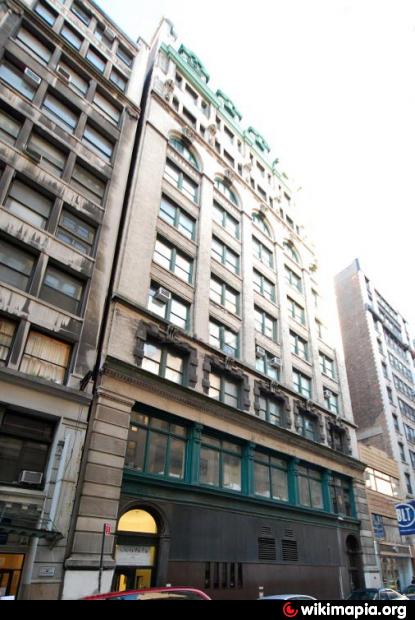
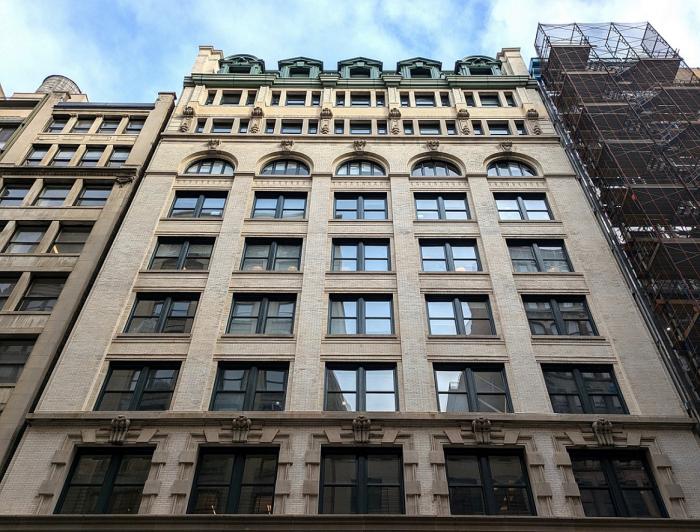
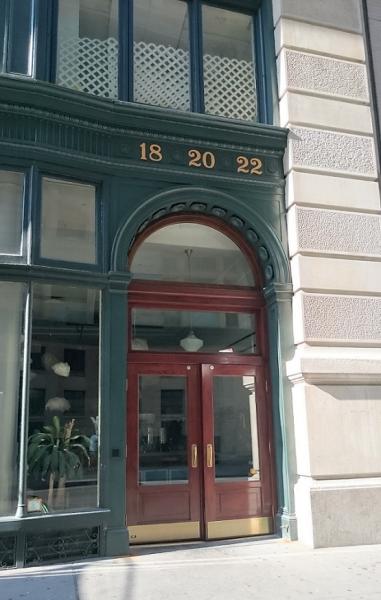
146-foot, 11-story Beaux-Arts residential building completed in 1904. Designed by Buchman & Fox as a store-and-loft building, it extends through the block to 23-27 West 17th Street. Both facades are nearly identical and are clad in off-white brick, limestone and terra-cotta. They feature an arcaded midsection and dormered mansard roof.
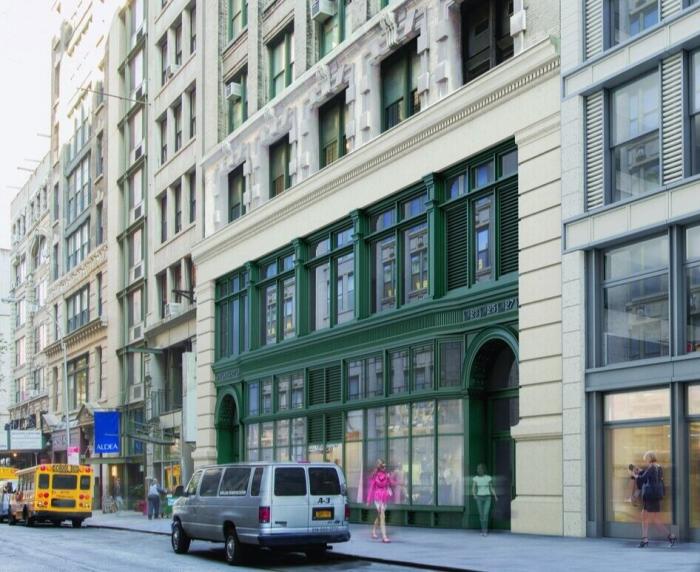
On 18th Street, rusticated limestone piers flank the 2-story base and support a dentiled limestone cornice. The piers, resting on polished granite blocks, have alternating textured and smooth ashlar. The storefront and entrances are spanned by a narrow incised cast-iron cornice with egg-and-dart molding on the fascia. Over the doors in the eastern and western end bays are the cast-iron numbers "-18-20-22-"; the soffits of the arched entrances are embellished with cast-iron rosettes. A 12-section transom extends across the storefront between the entrances; the extreme eastern transom is a multi-light, leaded panel and is possibly original. The store entrance, originally recessed below the two center transoms, has been widened by a half-transom width at each side, and altered with a modern cement and glass surround and door. The 2nd floor has five bays separated by cast-iron pilasters with foliate capitals. The western end bay holds three single-pane windows under transoms. The eastern bay maintains the same configuration, but has vents in the outer panels. The center bays each hold paired single-pane windows with transoms above.
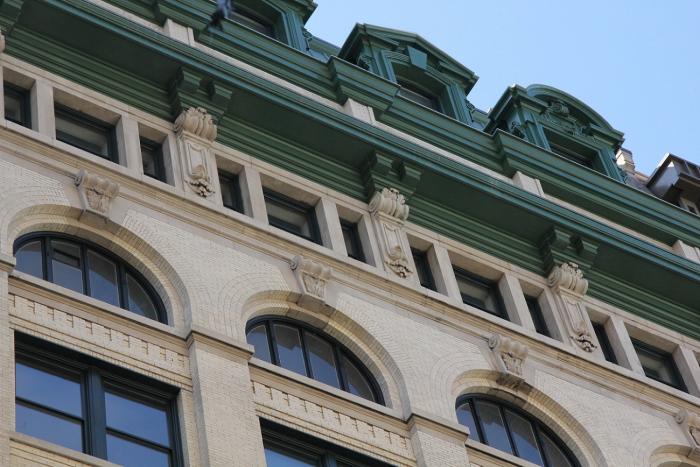
The 3rd-6th floors are faced wit brick and continue the 5-bay division of the 2nd floor. The 3rd floor has paired windows with metal mullions set in limestone Gibbs surrounds. The 4th-8th floors rise from a limestone belt course as an arcade. The windows are recessed slightly from the piers, and are identical to those at the 3rd floor. Each pair of windows shares a limestone sill. Simple raised brick bands decorate the spandrels in each bay between the stories. The spandrels under the arched 8h-floor window openings are decorated with narrow vertical panels. The 8th-floor arches are formed by concentric rings of brick voussoirs and console keystones. Four casement windows are shaped to fit each arch. The terra-cotta 9th floor contains the 5-bay arrangement, but with window openings organized in a tripartite pattern. Consoles with long straps, set under paired modillioned blocks, support the metal cornice and separate the bays of the 9th floor. The 10th floor is composed of five metal dormers set into a tiled mansarded roof. The two end dormers have square-headed windows and segmental pediments, with decoration in the tympana. The middle dormers have segmental-arched window heads with keystones and triangular pediments.
The 17th Street facade repeats the design of that on 18th Street. While the ground story of 23-27 West 17th Street has been severely altered, it retains the arched entrances, the cast-iron cornice spanning the facade, and the cast-iron numbers "-23-25-27-" above the doors. The cornice above the 9th floor has been removed. At the 11th floor brick chimneys with corbelled chimney heads have been added at both ends of the facade.
The western elevation is clad in brown brick, with bays of windows near the center, where there is a shallow light court.
Early tenants included several cloak and suit businesses, ladies' hats companies, Ballow-Dickson Wallpaper, and Susquehana Silk Mills. It was converted to condominiums around 1990. The ground floor is occupied by Summit Health on 18th Street, and The Association in Manhattan for Autistic Children on 17th Street.
On 18th Street, rusticated limestone piers flank the 2-story base and support a dentiled limestone cornice. The piers, resting on polished granite blocks, have alternating textured and smooth ashlar. The storefront and entrances are spanned by a narrow incised cast-iron cornice with egg-and-dart molding on the fascia. Over the doors in the eastern and western end bays are the cast-iron numbers "-18-20-22-"; the soffits of the arched entrances are embellished with cast-iron rosettes. A 12-section transom extends across the storefront between the entrances; the extreme eastern transom is a multi-light, leaded panel and is possibly original. The store entrance, originally recessed below the two center transoms, has been widened by a half-transom width at each side, and altered with a modern cement and glass surround and door. The 2nd floor has five bays separated by cast-iron pilasters with foliate capitals. The western end bay holds three single-pane windows under transoms. The eastern bay maintains the same configuration, but has vents in the outer panels. The center bays each hold paired single-pane windows with transoms above.
The 3rd-6th floors are faced wit brick and continue the 5-bay division of the 2nd floor. The 3rd floor has paired windows with metal mullions set in limestone Gibbs surrounds. The 4th-8th floors rise from a limestone belt course as an arcade. The windows are recessed slightly from the piers, and are identical to those at the 3rd floor. Each pair of windows shares a limestone sill. Simple raised brick bands decorate the spandrels in each bay between the stories. The spandrels under the arched 8h-floor window openings are decorated with narrow vertical panels. The 8th-floor arches are formed by concentric rings of brick voussoirs and console keystones. Four casement windows are shaped to fit each arch. The terra-cotta 9th floor contains the 5-bay arrangement, but with window openings organized in a tripartite pattern. Consoles with long straps, set under paired modillioned blocks, support the metal cornice and separate the bays of the 9th floor. The 10th floor is composed of five metal dormers set into a tiled mansarded roof. The two end dormers have square-headed windows and segmental pediments, with decoration in the tympana. The middle dormers have segmental-arched window heads with keystones and triangular pediments.
The 17th Street facade repeats the design of that on 18th Street. While the ground story of 23-27 West 17th Street has been severely altered, it retains the arched entrances, the cast-iron cornice spanning the facade, and the cast-iron numbers "-23-25-27-" above the doors. The cornice above the 9th floor has been removed. At the 11th floor brick chimneys with corbelled chimney heads have been added at both ends of the facade.
The western elevation is clad in brown brick, with bays of windows near the center, where there is a shallow light court.
Early tenants included several cloak and suit businesses, ladies' hats companies, Ballow-Dickson Wallpaper, and Susquehana Silk Mills. It was converted to condominiums around 1990. The ground floor is occupied by Summit Health on 18th Street, and The Association in Manhattan for Autistic Children on 17th Street.
Nearby cities:
Coordinates: 40°44'19"N 73°59'36"W
- ABC Carpet & Home 0.3 km
- 115-135 West 16th Street 0.4 km
- The Caroline Apartments 0.4 km
- Hugh O’Neill Dry Goods Store 0.4 km
- Zeckendorf Towers 0.5 km
- The Chelsea Seventh Condominium 0.6 km
- The Grand Madison Condominium 0.7 km
- The Greenwich Lane (former St. Vincent's Hospital Complex) 0.7 km
- Gramercy Square Condominium 0.8 km
- Eventi/The Beatrice 1 km
- Greenwich Village 1 km
- Chelsea 1 km
- West Village 1 km
- Midtown (Manhattan, NY) 1.4 km
- Lower (Downtown) Manhattan 2 km
- Manhattan 5 km
- Hudson County, New Jersey 6.8 km
- Brooklyn 11 km
- Queens 14 km
- The Palisades 25 km