
Allahabad University (Art Faculty) (Prayagraj)
India /
Uttar Pradesh /
Allahabad /
Prayagraj
World
/ India
/ Uttar Pradesh
/ Allahabad
World / India / Uttar Pradesh / Kaushambi
university, invisible
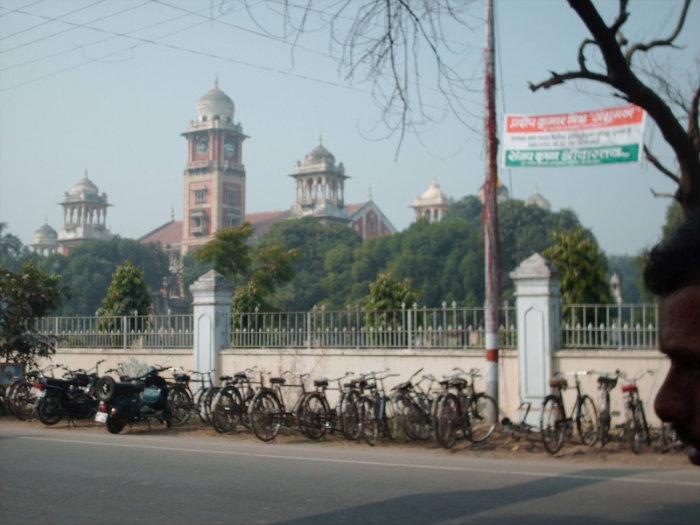

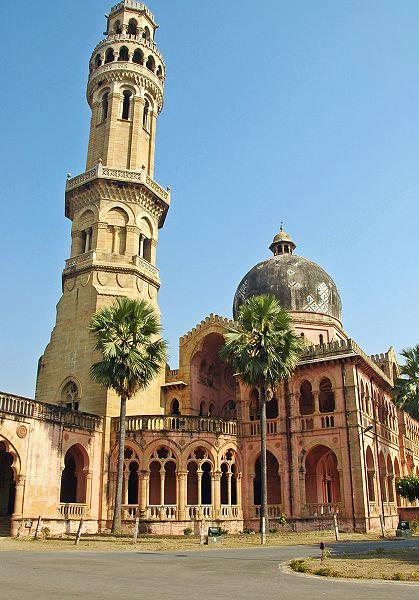
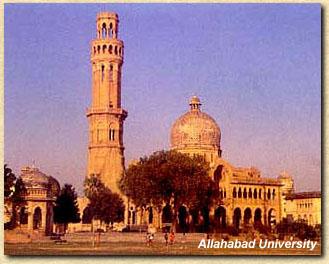
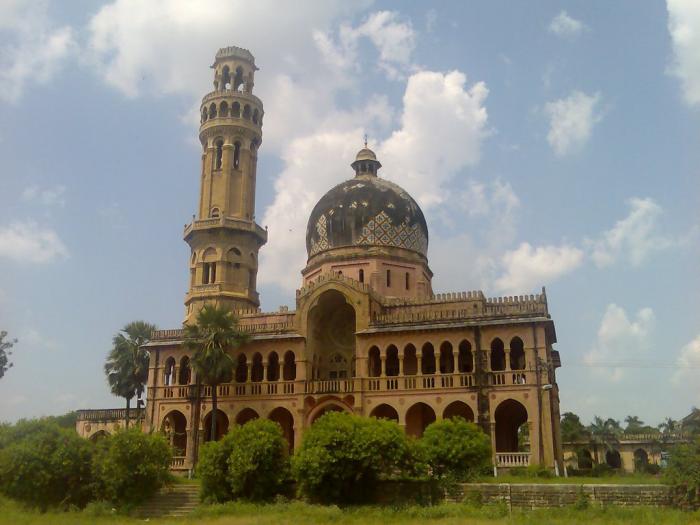

The foundation stone of the Muir Central College, was laid by Governor-General of India, Lord Northbrook on December 9, 1873. The College was named after Sir William Muir, Lt. Governor of United Province, who was instrumental in its foundation. The building was designed by William Emerson, who also designed Victoria Memorial in Kolkata and Crawford Market in Mumbai in a unique combination of Indo-Saracenic, Egyptian and Gothic styles.[5]
Initially it functioned under, University of Calcutta, and later, on 23 September 1887, the University of Allahabad was established, making it the fourth modern University established in India.
It began as an affiliating and examining body for graduate and Post-graduate degrees with a classical orientation in different branches of learning and the responsibility for secondary education as well. However, by 1904, the University established its own teaching departments and instituted doctoral research programmes. The University Senate hall was opened by the lieutenant-governor, Sir John Hewett, in 1912. In 1921, with the promulgation of the 'Allahabad University Act of 1921', the Muir Central College merged with University, which was re-organised as a unitary teaching and residential University. Further, over the next few years its affiliated Colleges were transferred to Agra University and the task of conducting secondary-level examinations was relocated.
In 1951, the University (while maintaining its fundamental unitary character) recognised certain local institutions as Associated Colleges authorised to teach undergraduate courses under the Faculties of Arts, Commerce, Science, and Law.
The University has had the privilege of having on its rolls a host of distinguished politicians and statesmen including, one President and two Vice-Presidents of the country, two former Prime Ministers, several Union and State ministers, at least four Chief Justices of the Supreme Court, besides a large number of senior bureaucrats. The list of eminent educationists, scientists, historians, littérateurs, economists, and philosophers produced by the University is much too long a list to be reproduced but speaks highly of the University's standards in education.
In view of these prestigious achievements by the Institution, as well as its position among the universities of Uttar Pradesh, the State Government accorded it formal recognition in July 1992 as a ‘Premier Institution’ (Vishesh Agrani Sanstha).
In 1987, the University completed one hundred years of establishment. It was during the centenary celebrations of the University that the demand for "Central status" to the University was made unanimously by the students, faculty, and employees. After a sustained campaign and several hiccups, the Government of India finally acceded to the public demand. In December 2004, a Bill was introduced in Parliament proposing to recognise the University of Allahabad as an ‘Institution of National Importance’ to restore the Central character of the University. Both Houses of the Parliament duly passed "The University of Allahabad Act, 2005" in May 2005.
On 23 June 2005, the President of India gave his assent to the said bill and the University was finally declared an 'Institution of National Importance' once again. The Government of India issued the gazette notification for the same on July 11, 2005, and the University started functioning as a Central University on July 14, 2005 making it a red-letter day in its 118 years old history.
The University of Allahabad Act, 2005 has provided for the following to be deemed as the Constituent Colleges of the University—1. Five Faculties (Arts, Commerce, Law, Medicine, and Science),
2. Three University institutes(namely the Institute of Inter-Disciplinary Studies, the Institute of Professional Studies, and the National Centre of Experimental Mineralogy and Petrology) and one Independent University Centre (The Centre of Behavioural and Cognitive Sciences),
3. One University college (The Motilal Nehru Medical College and Swarup Rani Nehru Hospital, Allahabad),
4. Three Constituent Institutes (The Govind Ballabh Pant Social Science Institute, Allahabad, the Harish Chandra Research Institute of Mathematics and Mathematical Physics, Allahabad and the Kamla Nehru Post-graduate Medical Institute, Allahabad),and,
5. Eleven local institutions.
Initially it functioned under, University of Calcutta, and later, on 23 September 1887, the University of Allahabad was established, making it the fourth modern University established in India.
It began as an affiliating and examining body for graduate and Post-graduate degrees with a classical orientation in different branches of learning and the responsibility for secondary education as well. However, by 1904, the University established its own teaching departments and instituted doctoral research programmes. The University Senate hall was opened by the lieutenant-governor, Sir John Hewett, in 1912. In 1921, with the promulgation of the 'Allahabad University Act of 1921', the Muir Central College merged with University, which was re-organised as a unitary teaching and residential University. Further, over the next few years its affiliated Colleges were transferred to Agra University and the task of conducting secondary-level examinations was relocated.
In 1951, the University (while maintaining its fundamental unitary character) recognised certain local institutions as Associated Colleges authorised to teach undergraduate courses under the Faculties of Arts, Commerce, Science, and Law.
The University has had the privilege of having on its rolls a host of distinguished politicians and statesmen including, one President and two Vice-Presidents of the country, two former Prime Ministers, several Union and State ministers, at least four Chief Justices of the Supreme Court, besides a large number of senior bureaucrats. The list of eminent educationists, scientists, historians, littérateurs, economists, and philosophers produced by the University is much too long a list to be reproduced but speaks highly of the University's standards in education.
In view of these prestigious achievements by the Institution, as well as its position among the universities of Uttar Pradesh, the State Government accorded it formal recognition in July 1992 as a ‘Premier Institution’ (Vishesh Agrani Sanstha).
In 1987, the University completed one hundred years of establishment. It was during the centenary celebrations of the University that the demand for "Central status" to the University was made unanimously by the students, faculty, and employees. After a sustained campaign and several hiccups, the Government of India finally acceded to the public demand. In December 2004, a Bill was introduced in Parliament proposing to recognise the University of Allahabad as an ‘Institution of National Importance’ to restore the Central character of the University. Both Houses of the Parliament duly passed "The University of Allahabad Act, 2005" in May 2005.
On 23 June 2005, the President of India gave his assent to the said bill and the University was finally declared an 'Institution of National Importance' once again. The Government of India issued the gazette notification for the same on July 11, 2005, and the University started functioning as a Central University on July 14, 2005 making it a red-letter day in its 118 years old history.
The University of Allahabad Act, 2005 has provided for the following to be deemed as the Constituent Colleges of the University—1. Five Faculties (Arts, Commerce, Law, Medicine, and Science),
2. Three University institutes(namely the Institute of Inter-Disciplinary Studies, the Institute of Professional Studies, and the National Centre of Experimental Mineralogy and Petrology) and one Independent University Centre (The Centre of Behavioural and Cognitive Sciences),
3. One University college (The Motilal Nehru Medical College and Swarup Rani Nehru Hospital, Allahabad),
4. Three Constituent Institutes (The Govind Ballabh Pant Social Science Institute, Allahabad, the Harish Chandra Research Institute of Mathematics and Mathematical Physics, Allahabad and the Kamla Nehru Post-graduate Medical Institute, Allahabad),and,
5. Eleven local institutions.
Wikipedia article: http://en.wikipedia.org/wiki/Allahabad_University
Nearby cities:
Coordinates: 25°27'59"N 81°51'33"E
- Allahabad University 1.8 km
- Indian Institute of Technology (BHU) Varanasi 115 km
- Banaras Hindu University 115 km
- Narendra Deva University Of Agriculture & Technology 121 km
- Lucknow University ( L.U.) 182 km
- IIT Kanpur 202 km
- Indira Gandhi National Tribal University 296 km
- PDPM Indian Institute of Information Technology Design and Manufacturing Jabalpur 316 km
- Jawaharlal Nehru Krishi Vishwavidyalaya 316 km
- Sagar 366 km
- Allengunj 0.6 km
- Katra 0.7 km
- Mumfordganj 1.2 km
- Chota Baghara 1.4 km
- Police Lines 1.4 km
- PAC LINES 1.5 km
- Beli Gaon & Colony 1.6 km
- Kamla Nagar 1.7 km
- BTC Area (Army Reserve Area) 2.5 km
- Civil Lines 2.5 km