
Chrysler Building
USA /
New Jersey /
West New York /
Lexington Avenue, 405
World
/ USA
/ New Jersey
/ West New York
World / United States / New York
office building, skyscraper, NRHP - National Register of Historic Places, interesting place, Art Deco (architecture), 1930_construction, U.S. National Historic Landmark
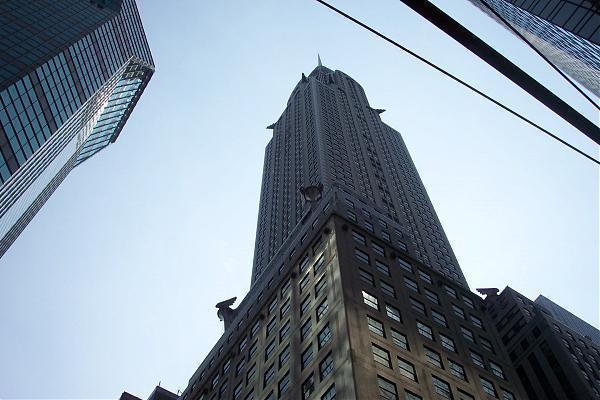
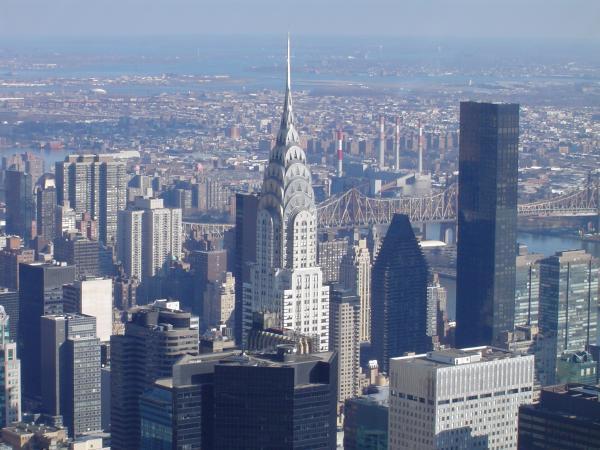

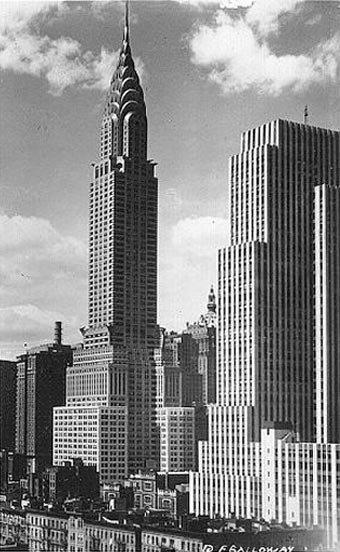


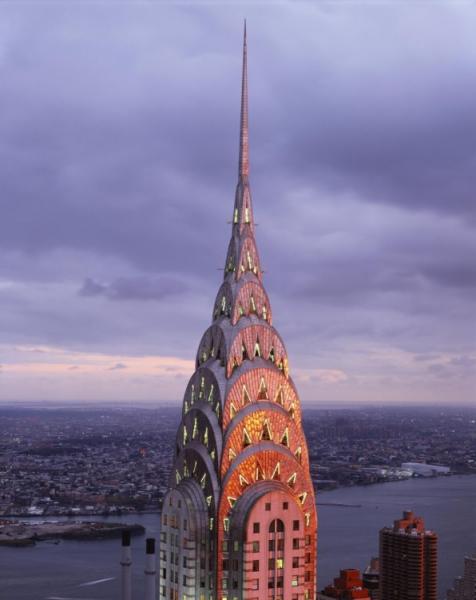
1,046-foot, 77-story Art-Deco office building completed in 1930. Designed by William van Alen, it was the tallest building in the world from 1930 until 1931, when it was passed by the Empire State Building. It was the headquarters of the Chrysler Corporation from 1930 until the mid 1950s.
Prior to its completion, the building stood about even with a rival project at 40 Wall Street, designed by H. Craig Severance. Severance increased the height of his project and then publicly claimed the title of the world's tallest building. In response, Van Alen obtained permission for a 125-foot-long spire and had it secretly constructed inside the frame of the building. Upon completion on May 27, 1930, the added height of the spire allowed the Chrysler Building to surpass 40 Wall Street as the tallest building in the world, and the Eiffel Tower as the tallest structure. It was the first man-made structure to stand taller than 1,000 feet.
It has a steel structural frame and its exterior facade incorporates brick and metal. A primary feature of the building is a terraced crown consisting of seven radiating terraced arches. The stainless-steel cladding is ribbed and riveted in a radiating sunburst pattern with many triangular windows, transitioning into smaller segments of the seven narrow setbacks of the facade of the terraced crown.
The first four floors of the building cover the entire site and are faced with polished black Shastone granite at the ground floor and white Georgian marble above. The most striking features of this portion of the building are the two entrances, on Lexington Avenue and 42nd Street. Each entrance rises for a height of three floors in proscenium fashion and is enframed by Shastone granite. Set back within the deep reveals of the entrances are sets of revolving doors beneath intricately patterned metal-and-glass screens. There is a 1-story entrance on 43rd Street. Also at ground floor level are large show-windows for shops, framed in metal. WIndows for offices may be seen at the 2nd, 3rd, & 4th floors. Ornamental spandrels are set at the bases of the 2nd-floor windows. The exposed metal frames of the entries and windows are of "Nirosta" steel, a kind of rust resistant chromium nickel steel, manufactured for the first time in the United States specifically for the Chrysler Building according to a German formula from Krupp.
Above the 4th floor, the building is penetrated on the east and west sides by light courts extending to the face of the tower, while on the north and south the structure gradually rises in a series of setbacks. The facing of the walls through the first setback at the 16th floor is of white brick with contrasting white marble strips creating a basket weave pattern. Windows are set in a regular grid pattern. An unusual feature of all windows in the building is that they have no reveals; frames are set flush with the walls.
In the next setback, ending at the 24th floor, there is a vertical emphasis with piers of white brick alternating with vertical window strips. Aluminum spandrels between the windows aid this effect. Spandrels at the 20th, 21st, & 22nd floors are adorned with polished abstract relief ornament. At the corners of the 24th floor are placed conventionalized pineapples, about nine feet high, of "Nirosta" steel.
The next three floors, through the 27th, form the third setback. Horizontal banding and zigzag motifs in grey and black brick contrast with the verticality of the setback below. The fourth setback, to the 31st floor, marks the emergence of the tower shaft from the lower masses. At the 31st floor the corners of the building are extended outward and crowned by huge ornamental Chrysler radiator caps in "Nirosta" steel, spanning about 15 feet. Also at this floor is a frieze in grey and white brick of stylized racing automobiles with polished steel hub caps.
The treatment of the shaft of the tower is a dual one emphasizing both verticality and horizontality. Windows are grouped into three vertical strips in the center of each tower face. Each group has a brick enframement and marble pier extending continuously upward across the windows. Spandrels between the windows are also given vertical emphasis with alternating vertical stripes in grey and white brick. By contrast the corners of the tower are horizontally banded with black brick. Another slight setback at the 59th floor is crowned by gargoyles, also of "Nirosta" steel, in the form of eagle's heads. Above this begin the series of "Nirosta" steel arches set with triangular windows which form the dome of the building.
The lobby's spectacular murals by Edward Trumbull were restored by Beyer Blinder Belle Architects & Planners with EverGreene Architectural Arts. The ground floor is occupied by a Chase Bank branch, USPack Logistics courier service, and Spaces rental agency.
archive.org/details/chryslerbuilding0000stra/mode/2up
archive.org/details/americanrhapsody0000pier_a0p5/mode/...
usmodernist.org/PA/PP-1930-06.pdf
archive.org/details/sim_american-architect-and-architec...
Prior to its completion, the building stood about even with a rival project at 40 Wall Street, designed by H. Craig Severance. Severance increased the height of his project and then publicly claimed the title of the world's tallest building. In response, Van Alen obtained permission for a 125-foot-long spire and had it secretly constructed inside the frame of the building. Upon completion on May 27, 1930, the added height of the spire allowed the Chrysler Building to surpass 40 Wall Street as the tallest building in the world, and the Eiffel Tower as the tallest structure. It was the first man-made structure to stand taller than 1,000 feet.
It has a steel structural frame and its exterior facade incorporates brick and metal. A primary feature of the building is a terraced crown consisting of seven radiating terraced arches. The stainless-steel cladding is ribbed and riveted in a radiating sunburst pattern with many triangular windows, transitioning into smaller segments of the seven narrow setbacks of the facade of the terraced crown.
The first four floors of the building cover the entire site and are faced with polished black Shastone granite at the ground floor and white Georgian marble above. The most striking features of this portion of the building are the two entrances, on Lexington Avenue and 42nd Street. Each entrance rises for a height of three floors in proscenium fashion and is enframed by Shastone granite. Set back within the deep reveals of the entrances are sets of revolving doors beneath intricately patterned metal-and-glass screens. There is a 1-story entrance on 43rd Street. Also at ground floor level are large show-windows for shops, framed in metal. WIndows for offices may be seen at the 2nd, 3rd, & 4th floors. Ornamental spandrels are set at the bases of the 2nd-floor windows. The exposed metal frames of the entries and windows are of "Nirosta" steel, a kind of rust resistant chromium nickel steel, manufactured for the first time in the United States specifically for the Chrysler Building according to a German formula from Krupp.
Above the 4th floor, the building is penetrated on the east and west sides by light courts extending to the face of the tower, while on the north and south the structure gradually rises in a series of setbacks. The facing of the walls through the first setback at the 16th floor is of white brick with contrasting white marble strips creating a basket weave pattern. Windows are set in a regular grid pattern. An unusual feature of all windows in the building is that they have no reveals; frames are set flush with the walls.
In the next setback, ending at the 24th floor, there is a vertical emphasis with piers of white brick alternating with vertical window strips. Aluminum spandrels between the windows aid this effect. Spandrels at the 20th, 21st, & 22nd floors are adorned with polished abstract relief ornament. At the corners of the 24th floor are placed conventionalized pineapples, about nine feet high, of "Nirosta" steel.
The next three floors, through the 27th, form the third setback. Horizontal banding and zigzag motifs in grey and black brick contrast with the verticality of the setback below. The fourth setback, to the 31st floor, marks the emergence of the tower shaft from the lower masses. At the 31st floor the corners of the building are extended outward and crowned by huge ornamental Chrysler radiator caps in "Nirosta" steel, spanning about 15 feet. Also at this floor is a frieze in grey and white brick of stylized racing automobiles with polished steel hub caps.
The treatment of the shaft of the tower is a dual one emphasizing both verticality and horizontality. Windows are grouped into three vertical strips in the center of each tower face. Each group has a brick enframement and marble pier extending continuously upward across the windows. Spandrels between the windows are also given vertical emphasis with alternating vertical stripes in grey and white brick. By contrast the corners of the tower are horizontally banded with black brick. Another slight setback at the 59th floor is crowned by gargoyles, also of "Nirosta" steel, in the form of eagle's heads. Above this begin the series of "Nirosta" steel arches set with triangular windows which form the dome of the building.
The lobby's spectacular murals by Edward Trumbull were restored by Beyer Blinder Belle Architects & Planners with EverGreene Architectural Arts. The ground floor is occupied by a Chase Bank branch, USPack Logistics courier service, and Spaces rental agency.
archive.org/details/chryslerbuilding0000stra/mode/2up
archive.org/details/americanrhapsody0000pier_a0p5/mode/...
usmodernist.org/PA/PP-1930-06.pdf
archive.org/details/sim_american-architect-and-architec...
Wikipedia article: http://en.wikipedia.org/wiki/Chrysler_Building
Nearby cities:
Coordinates: 40°45'5"N 73°58'31"W
This article is protected.
- Socony-Mobil Building 0.1 km
- Pfizer Building 0.2 km
- 450 Lexington Avenue 0.2 km
- Daily News Building 0.2 km
- The Graybar Building 0.2 km
- MetLife Building 0.3 km
- One Vanderbilt 0.4 km
- 245 Park Avenue 0.4 km
- Helmsley Building 0.4 km
- 277 Park Avenue 0.5 km
- Grand Central - 42nd Street Subway Station (4,5,6<6>7<7>S) 0.2 km
- Tudor City 0.4 km
- Con-Edison East 40th Street Substation 0.5 km
- Western Terminus of I-495 0.5 km
- Murray Hill 0.5 km
- One United Nations Park Condominium 0.7 km
- Turtle Bay 0.7 km
- Midtown (North Central) 0.9 km
- Amtrak East River Tunnels 0.9 km
- Queens Midtown Tunnel 1.3 km
Comments