
Biserica Stavropoleos (Bucharest)
Romania /
Bukarest /
Bucharest /
Strada Stavropoleos
World
/ Romania
/ Bukarest
/ Bucharest
World / Romania
church, listed building / architectural heritage


www.stavropoleos.ro
locuriuitate.blogspot.ro/2012/02/biserica-stavropoleos....
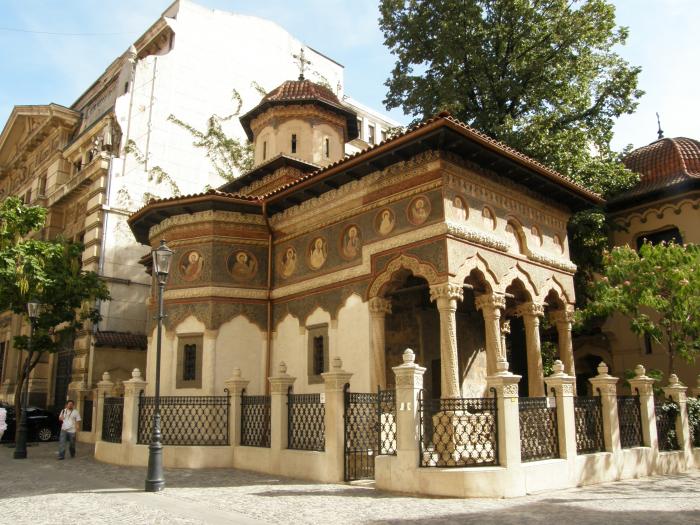
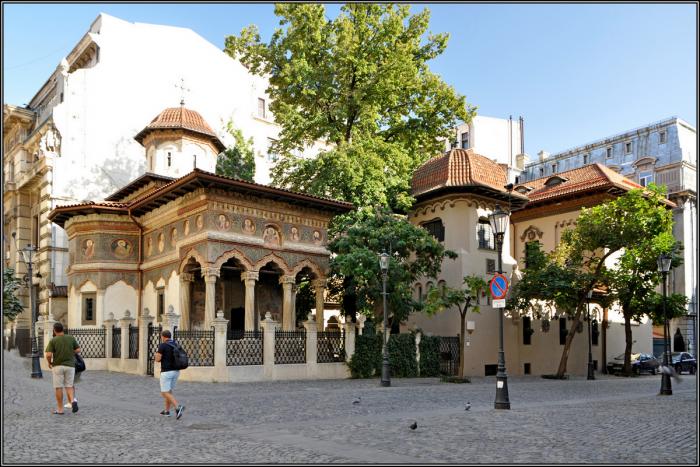
The Stavropoleos Church was built by Archimandrite Ioanichie in 1724, during the second reign of Nicolae Mavrocordat (1719-1730) in the Romanian Land. Born in the village of Ostanitza in the eparchy of Pogoniana (Epirus), Ioanichie came to the Romanian Land from Gura, a dependent monastery of the Pogoniana Archbishopric. The present church was built by Ioanichie within the precincts of the two-storey inn he had established in Bucharest. The monastery he founded was sustained financially by the inn, a common arrangement during the epoch.
In 1726, Abbot Ioanichie was elected Metropolitan of Stavropoleos and Exarch of the Karia region. At this time, the monastery which he had built was given the title Stavropoleos, after the name of the old metropolis (bishop’s see).
Of the original monastery and inn buildings, only the church has been preserved. It represents one of the most outstanding examples of the Brincoveanu style.
The other buildings that can be seen today are the result of an extensive restoration and building project begun in 1897 by well-known architect Ion Mincu.
locuriuitate.blogspot.ro/2012/02/biserica-stavropoleos....
The Stavropoleos Church was built by Archimandrite Ioanichie in 1724, during the second reign of Nicolae Mavrocordat (1719-1730) in the Romanian Land. Born in the village of Ostanitza in the eparchy of Pogoniana (Epirus), Ioanichie came to the Romanian Land from Gura, a dependent monastery of the Pogoniana Archbishopric. The present church was built by Ioanichie within the precincts of the two-storey inn he had established in Bucharest. The monastery he founded was sustained financially by the inn, a common arrangement during the epoch.
In 1726, Abbot Ioanichie was elected Metropolitan of Stavropoleos and Exarch of the Karia region. At this time, the monastery which he had built was given the title Stavropoleos, after the name of the old metropolis (bishop’s see).
Of the original monastery and inn buildings, only the church has been preserved. It represents one of the most outstanding examples of the Brincoveanu style.
The other buildings that can be seen today are the result of an extensive restoration and building project begun in 1897 by well-known architect Ion Mincu.
Wikipedia article: http://en.wikipedia.org/wiki/Stavropoleos
Nearby cities:
Coordinates: 44°25'54"N 26°5'55"E
- Radu Vodă Monastery 1 km
- People's Salvation Cathedral 1.5 km
- Biserica "Izvorul Tamaduirii" - Mavrogheni 3 km
- Biserica Sf Maria 4.1 km
- IML Mina Minovici 5.8 km
- The Romanian Saints Church 6.7 km
- Biserica Pitigaia (ruine) 21 km
- Manastirea / Schitul Delta Neajlovului 28 km
- "Barbu Belu" Schit, Com. Gostinari - Old church 29 km
- Radovanu Church 43 km
- Strada Lipscani 0.1 km
- Victoria Galleries - Dacia-România Palace 0.1 km
- Romanian National History Museum 0.1 km
- CEC Palace 0.2 km
- Victoria Shopping Center 0.2 km
- General Directorate of Bucharest Police 0.2 km
- Vama Postei Palace 0.3 km
- Piata Natiunilor Unite 0.3 km
- Memorial to the Victims of the Holocaust in Romania 0.4 km
- Detaşamentul de Pompieri ”Mihai Vodă” 0.5 km