
NYPL Science, Industry & Business Library
USA /
New Jersey /
West New York /
Madison Avenue, 188
World
/ USA
/ New Jersey
/ West New York
library
Add category


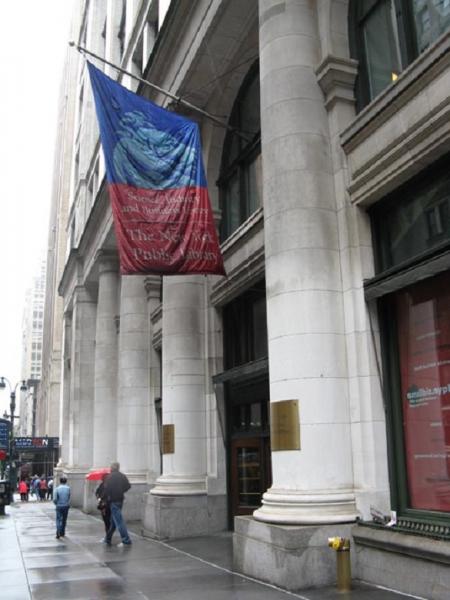
210-foot, 13-story Italian-Renaissance multi-use building completed in 1913 as an addition to the main 8-story 1903 building adjoining it to the west. Designed by Trowbridge & Livingston as the annex for the B. Altman & Co. Department Store, it now houses the research library within the New York Public Library system relating to science, business, and related fields.
The taller addition matches the original building on the lower floors, extending it four bays farther to Madison Avenue. These four easternmost bays rise to a 13-story tower. The upper five floors, faced in white brick rather than limestone, are handled as follows: the 9th floor, at the level of the cornice to the west, has paired windows, above which is a band course. The 10th & 11th floors are treated as a unit, with paired, recessed windows. Within the recess, the windows are separated by a slender double-height Ionic column and architrave from which spring small arches. A band course separates these windows from the 12th-floor level, which is identical to the 9th floor. A corbelled band course in turn separates the 12th from the 13th floor, which has similar window treatment; the 13th floor is capped by a small cornice.
The Madison Avenue facade is related in design to the 5th Avenue facade, but not identical. The first two floors form a base similar to that on 5th Avenue, but with no projecting central portico. Instead, the single bay at either end projects slightly. The central bay of the facade has a single entrance, but without the ornamental canopy like those on 5th Avenue. The end bays are limestone-faced at the lower eight floors, and brick-faced above. The end bays are further distinguished from the inner bays by having narrower windows. The brick faced inner bays have paired windows at the 3rd floor. The 4th-6th-floor bays are treated as a 3-story unit, with 3-story brick piers supporting a stone architrave. Within the brick piers, the windows are divided further into three small bays by a metal framework. At the 4th-floor level in each bay, the three smaller bays are formed by two slender Corinthian columns on tall pedestals, supporting an architrave; the architrave breaks forward over the central small bay and supports a segmental pediment. This form is repeated at the 5th floor with Ionic columns, with no pediments or pedestals, but with console brackets supported by the columns.
The 7th & 8th floors, separated by a band course, are treated as a double-height arcade defined by brick piers with a paneled effect; the brick arches have keystones. The windows within the arches are divided by slender colonnettes as the 7th floor. At the 9th floor each bay consists of a pair of square-headed windows. The 10th-11th floors are a modified reprise of the design of the 4th-6th floors. The 12th-floor bays have square-headed windows, above which is a level of brick corbelling. The final 13th-floor bays have paired windows topped by a small cornice. The stone-faced outer bays above the 2nd floor have similar windows to the middle bays, but smaller. The 35th Street facade is similar to that on 34th Street.
The interior was converted by Gwathmey Siegel & Associates.
The taller addition matches the original building on the lower floors, extending it four bays farther to Madison Avenue. These four easternmost bays rise to a 13-story tower. The upper five floors, faced in white brick rather than limestone, are handled as follows: the 9th floor, at the level of the cornice to the west, has paired windows, above which is a band course. The 10th & 11th floors are treated as a unit, with paired, recessed windows. Within the recess, the windows are separated by a slender double-height Ionic column and architrave from which spring small arches. A band course separates these windows from the 12th-floor level, which is identical to the 9th floor. A corbelled band course in turn separates the 12th from the 13th floor, which has similar window treatment; the 13th floor is capped by a small cornice.
The Madison Avenue facade is related in design to the 5th Avenue facade, but not identical. The first two floors form a base similar to that on 5th Avenue, but with no projecting central portico. Instead, the single bay at either end projects slightly. The central bay of the facade has a single entrance, but without the ornamental canopy like those on 5th Avenue. The end bays are limestone-faced at the lower eight floors, and brick-faced above. The end bays are further distinguished from the inner bays by having narrower windows. The brick faced inner bays have paired windows at the 3rd floor. The 4th-6th-floor bays are treated as a 3-story unit, with 3-story brick piers supporting a stone architrave. Within the brick piers, the windows are divided further into three small bays by a metal framework. At the 4th-floor level in each bay, the three smaller bays are formed by two slender Corinthian columns on tall pedestals, supporting an architrave; the architrave breaks forward over the central small bay and supports a segmental pediment. This form is repeated at the 5th floor with Ionic columns, with no pediments or pedestals, but with console brackets supported by the columns.
The 7th & 8th floors, separated by a band course, are treated as a double-height arcade defined by brick piers with a paneled effect; the brick arches have keystones. The windows within the arches are divided by slender colonnettes as the 7th floor. At the 9th floor each bay consists of a pair of square-headed windows. The 10th-11th floors are a modified reprise of the design of the 4th-6th floors. The 12th-floor bays have square-headed windows, above which is a level of brick corbelling. The final 13th-floor bays have paired windows topped by a small cornice. The stone-faced outer bays above the 2nd floor have similar windows to the middle bays, but smaller. The 35th Street facade is similar to that on 34th Street.
The interior was converted by Gwathmey Siegel & Associates.
Wikipedia article: https://en.wikipedia.org/wiki/Science,_Industry_and_Business_Library
Nearby cities:
Coordinates: 40°44'53"N 73°58'58"W
- Nassau County Medical Society/Academy of Medicine 33 km
- Sayreville Public Library 43 km
- Farmingdale Public Library 44 km
- Cold Spring Harbor Library and Enviromental Center 46 km
- AT&T Archives 46 km
- Marlboro Public Library 52 km
- Murry & Leonie Guggenheim Memorial Library 52 km
- Monmouth County Library Headquarters 57 km
- Monroe Township Public Library 61 km
- Smithtown Library - Nesconset Branch 70 km
- Koreatown 0.3 km
- NoMad 0.4 km
- Midtown (South Central) 0.6 km
- Murray Hill 0.6 km
- Kips Bay 0.9 km
- Flatiron District 1 km
- Amtrak East River Tunnels 1.3 km
- Manhattan 3.8 km
- Hudson County, New Jersey 7.8 km
- Queens 14 km