
67 West 73rd Street
USA /
New Jersey /
West New York /
West 73rd Street, 67
World
/ USA
/ New Jersey
/ West New York
apartment building
Add category

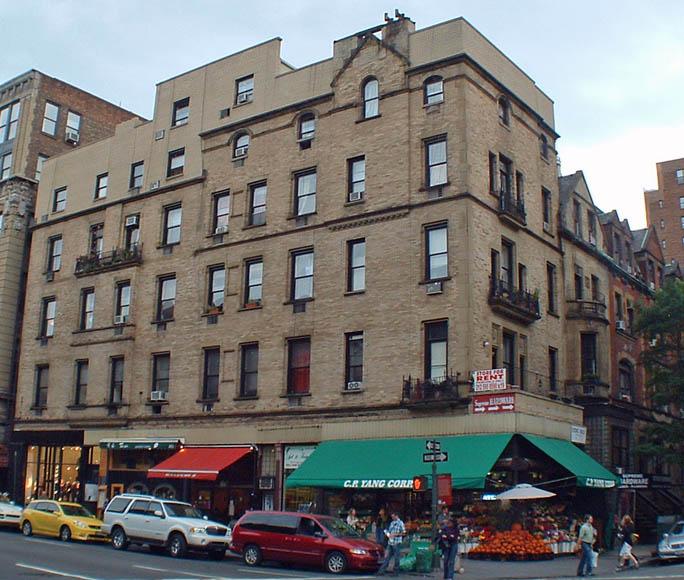
5-story German Renaissance-revival residential building completed in 1884. Designed by Henry J. Hardenbergh, it caps the western end of the row of 18 houses to the east that were also designed by Hardenbergh (only 13 of these row houses remain; the eastern five were replaced by a large apartment building in the 1920s). The facade of No. 67, designed as an apartment building from the beginning, is clad in yellow-beige brick and terra-cotta above a ground floor lined with metal-and-glass storefronts. Originally the building culminated in a large hipped roof with gables and chimneys, at the south end which added interest to its profile and differentiated it dramatically from from the row houses extending to the east.
The residential entrance is at the east end of the south facade on 73rd Street. It has paneled wood-and-glass double-doors atop a small stoop, flanked by carved pilasters and set below a fanlight in a round arch. The ground-floor storefront to the left projects out some from the rest of the south facade, and is capped by a stone coping and metal railing covered with foliage. The upper floors have stone quoins at the corners. The 2nd-4th floors are organized into a tripartite bay on the left, and a single-window bay on the right. The side windows in the tripartite bay are not only narrower, but also shorter than the center windows. At the 2nd floor, they have tan terra-cotta enframements, and the side windows are topped by square terra-cotta panels with carved faces. There are also tan terra-cotta enframements at the 3rd floor, where the upper corners of the windows are rounded, and a shallow stone balcony has a wrought-iron railing; there is carved foliate ornament on the underside of the balcony. The 4th floor, set off by a string course, has a smaller balcony fronting only the center window of the tripartite bay. At the 5th floor both bays have a small, arched window, with another string course near its top, and a stone cornice above. A more contemporary vertical extension of beige brick rises to a stone coping.
The longer west facade on the avenue is roughly divided into two sections. The original part of the south section is taller; it has a single-window bay at the south end, followed by two more single-windows (the first one narrower), and a bay of paired windows. There are terra-cotta lintels on all but the 2nd bay of windows. A string course runs below the 4th floor, underlined by a row of rosette-like carvings at the 2nd floor, which projects slightly at the 4th-5th floors. There are recessed rectangular brick panels between the paired windows at the 2nd-4th floors, and all four bays have a small round-arched window at the 5th floor, taller at the projecting 2nd bay, which culminates in a gable with a stone cornice extending to either side.
The shorter north section has four bays of single-windows, with the middle two slightly projecting at the 2nd-3rd floors, topped by a dentiled cornice with a wrought-iron railing above. Above the stone cornice, the newer extension of lighter-colored brick has another floor of four single-windows. This newer vertical extension runs across the entire facade, and is stepped up higher at the center, where there are two single-windows at an attic level. The stepped-up center section and both ends are capped by stone copings.
The building contains 24 apartment units. The ground floor is occupied by Tenzan restaurant, Angaar Indian restaurant, Central Art Gallery, and C.P. Yang Corp. produce market, with 73rd Street Hardware on the 73rd Street side.
The residential entrance is at the east end of the south facade on 73rd Street. It has paneled wood-and-glass double-doors atop a small stoop, flanked by carved pilasters and set below a fanlight in a round arch. The ground-floor storefront to the left projects out some from the rest of the south facade, and is capped by a stone coping and metal railing covered with foliage. The upper floors have stone quoins at the corners. The 2nd-4th floors are organized into a tripartite bay on the left, and a single-window bay on the right. The side windows in the tripartite bay are not only narrower, but also shorter than the center windows. At the 2nd floor, they have tan terra-cotta enframements, and the side windows are topped by square terra-cotta panels with carved faces. There are also tan terra-cotta enframements at the 3rd floor, where the upper corners of the windows are rounded, and a shallow stone balcony has a wrought-iron railing; there is carved foliate ornament on the underside of the balcony. The 4th floor, set off by a string course, has a smaller balcony fronting only the center window of the tripartite bay. At the 5th floor both bays have a small, arched window, with another string course near its top, and a stone cornice above. A more contemporary vertical extension of beige brick rises to a stone coping.
The longer west facade on the avenue is roughly divided into two sections. The original part of the south section is taller; it has a single-window bay at the south end, followed by two more single-windows (the first one narrower), and a bay of paired windows. There are terra-cotta lintels on all but the 2nd bay of windows. A string course runs below the 4th floor, underlined by a row of rosette-like carvings at the 2nd floor, which projects slightly at the 4th-5th floors. There are recessed rectangular brick panels between the paired windows at the 2nd-4th floors, and all four bays have a small round-arched window at the 5th floor, taller at the projecting 2nd bay, which culminates in a gable with a stone cornice extending to either side.
The shorter north section has four bays of single-windows, with the middle two slightly projecting at the 2nd-3rd floors, topped by a dentiled cornice with a wrought-iron railing above. Above the stone cornice, the newer extension of lighter-colored brick has another floor of four single-windows. This newer vertical extension runs across the entire facade, and is stepped up higher at the center, where there are two single-windows at an attic level. The stepped-up center section and both ends are capped by stone copings.
The building contains 24 apartment units. The ground floor is occupied by Tenzan restaurant, Angaar Indian restaurant, Central Art Gallery, and C.P. Yang Corp. produce market, with 73rd Street Hardware on the 73rd Street side.
Nearby cities:
Coordinates: 40°46'41"N 73°58'40"W
- 18-52 West 74th Street
- 41-65 West 73rd Street
- The Olcott 0.1 km
- Mayfair Towers Apartments 0.1 km
- Park Royal 0.1 km
- The San Remo 0.2 km
- The Majestic 0.2 km
- The Dakota 0.2 km
- 40-58 West 70th Street 0.3 km
- Park Millennium 0.5 km
- Lincoln Square 0.7 km
- Manhattan 0.7 km
- Upper West Side 1 km
- Central Park 1.2 km
- Upper East Side 1.7 km
- Hell's Kitchen (Clinton) 2.2 km
- Midtown (Manhattan, NY) 3.2 km
- Hudson County, New Jersey 10 km
- Queens 17 km
- The Palisades 20 km