
The Dakota
USA /
New Jersey /
West New York /
West 72nd Street, 1
World
/ USA
/ New Jersey
/ West New York
World / United States / New York
NRHP - National Register of Historic Places, interesting place, apartment building, 1884_construction, movie / film / TV location, historic landmark, housing cooperative, Renaissance Revival (architecture)


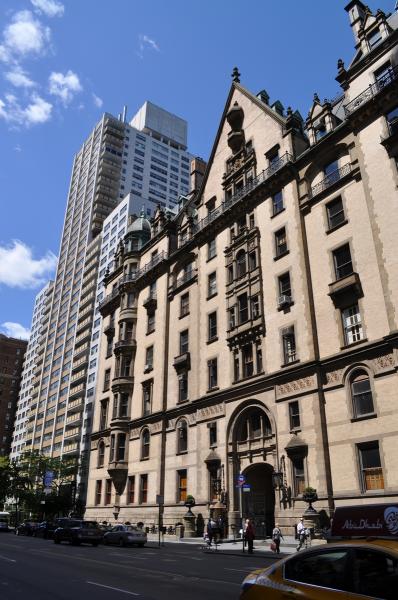
9.5-story German Renaissance-revival cooperative-apartment building completed in 1884. Designed by Henry Janeway Hardenbergh, its location was criticized because it was built so far out in the country and away from the core of the city that it "might as well have been in the Dakota Territory." Owner and developer Edward Cabot Clark thumbed his nose at his critics by naming the building "The Dakota", but the more likely reasoning for the name was due to Clark's interest in naming many things on the Upper West Side after Western states and territories. It turned out as an immediate success with all its apartments rented on opening day. At the time of completion, it was still surrounded by unpaved streets and vacant lots.
One of the city's most legendary apartment buildings, it is a massive, fortress-like building with a large center courtyard. It has been described as being in the German Renaissance, Chateauesque, Brewery Brick, and even “Victorian Kremlin" styles. The four corners of the courtyard, which has a fountain, lead to separate lobbies and passenger elevators. (Service elevators run up the middle of each side of the building.) The basement moat surround all three main facades of the building is enclosed by an iron fence between low, thick stone posts and on a stone base, with each segment featuring two iron dragons wrapping around the horizontal beam and a central keystone-shaped element with bearded face. The facades are clad in light yellow-tan brick with darker masonry trim and terra-cotta ornament above a rusticated stone basement level, where the walls are 28 inches thick.
All three principal elevations have three horizontal divisions: the base, consisting of two stories and basement, the shaft of four floors, and the crown, or roof with its multiplicity of gables and dormers. At the top of the 2nd floor, and separating the base from the shaft, is a wide band course consisting of handsomely carved panels. Around the basement is a dry moat.
The arched main entrance centered on 72nd Street is a porte-cochère large enough for the horse-drawn carriages that once entered and allowed passengers to disembark sheltered from the weather. tanding just outside the archway (to the left) is a bronze gatehouse. The entry into the courtyard is through wrought-iron gates in a segmental-arched opening; the stone pilasters with Renaissance ornament framing the entryway continue up through the 2nd floor, where there is a tripartite window and round-arch. The three window segments are separated by spiral colonnettes, and there are also carved panels below each segment. Flanking the pilasters are original, paired, black iron gas lamps.
On either side of the main entrance, there is a narrow window framed by paneled stone pilasters and topped by a semi-conical crown with rows of wave motifs. There are small windows at the 2nd floor, flanking the round-arch. All of the windows have keyed stone surrounds. Farther to the outside are two bays that are slightly recessed, both having wide windows, round-arched at the 2nd floor. Continuing outward to the end pavilions, the ground floor has two bays of double-windows at the 1st floor, and at the 2nd floor are two round-arched windows flanking the base of a bay of projecting, semi-circular oriel windows that runs up the 7th floor. The oriels have three narrow windows on each floor, with various stone cornices between floors. A segmental-arched basement window corresponds to each bay. Square-headed windows are located on the rest of the upper floors, with a bay of elaborate tripartite windows above the entry arch.
Boldly accenting the facade at the 7th floor level and connecting the shaft with the crown is an ornately bracketed cornice, with a decorative metal railing, wrapping around the curved oriel bays. The two recessed bays set back above the 6th floor, where they have end pilasters joined by segmental-arches, and a separate metal railing between them at the base of the windows; these bays have dormer windows at the 7th floor with peaked roofs. The middle section has a large gable rising above the 7th floor, with tripartite windows continuing at the center on the 8th & 9th floors, but with the center panel on the 9th floor replaced by a diamond-shaped terra-cotta panel with the face of a Dakota Indian. Above these, near the apex of the gable, is a niche with a projecting base and hood. The end pavilions are both have octagonal copper turrets at the 8th floor capping the oriel bays, crowned by steep, shingled domes with short spires. The tall, east-and-west facing gables rising behind and to the sides are pierced by a dormer on either side of the turrets. At the 9th floor there are five smaller peaked dormers - a single one at the inner edge, and then two pairs farther outside. Pairs of smaller dormers also flank the central gable. At both ends of the west pavilion, and the west end of the east pavilion, chimneys rise up to the ridge line. At the south edge of the central gable's east and west elevations, the slate shingles are broken by peaked dormers at the 8th, 9th, & 10th floors.
The east facade facing Central Park has two bays at each of the end pavilions, a tripartite bay in the center, flanked by a bay of narrow windows on either side, and slightly-recessed sections in between, each with two window bays. The design of the base carries over to this facade, with round-arched 2nd-floor windows and a stone-and-terra-cotta band course. At the end pavilions, the 2nd-floor windows have small, rounded, stone balconettes with metal raillings. There are also small, boxy stone balconettes at these bays on the 4th floor, fronted by carved stone walls, and with a curved iron railing in between. Niches are located between the 4th-floor windows at both pavilions, and there are also balconettes at the 5th floor, with metal railings between the stone end posts. At the center bay the 4th & 5th floors have projecting, stone tripartite bays with narrow, rounded end sections.
Both end pavilions end in large gables. The recessed sections between the central and end pavilions have dormers at the 7th & 8th floors, and the center section is crowned by a pyramidal mansard topped by a flagpole. This mansard is peppered with dormers and has a projecting section in front narrowing to a finial.
There is also a rear entrance on 73rd Street with a stone bridge crossing the moat that is set behind an iron gate. Above it is a narrow opening extending up to the 7th floor, where there is a window bay joining the east and west halves; there is also a round-arched span of the band course above the 2nd floor bridging the gap. The north facade has red brick cladding instead of stone at the basement level, where the windows are round-arched with ornamental iron grilles. A stone band course caps the basement level. To the east of the entrance gap there are four bays of single-windows and an end bay with paired windows; this is matched on the west side except with one extra bay before the end bay. Many of the windows on the upper floors have small rounded stone balconies with metal railings. At the top floors this facade has two gables flanking the center bay, and to the outsides there are three large dormers at the 8th floor, the outer two paired together. Behind and above them rises sections of mansard roof, pierced by smaller dormers at the 9th floor.
The rear, west elevation is clad in red brick and lacks the ornament of the main facades below the 7th floor, although it does have a large number of windows, with simple stone sills and lintels. The 3-story mansard at the top is pierced by many peaked copper dormers and four 2-story brick gables near the center, while the ends form their own large gables, the peaks flanked by pairs of chimneys.
Because elevators were quite new at the time and as was the concept of apartment living for the well-to-do, the eighth and ninth floors of the building were originally used for servants' quarters and laundry and storage rooms, although they would eventually be converted to apartments, and the tenth floor included a roof garden and a children's playroom. The building was converted to a co-op in 1961, with 93 apartments and a notoriously picky co-op board.
This was the residence of John Lennon, Yoko Ono, and their son Sean. On December 8, 1980, at 10:50 pm, John Lennon was shot four times by Mark David Chapman as he passed through the archway on the 72nd Street side of the building. Lennon died a short time later at Roosevelt Hospital. Other famous tenants have included composer/conductor Leonard Bernstein; actors Lauren Bacall, José Ferrer, Judy Garland, Judy Holiday, Boris Karloff and Jason Robards; news anchor Connie Chung and her TV host husband Maury Povich; dancer Rudolf Nureyev; musical stars Roberta Flack and Paul Simon; and football coach/announcer John Madden. The building was also used as the setting for the 1968 film "Rosemary's Baby."
daytoninmanhattan.blogspot.com/2020/09/the-1884-dakota-...
www.youtube.com/watch?v=e4sNfERt41o&ab_channel=Arch...
One of the city's most legendary apartment buildings, it is a massive, fortress-like building with a large center courtyard. It has been described as being in the German Renaissance, Chateauesque, Brewery Brick, and even “Victorian Kremlin" styles. The four corners of the courtyard, which has a fountain, lead to separate lobbies and passenger elevators. (Service elevators run up the middle of each side of the building.) The basement moat surround all three main facades of the building is enclosed by an iron fence between low, thick stone posts and on a stone base, with each segment featuring two iron dragons wrapping around the horizontal beam and a central keystone-shaped element with bearded face. The facades are clad in light yellow-tan brick with darker masonry trim and terra-cotta ornament above a rusticated stone basement level, where the walls are 28 inches thick.
All three principal elevations have three horizontal divisions: the base, consisting of two stories and basement, the shaft of four floors, and the crown, or roof with its multiplicity of gables and dormers. At the top of the 2nd floor, and separating the base from the shaft, is a wide band course consisting of handsomely carved panels. Around the basement is a dry moat.
The arched main entrance centered on 72nd Street is a porte-cochère large enough for the horse-drawn carriages that once entered and allowed passengers to disembark sheltered from the weather. tanding just outside the archway (to the left) is a bronze gatehouse. The entry into the courtyard is through wrought-iron gates in a segmental-arched opening; the stone pilasters with Renaissance ornament framing the entryway continue up through the 2nd floor, where there is a tripartite window and round-arch. The three window segments are separated by spiral colonnettes, and there are also carved panels below each segment. Flanking the pilasters are original, paired, black iron gas lamps.
On either side of the main entrance, there is a narrow window framed by paneled stone pilasters and topped by a semi-conical crown with rows of wave motifs. There are small windows at the 2nd floor, flanking the round-arch. All of the windows have keyed stone surrounds. Farther to the outside are two bays that are slightly recessed, both having wide windows, round-arched at the 2nd floor. Continuing outward to the end pavilions, the ground floor has two bays of double-windows at the 1st floor, and at the 2nd floor are two round-arched windows flanking the base of a bay of projecting, semi-circular oriel windows that runs up the 7th floor. The oriels have three narrow windows on each floor, with various stone cornices between floors. A segmental-arched basement window corresponds to each bay. Square-headed windows are located on the rest of the upper floors, with a bay of elaborate tripartite windows above the entry arch.
Boldly accenting the facade at the 7th floor level and connecting the shaft with the crown is an ornately bracketed cornice, with a decorative metal railing, wrapping around the curved oriel bays. The two recessed bays set back above the 6th floor, where they have end pilasters joined by segmental-arches, and a separate metal railing between them at the base of the windows; these bays have dormer windows at the 7th floor with peaked roofs. The middle section has a large gable rising above the 7th floor, with tripartite windows continuing at the center on the 8th & 9th floors, but with the center panel on the 9th floor replaced by a diamond-shaped terra-cotta panel with the face of a Dakota Indian. Above these, near the apex of the gable, is a niche with a projecting base and hood. The end pavilions are both have octagonal copper turrets at the 8th floor capping the oriel bays, crowned by steep, shingled domes with short spires. The tall, east-and-west facing gables rising behind and to the sides are pierced by a dormer on either side of the turrets. At the 9th floor there are five smaller peaked dormers - a single one at the inner edge, and then two pairs farther outside. Pairs of smaller dormers also flank the central gable. At both ends of the west pavilion, and the west end of the east pavilion, chimneys rise up to the ridge line. At the south edge of the central gable's east and west elevations, the slate shingles are broken by peaked dormers at the 8th, 9th, & 10th floors.
The east facade facing Central Park has two bays at each of the end pavilions, a tripartite bay in the center, flanked by a bay of narrow windows on either side, and slightly-recessed sections in between, each with two window bays. The design of the base carries over to this facade, with round-arched 2nd-floor windows and a stone-and-terra-cotta band course. At the end pavilions, the 2nd-floor windows have small, rounded, stone balconettes with metal raillings. There are also small, boxy stone balconettes at these bays on the 4th floor, fronted by carved stone walls, and with a curved iron railing in between. Niches are located between the 4th-floor windows at both pavilions, and there are also balconettes at the 5th floor, with metal railings between the stone end posts. At the center bay the 4th & 5th floors have projecting, stone tripartite bays with narrow, rounded end sections.
Both end pavilions end in large gables. The recessed sections between the central and end pavilions have dormers at the 7th & 8th floors, and the center section is crowned by a pyramidal mansard topped by a flagpole. This mansard is peppered with dormers and has a projecting section in front narrowing to a finial.
There is also a rear entrance on 73rd Street with a stone bridge crossing the moat that is set behind an iron gate. Above it is a narrow opening extending up to the 7th floor, where there is a window bay joining the east and west halves; there is also a round-arched span of the band course above the 2nd floor bridging the gap. The north facade has red brick cladding instead of stone at the basement level, where the windows are round-arched with ornamental iron grilles. A stone band course caps the basement level. To the east of the entrance gap there are four bays of single-windows and an end bay with paired windows; this is matched on the west side except with one extra bay before the end bay. Many of the windows on the upper floors have small rounded stone balconies with metal railings. At the top floors this facade has two gables flanking the center bay, and to the outsides there are three large dormers at the 8th floor, the outer two paired together. Behind and above them rises sections of mansard roof, pierced by smaller dormers at the 9th floor.
The rear, west elevation is clad in red brick and lacks the ornament of the main facades below the 7th floor, although it does have a large number of windows, with simple stone sills and lintels. The 3-story mansard at the top is pierced by many peaked copper dormers and four 2-story brick gables near the center, while the ends form their own large gables, the peaks flanked by pairs of chimneys.
Because elevators were quite new at the time and as was the concept of apartment living for the well-to-do, the eighth and ninth floors of the building were originally used for servants' quarters and laundry and storage rooms, although they would eventually be converted to apartments, and the tenth floor included a roof garden and a children's playroom. The building was converted to a co-op in 1961, with 93 apartments and a notoriously picky co-op board.
This was the residence of John Lennon, Yoko Ono, and their son Sean. On December 8, 1980, at 10:50 pm, John Lennon was shot four times by Mark David Chapman as he passed through the archway on the 72nd Street side of the building. Lennon died a short time later at Roosevelt Hospital. Other famous tenants have included composer/conductor Leonard Bernstein; actors Lauren Bacall, José Ferrer, Judy Garland, Judy Holiday, Boris Karloff and Jason Robards; news anchor Connie Chung and her TV host husband Maury Povich; dancer Rudolf Nureyev; musical stars Roberta Flack and Paul Simon; and football coach/announcer John Madden. The building was also used as the setting for the 1968 film "Rosemary's Baby."
daytoninmanhattan.blogspot.com/2020/09/the-1884-dakota-...
www.youtube.com/watch?v=e4sNfERt41o&ab_channel=Arch...
Wikipedia article: http://en.wikipedia.org/wiki/The_Dakota
Nearby cities:
Coordinates: 40°46'36"N 73°58'34"W
- The Majestic 0.1 km
- Mayfair Towers Apartments 0.1 km
- The Olcott 0.2 km
- Park Royal 0.2 km
- The San Remo 0.2 km
- 18-52 West 74th Street 0.2 km
- 41-65 West 73rd Street 0.2 km
- 40-58 West 70th Street 0.3 km
- 191-199 Columbus Avenue 0.4 km
- Park Millennium 0.5 km
- Manhattan 0.6 km
- Lincoln Square 0.8 km
- Upper West Side 1.1 km
- Central Park 1.1 km
- Upper East Side 1.6 km
- Hell's Kitchen (Clinton) 2.2 km
- Midtown (Manhattan, NY) 3.1 km
- Hudson County, New Jersey 10 km
- Queens 17 km
- The Palisades 21 km
Comments