
Tweed Courthouse
USA /
New Jersey /
Hoboken /
Chambers Street, 52
World
/ USA
/ New Jersey
/ Hoboken
World / United States / New York
office building, administrative building, Neoclassical (architecture), local government, 1881_construction

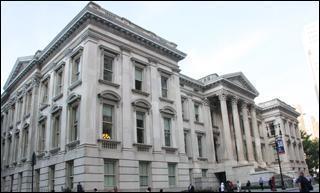
3.5-story Neo-Classical (American Victorian) courthouse completed in 1881. Designed by John Kellum and Leopold Eidlitz, it was the first permanent government building erected by the City after the completion of City Hall.
The building sits on a low granite curb with a rusticated marble basement. Above, the walls are faced in white marble ashlar. The building is composed of a central section with two projecting wings, with an addition in the center on the south facade. The main facade, on Chambers Street, is composed of a central block with a monumental pedimented portico and two flanking bays. Each bay and both wings are three windows wide. The entrance is marked by the triangular pedimented portico with dentils and modillions, supported by four massive Corinthian columns, which dominates the facade. It rises from the granite stairway, which was altered and shortened in 1942 when Chambers Street was widened. Behind and between the columns, a keystone-arched doorway matches the elaborate scrolled pediments of the two flanking openings. The doorway has Italianate wooden double doors.
The windows have arched and flat stone pediments. Each window has a marble surround, center colonette, and pilasters. The windows on the end wings have the same basic composition but their decoration is more elaborate. Above the base the upper floor windows are separated by pilasters with molded capitals that have a prominent egg-and-dart pattern. The main facade is topped by a massive Corinthian entablature composed of an architrave, frieze and modillioned cornice. There is an octagonal skylight at the roof, replacing a planned dome.
The east and west facades are identical, each composed of three bays, each with three windows, and a triangular pediment topping the center window. The rear, or south, facade is composed of three sections, and is the same as the main facade, except for the center wing. The first floor has a cluster of three arched windows on the east and west facades of the wing, and a door with two windows on either side on the south facade. There is an entryway to the cellar on the west side of the south wing. Clusters of three enriched compound windows ornament the 2nd floor. On the 3rd floor, rectangular windows with foliated banding are separated by pilasters. At the top, attic floor enriched compound-arched windows are separated by pilasters. Foliate belt courses add a layer of horizontal detail to the facades. A chimney with a decorative cap tops this wing.
Officially known as the New York County Courthouse, it is notable not only for the unparalleled artistry of its design and decoration, but also for its association with one of New York’s greatest political scandals. The courthouse is the legacy of Tammany Hall boss William M. Tweed (1823-1878), who used the construction project to embezzle large sums of money from the budget. In 1873 “Boss” Tweed was tried and convicted in an unfinished courtroom in this building and sentenced to 12 years in prison. Afterwards construction proceeded at a very slow pace and it was not until 1881 that the courthouse was finally completed, 20 years after construction first began.
The New York County Supreme Court used the space until 1929, and then the building housed the City Court until 1961, when that court moved to 111 Centre Street. After that, the former courthouse was used as a municipal office building. In 1999, an extensive two-year restoration began to return the building to its original grandeur. Outside, marble cornices were replaced and leaf detail on the Corinthian columns was rebuilt. A new roof was designed to replicate the original, which was discovered to have been made of metal, and skylights were restored. The grand entrance stairway, which had been removed during World War II for the widening of Chambers Street, was rebuilt with the addition of 17 new Vermont granite steps. Today the principal occupant is the NYC Department of Education.
The building sits on a low granite curb with a rusticated marble basement. Above, the walls are faced in white marble ashlar. The building is composed of a central section with two projecting wings, with an addition in the center on the south facade. The main facade, on Chambers Street, is composed of a central block with a monumental pedimented portico and two flanking bays. Each bay and both wings are three windows wide. The entrance is marked by the triangular pedimented portico with dentils and modillions, supported by four massive Corinthian columns, which dominates the facade. It rises from the granite stairway, which was altered and shortened in 1942 when Chambers Street was widened. Behind and between the columns, a keystone-arched doorway matches the elaborate scrolled pediments of the two flanking openings. The doorway has Italianate wooden double doors.
The windows have arched and flat stone pediments. Each window has a marble surround, center colonette, and pilasters. The windows on the end wings have the same basic composition but their decoration is more elaborate. Above the base the upper floor windows are separated by pilasters with molded capitals that have a prominent egg-and-dart pattern. The main facade is topped by a massive Corinthian entablature composed of an architrave, frieze and modillioned cornice. There is an octagonal skylight at the roof, replacing a planned dome.
The east and west facades are identical, each composed of three bays, each with three windows, and a triangular pediment topping the center window. The rear, or south, facade is composed of three sections, and is the same as the main facade, except for the center wing. The first floor has a cluster of three arched windows on the east and west facades of the wing, and a door with two windows on either side on the south facade. There is an entryway to the cellar on the west side of the south wing. Clusters of three enriched compound windows ornament the 2nd floor. On the 3rd floor, rectangular windows with foliated banding are separated by pilasters. At the top, attic floor enriched compound-arched windows are separated by pilasters. Foliate belt courses add a layer of horizontal detail to the facades. A chimney with a decorative cap tops this wing.
Officially known as the New York County Courthouse, it is notable not only for the unparalleled artistry of its design and decoration, but also for its association with one of New York’s greatest political scandals. The courthouse is the legacy of Tammany Hall boss William M. Tweed (1823-1878), who used the construction project to embezzle large sums of money from the budget. In 1873 “Boss” Tweed was tried and convicted in an unfinished courtroom in this building and sentenced to 12 years in prison. Afterwards construction proceeded at a very slow pace and it was not until 1881 that the courthouse was finally completed, 20 years after construction first began.
The New York County Supreme Court used the space until 1929, and then the building housed the City Court until 1961, when that court moved to 111 Centre Street. After that, the former courthouse was used as a municipal office building. In 1999, an extensive two-year restoration began to return the building to its original grandeur. Outside, marble cornices were replaced and leaf detail on the Corinthian columns was rebuilt. A new roof was designed to replicate the original, which was discovered to have been made of metal, and skylights were restored. The grand entrance stairway, which had been removed during World War II for the widening of Chambers Street, was rebuilt with the addition of 17 new Vermont granite steps. Today the principal occupant is the NYC Department of Education.
Wikipedia article: http://en.wikipedia.org/wiki/Tweed_Courthouse
Nearby cities:
Coordinates: 40°42'48"N 74°0'19"W
- One Police Plaza - NYPD Headquarters 0.3 km
- Brookfield Place 1 km
- 55 Water Street 1.1 km
- Dumbo Heights 2 km
- Buildings 11, 11A, 12 & 12A 2.6 km
- 204 Van Dyke Street 4.2 km
- Brooklyn Wholesale Meat Market 7.2 km
- Bayonne Drydock Headquarters/Machine Shop 7.8 km
- Jerhel Plastics 10 km
- Atlas Terminals 12 km
- City Hall Park 0.1 km
- Civic Center 0.2 km
- NYPD Civic Center Security Zone 0.3 km
- TriBeCa 0.7 km
- Financial District 0.8 km
- Lower (Downtown) Manhattan 1.2 km
- Hudson County, New Jersey 6.1 km
- Manhattan 8 km
- Brooklyn 9 km
- Queens 13 km
Comments