
Ivan the Great Bell Tower (Moscow)
Russia /
Moscow /
Moscow /
Kremlyovskaya naberezhnaya
World
/ Russia
/ Moscow
/ Moscow
, 0 km from center (Москва)
World / Russia / Moscow City / Central
belfry, interesting place, Russian Orthodox Church, 16th century construction, object of cultural heritage of federal importance (Russia)
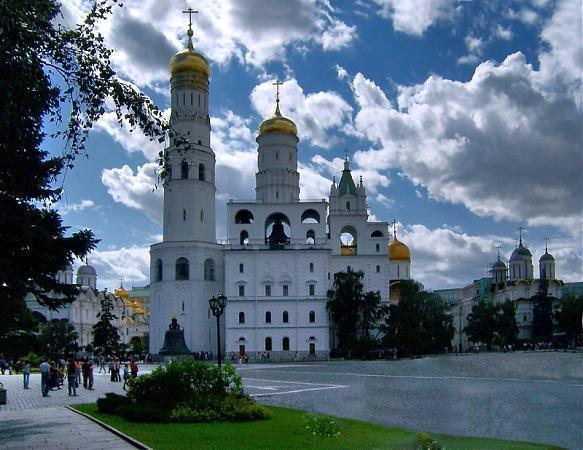


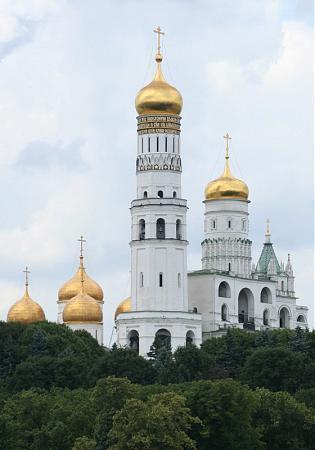

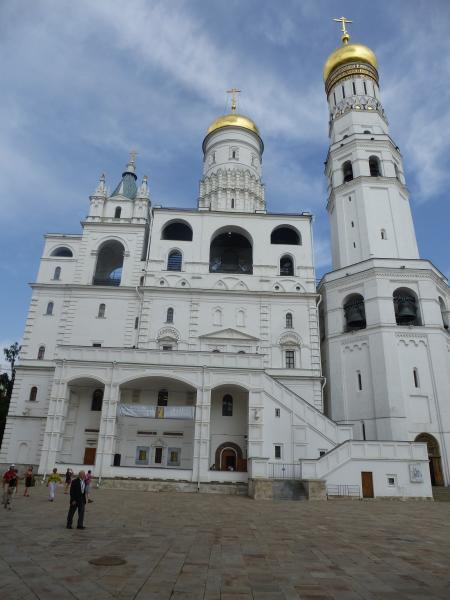
Ivan the Great Bell Tower, but it also includes the Assumption Belfry and Filaret Annex. The strange configuration is the result of having been built in several phases. Moscow's first stone bell tower, affiliated with the Church of St. Ivan of the Ladder under the Bell stood on this site from 1329.
Ivan III ordered the erection of a two-tiered bell tower with a church in 1505 on the site of the former bell tower. When completed by the builder Bon Fryazin (also known as Marco Bon) in 1508, the 60-meter bell tower consisted of two octagonal pillars, one on top of the other, tapering toward the top and crowned by a dome with a circular drum. While the body of the tower is made of brick, the foundation is of white stone. Bon Fryazin is known only to have built one structure in Moscow, but it was built to last. The lower level of the tower rests on 5 meter wide solid brick walls which taper to 2.5 meters at the second tier. Iron reinforcing rods were set in the first tier masonry. The tower survived numerous fires and other disasters, which frequently swept the Kremlin.
At the beginning of the 17th century Boris Godunov ordered the tower extended 21 meters, with additional tiers, as it appears today. The upper octagon was decorated with a double row of kokoshniki. Above this was added a cylindrical drum with false narrow windows painted black. Under the gold dome are three rows of inscription in gilt letters on copper leaf against a blue background. The old Slavonic script states "by the grace of the Holy Trinity and the Tsar and Grand Prince Boris and his son Fyodor said church was built and adorned with gold in 1600."
Some say that it was at this point that the tower got its name of "Great" because of its height of 81 meters. And that Ivan was included in the name because on this site previously had stood a church to St. Ivan Clamacus (Ladder). Others claim that the name can be attributed to Ivan the Great who ordered the first part of the current tower built on this site.
Assumption Belfry is the four-story building with a single dome next to the Bell Tower. Petrok Maly, who was responsible for the Kitai Gorod walls, initially supervised the belfry's construction when it began in 1532. Russian builders completed it in 1543 after his departure. In 1552 a splendid double flight of steps with broad observation platform was built onto the façade of the third tier. From the beginning, the belfry contained a church. At the end of the 18th century the Church of St. Nicholas of Gostunsky was moved into the belfry. Twenty-one bells cast by Russian craftsmen in the 16th-17th centuries hang here. The largest of which, the 64-ton bronze Assumption Bell, traditionally tolled three times when the tsar died. On the instructions of Patriarch Filaret, in 1642 the stonemason Bazhen Ogurtsov attached onto the belfry a new bell tower with a sharp-pointed tent roof. Subsequently, this addition became known as the Filaret Annex.
In 1812 Napoleon's forces heard rumor that the central cross on the Cathedral of the Annunciation had been cast in gold. Legend tells that he confused the cathedral for the Bell Tower whose cross was gilded. French engineers tried but were unable to remove the cross. Then a Russian peasant offered to climb up and using ropes lower the cross to the ground. When he went to Napoleon seeking a reward, Napoleon ordered him shot as a traitor to this country.
Napoleon tried to blow up the bell tower as they retreated from Moscow. The powerful explosion destroyed the two buildings next to it, but the tower itself survived with nothing worse than a crack in its circular drum. Following the design of neoclassical architects Ivan Yegotov (1756-1815) and Luigi Rusca, an Italian known in Russian as Aloizy Ivanovich Rusca (1762-1822), the Swiss architect Domenico Ivanovich Gilardi (1785-1845) restored the Belfry and Annex. Since no documents have survived to show what these buildings looked like before their restoration, it can only be assumed that they were reproduced as closely as possible to the originals.
Ivan III ordered the erection of a two-tiered bell tower with a church in 1505 on the site of the former bell tower. When completed by the builder Bon Fryazin (also known as Marco Bon) in 1508, the 60-meter bell tower consisted of two octagonal pillars, one on top of the other, tapering toward the top and crowned by a dome with a circular drum. While the body of the tower is made of brick, the foundation is of white stone. Bon Fryazin is known only to have built one structure in Moscow, but it was built to last. The lower level of the tower rests on 5 meter wide solid brick walls which taper to 2.5 meters at the second tier. Iron reinforcing rods were set in the first tier masonry. The tower survived numerous fires and other disasters, which frequently swept the Kremlin.
At the beginning of the 17th century Boris Godunov ordered the tower extended 21 meters, with additional tiers, as it appears today. The upper octagon was decorated with a double row of kokoshniki. Above this was added a cylindrical drum with false narrow windows painted black. Under the gold dome are three rows of inscription in gilt letters on copper leaf against a blue background. The old Slavonic script states "by the grace of the Holy Trinity and the Tsar and Grand Prince Boris and his son Fyodor said church was built and adorned with gold in 1600."
Some say that it was at this point that the tower got its name of "Great" because of its height of 81 meters. And that Ivan was included in the name because on this site previously had stood a church to St. Ivan Clamacus (Ladder). Others claim that the name can be attributed to Ivan the Great who ordered the first part of the current tower built on this site.
Assumption Belfry is the four-story building with a single dome next to the Bell Tower. Petrok Maly, who was responsible for the Kitai Gorod walls, initially supervised the belfry's construction when it began in 1532. Russian builders completed it in 1543 after his departure. In 1552 a splendid double flight of steps with broad observation platform was built onto the façade of the third tier. From the beginning, the belfry contained a church. At the end of the 18th century the Church of St. Nicholas of Gostunsky was moved into the belfry. Twenty-one bells cast by Russian craftsmen in the 16th-17th centuries hang here. The largest of which, the 64-ton bronze Assumption Bell, traditionally tolled three times when the tsar died. On the instructions of Patriarch Filaret, in 1642 the stonemason Bazhen Ogurtsov attached onto the belfry a new bell tower with a sharp-pointed tent roof. Subsequently, this addition became known as the Filaret Annex.
In 1812 Napoleon's forces heard rumor that the central cross on the Cathedral of the Annunciation had been cast in gold. Legend tells that he confused the cathedral for the Bell Tower whose cross was gilded. French engineers tried but were unable to remove the cross. Then a Russian peasant offered to climb up and using ropes lower the cross to the ground. When he went to Napoleon seeking a reward, Napoleon ordered him shot as a traitor to this country.
Napoleon tried to blow up the bell tower as they retreated from Moscow. The powerful explosion destroyed the two buildings next to it, but the tower itself survived with nothing worse than a crack in its circular drum. Following the design of neoclassical architects Ivan Yegotov (1756-1815) and Luigi Rusca, an Italian known in Russian as Aloizy Ivanovich Rusca (1762-1822), the Swiss architect Domenico Ivanovich Gilardi (1785-1845) restored the Belfry and Annex. Since no documents have survived to show what these buildings looked like before their restoration, it can only be assumed that they were reproduced as closely as possible to the originals.
Wikipedia article: http://en.wikipedia.org/wiki/Ivan_the_Great_Bell_Tower
Nearby cities:
Coordinates: 55°45'2"N 37°37'5"E
- The Church of St. Sophia Bell-Tower 0.3 km
- Belltower of the Znamensky Cathedral, part of the former Monastery of Our Lady of the Sign 0.6 km
- Moscow Bell Center 1.1 km
- Church of the Life-Giving Trinity in the Serebryankiy (Silversmith Quarters) with the Bell Tower and Church of the Beheading of John the Baptist 1.6 km
- Bell Tower of the Church of the Ascension at Nikitsky Gate 1.7 km
- Over the gate church of the Intercession 1.9 km
- Bell Tower of the Church of St. Sergius of Radonezh of the Novospassky Monastery 3.2 km
- Bell Tower 3.6 km
- Bell Tower with two Churches 4.7 km
- Church of Feast of the Ascension 10 km
- Moscow Kremlin 0.1 km
- Zemlyanoy Gorod 0.2 km
- Tsentralny Administrative Okrug 0.4 km
- Bely Gorod ('The White Town') 0.6 km
- Kitay-gorod 0.6 km
- Balchug Island 1.4 km
- Zamoskvorechye District 2.1 km
- Tverskoy District 2.3 km
- Yakimanka District 2.5 km
- Basmanny District 3.7 km