
North Michigan Ave. Lift Bridge (Buffalo, New York)
USA /
New York /
Buffalo /
Buffalo, New York
World
/ USA
/ New York
/ Buffalo
World / United States / Ohio
bridge
Add category
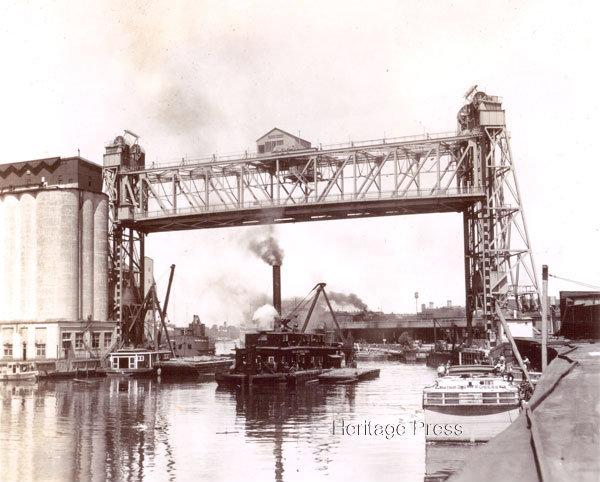
First spanned in the early 1870's, the Michigan Avenue Bridge provided a crossing point between the rapidly developing Buffalo mainland waterfront with the myriad of canals and islands which now form Kelly's Island. Initially required to be high enough to allow canal barges to pass beneath, the North Michigan Avenue Bridge was quickly made obsolete as increasingly large sail and steam powered ships began venturing further and further up the Buffalo River.
Replaced with a dual-leaf bascule bridge before the turn of the century, the bridge was essentially worn out after only 30 years of heavy service and harsh winters and was replaced by a steel single-span lift bridge in 1930. This fully modern bridge operated for 29 years and saw its way through the 1958 shipping season before heavy ice conditions closed the Buffalo River for the winter in January 1959. Placed in its typical reduced manning status for the slower winter months, the bridge was unmanned on the night of January 21st, 1959 when gale force winds began to lash the Buffalo waterfront.
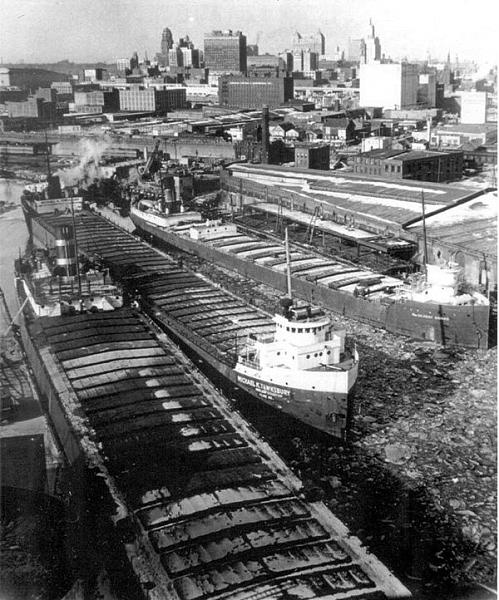
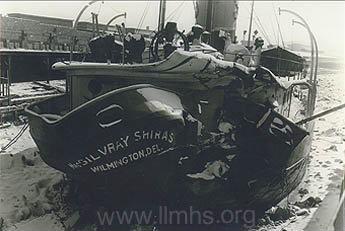
When combined with a sudden freeze/thaw snap and resultant ice jams on the winding Buffalo River, the winds and ice proved to be too much force for the mooring wires of the laid-up steamship MacGilvary Shiras to handle as she was berthed at the Concrete Central Elevator. Uprooting her bollards and snapping her lines, the Shiras moved through the sharp turns of the Buffalo River alone until she collided with the steamship Michael K. Tewksbury, similarly laid up at the Standard Elevator. Alert bridge operators at the Ohio Street Lift Bridge managed to get their span up as the two ships miraculously maneuvered their way through the 90-degree turn at Ohio Street and made straight for the Michigan Street Bridge, which despite efforts by the Ohio St bridge crew was unable to be raised in time.
Struck first by the Shiras and then by the Tewksbury, the center span of the Michigan Street Bridge was ripped off and fell into the Buffalo River, trapping both ships in mid-stream. The East Tower of the bridge collapsed to the North, crushing a small building and landing in front of the Buffalo Fireboat Edward M. Cotter, trapping it in its berth. The West Tower remained standing for several days after the accident, but in its severely damaged state it eventually collapsed into the Buffalo River.
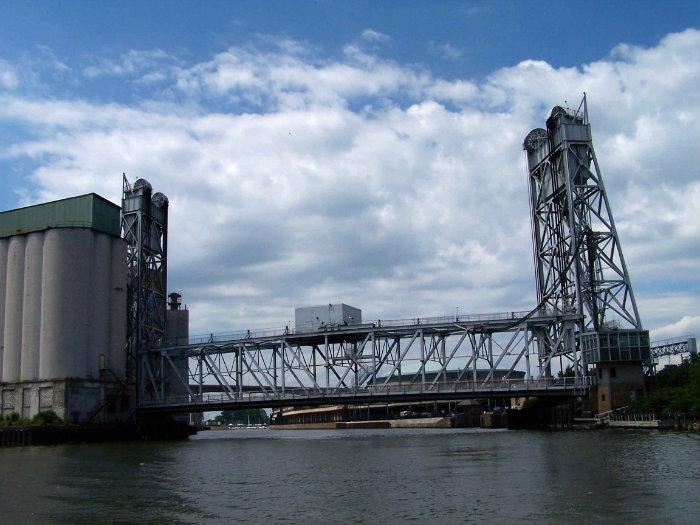
The accident caused millions of dollars in damages to ships, the bridge and cost millions more and several weeks of round-the-clock salvage efforts to clear the waterway in frigid winter conditions. With the matter still being fought over in several courts, the city of Buffalo raced to construct a new North Michigan Ave. Lift Bridge, and construction began on the current span in 1960.
Completed in time for the end of the 1960 shipping season, the current lift bridge is a single-span lift bridge with a total span of 245.7ft, a 37.7ft wide deck and offers clearances of 14ft above MHW when closed and 100ft when open.
Replaced with a dual-leaf bascule bridge before the turn of the century, the bridge was essentially worn out after only 30 years of heavy service and harsh winters and was replaced by a steel single-span lift bridge in 1930. This fully modern bridge operated for 29 years and saw its way through the 1958 shipping season before heavy ice conditions closed the Buffalo River for the winter in January 1959. Placed in its typical reduced manning status for the slower winter months, the bridge was unmanned on the night of January 21st, 1959 when gale force winds began to lash the Buffalo waterfront.
When combined with a sudden freeze/thaw snap and resultant ice jams on the winding Buffalo River, the winds and ice proved to be too much force for the mooring wires of the laid-up steamship MacGilvary Shiras to handle as she was berthed at the Concrete Central Elevator. Uprooting her bollards and snapping her lines, the Shiras moved through the sharp turns of the Buffalo River alone until she collided with the steamship Michael K. Tewksbury, similarly laid up at the Standard Elevator. Alert bridge operators at the Ohio Street Lift Bridge managed to get their span up as the two ships miraculously maneuvered their way through the 90-degree turn at Ohio Street and made straight for the Michigan Street Bridge, which despite efforts by the Ohio St bridge crew was unable to be raised in time.
Struck first by the Shiras and then by the Tewksbury, the center span of the Michigan Street Bridge was ripped off and fell into the Buffalo River, trapping both ships in mid-stream. The East Tower of the bridge collapsed to the North, crushing a small building and landing in front of the Buffalo Fireboat Edward M. Cotter, trapping it in its berth. The West Tower remained standing for several days after the accident, but in its severely damaged state it eventually collapsed into the Buffalo River.
The accident caused millions of dollars in damages to ships, the bridge and cost millions more and several weeks of round-the-clock salvage efforts to clear the waterway in frigid winter conditions. With the matter still being fought over in several courts, the city of Buffalo raced to construct a new North Michigan Ave. Lift Bridge, and construction began on the current span in 1960.
Completed in time for the end of the 1960 shipping season, the current lift bridge is a single-span lift bridge with a total span of 245.7ft, a 37.7ft wide deck and offers clearances of 14ft above MHW when closed and 100ft when open.
Nearby cities:
Coordinates: 42°52'17"N 78°52'22"W
- CP-1 Drawbridge 1.5 km
- CP-DRAW 2 km
- Peace Bridge 5.2 km
- Fort Erie, Ontario - Buffalo, New York Border Crossing (Peace Bridge) 5.5 km
- Interstate 190/Scajaquada Expressway Interchange 7 km
- South Grand Island Bridge 15 km
- Townline Causeway 33 km
- Cattaraugus Creek Bridge and Fishing Spot 39 km
- Chautauqua County Veterans Memorial Bridge 91 km
- Smock Memorial Bridge 174 km
- Buffalo Outer Harbor Park 1 km
- First Ward Neighborhood 1.2 km
- Downtown Buffalo 1.6 km
- Fillmore District 2.3 km
- Ellicott District 2.4 km
- Riverbend Campus 2.9 km
- Tifft Nature Perserve 3 km
- South District 3.2 km
- East Side Neighborhood 3.9 km
- Lovejoy 5.1 km
Comments