
Jackson House (Centre Island, New York)
USA /
New York /
Centre Island /
Centre Island, New York
World
/ USA
/ New York
/ Centre Island
World / United States / New York
residence, Modern (architecture)
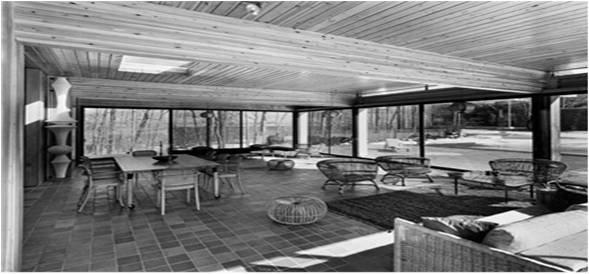
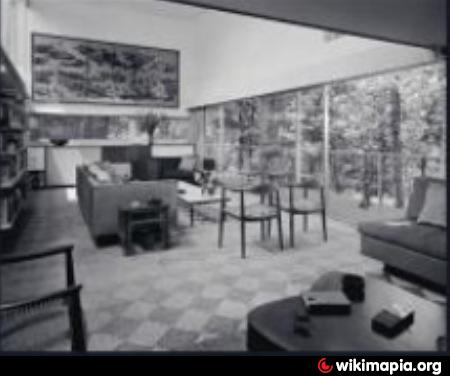
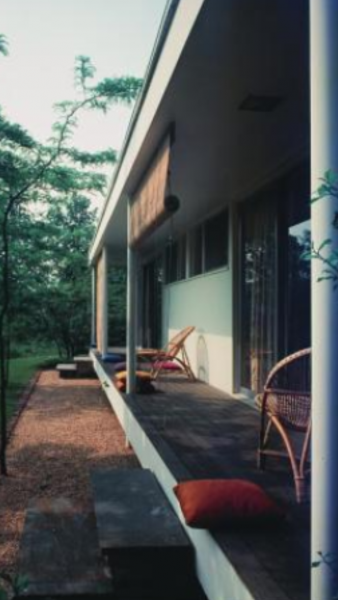
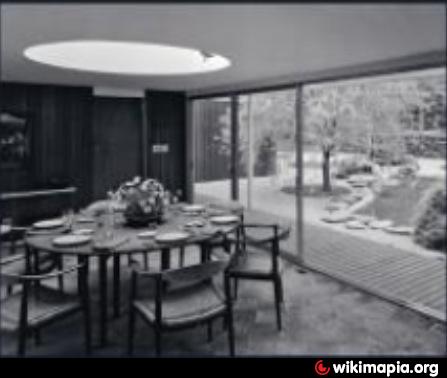

A post-modern home (still extant) built for Mary Livingston Griggs Burke (1916-2012) and Her Husband Jackson Burke (1908-1975) in 1954-1955 to a design by The Architects' Collaborative (TAC).
Mary Griggs Burke's first trip to Japan, in 1954, was spurred by a modernist connection: her acquaintanceship with the German architect Walter Gropius (1883-1969), founder of the pioneering Bauhaus School. Attracted to the architectural principles of the Bauhaus, which stressed open-plan structures and an integrated relationship with the outer environment, she commissioned the design of a country home in the Bauhaus style from architect Ben Thompson, a member of The Architects' Collaborative (TAC) of Cambridge, Massachusetts. Formed by Gropius during his long tenure as chairman of Harvard University's Department of Architecture, TAC was one of the main proponents of Bauhaus design in the United States. Like Frank Lloyd Wright before him, Gropius was strongly influenced by traditional Japanese design, and incorporated many of its principles into Bauhaus concepts.
To complement the clean lines and open design of her country house, situated on a wooded lot bordering Long Island Sound, Mary Griggs Burke and Thompson envisioned creating an adjoining garden in the Japanese style. The attraction of such a garden lay not only in a stylistic affinity with Bauhaus design, but in the way elements of the Japanese garden reflected the owner's personal experience of nature, particularly the moss and pine trees of northern Wisconsin, where she had spent so much of her childhood. She also recalled the way her mother had created a Wisconsin rock garden with a distinct Japanese flavour, echoing features she had seen in her trip to Japan as a young woman.
The Japanese style is evident in the irregular shape of the pond and use of flat rocks around its rim; the island of planting from which a small waterfall issues; and the recirculating stream which runs from the pond under the holly hedge. The path of irregular flat stones and the round grass shapes in the small pebbled surface were inspired by circles made with moss in Samkoin, Kyoto, Japan. There is also a purification basin. The pool house garden has a dry stream with a stone bridge and at the beginning a small memorial (standing stone) to a child with the image of Jizo, the patron saint of children, women in childbirth, and travelers. Above it are two Korean ancestor figures leading the way to the upper garden, which is filled with different varieties of lilacs.
Mary Griggs Burke went on to become the foremost collector of Japanese Art outside of Japan, ultimately bequeathing her collection to the Metropolitan Museum and the Minneapolis Institute of Arts.
Design by: Ben Thompson (architect and landscape architect, 1954-1955); Shogo J. Myaido (architect, 1970); Louis Parenti (gardener, 1954-1962); Charlie Wenger (gardener, 1963-1978); John Grannis (gardener, 1978 to date).
www.thecityreview.com/griggs.html
Mary Griggs Burke's first trip to Japan, in 1954, was spurred by a modernist connection: her acquaintanceship with the German architect Walter Gropius (1883-1969), founder of the pioneering Bauhaus School. Attracted to the architectural principles of the Bauhaus, which stressed open-plan structures and an integrated relationship with the outer environment, she commissioned the design of a country home in the Bauhaus style from architect Ben Thompson, a member of The Architects' Collaborative (TAC) of Cambridge, Massachusetts. Formed by Gropius during his long tenure as chairman of Harvard University's Department of Architecture, TAC was one of the main proponents of Bauhaus design in the United States. Like Frank Lloyd Wright before him, Gropius was strongly influenced by traditional Japanese design, and incorporated many of its principles into Bauhaus concepts.
To complement the clean lines and open design of her country house, situated on a wooded lot bordering Long Island Sound, Mary Griggs Burke and Thompson envisioned creating an adjoining garden in the Japanese style. The attraction of such a garden lay not only in a stylistic affinity with Bauhaus design, but in the way elements of the Japanese garden reflected the owner's personal experience of nature, particularly the moss and pine trees of northern Wisconsin, where she had spent so much of her childhood. She also recalled the way her mother had created a Wisconsin rock garden with a distinct Japanese flavour, echoing features she had seen in her trip to Japan as a young woman.
The Japanese style is evident in the irregular shape of the pond and use of flat rocks around its rim; the island of planting from which a small waterfall issues; and the recirculating stream which runs from the pond under the holly hedge. The path of irregular flat stones and the round grass shapes in the small pebbled surface were inspired by circles made with moss in Samkoin, Kyoto, Japan. There is also a purification basin. The pool house garden has a dry stream with a stone bridge and at the beginning a small memorial (standing stone) to a child with the image of Jizo, the patron saint of children, women in childbirth, and travelers. Above it are two Korean ancestor figures leading the way to the upper garden, which is filled with different varieties of lilacs.
Mary Griggs Burke went on to become the foremost collector of Japanese Art outside of Japan, ultimately bequeathing her collection to the Metropolitan Museum and the Minneapolis Institute of Arts.
Design by: Ben Thompson (architect and landscape architect, 1954-1955); Shogo J. Myaido (architect, 1970); Louis Parenti (gardener, 1954-1962); Charlie Wenger (gardener, 1963-1978); John Grannis (gardener, 1978 to date).
www.thecityreview.com/griggs.html
Nearby cities:
Coordinates: 40°54'44"N 73°31'13"W
- "Eastover Farm" 0.1 km
- 'Applegarth' 0.6 km
- "Shoremonde" 0.9 km
- "Dolonar" 2.9 km
- "Northwood" II 5.1 km
- "Farnsworth" (demolished) 6.3 km
- "Redcote" 6.4 km
- Mill River at Upper Brookville Development 6.7 km
- "Meudon" (demolished) 7.8 km
- Matinecock Point at Glen Cove Development 8.4 km
- Cold Spring Harbor 5 km
- West Neck 5.3 km
- Oyster Bay, New York 5.5 km
- Syosset, New York 11 km
- Town of Huntington 13 km
- Town of North Hempstead 17 km
- Nassau County, New York 19 km
- Westchester County, New York 29 km
- Long Island Sound 38 km
- Suffolk County, New York 71 km