
Cannelton Cotton Mill (Cannelton, Indiana)
USA /
Indiana /
Cannelton /
Cannelton, Indiana
World
/ USA
/ Indiana
/ Cannelton
World / United States / Indiana
NRHP - National Register of Historic Places, 1840s construction, cotton spinning mill, U.S. National Historic Landmark
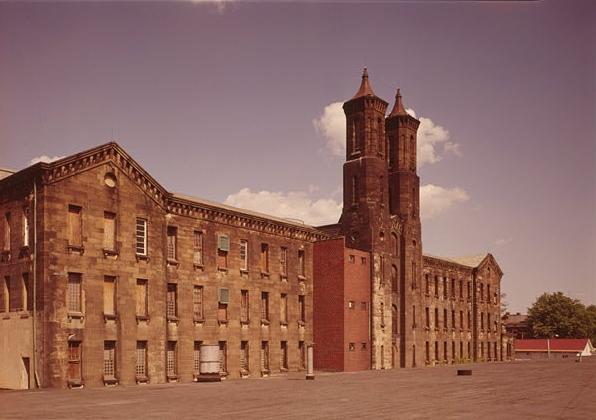

Cannelton Cotton Mill, also known as Indiana Cotton Mill, is a National Historic Landmark of the United States located in Cannelton, Indiana.
Above photos show the mill before and after restoration
History
Construction of the Cannelton Cotton Mill began in 1849 and was completed in 1851. Designed by Rhode Island architect Thomas Alexander Tefft and built of sandstone, the mill was once the largest industrial building in the United States west of the Allegheny Mountains. It initially employed about 400 workers, mostly women and girls, and annually produced more than 200,000 pounds of cotton batting and four million yards of cotton sheeting. During the Civil War, it made uniforms for the Union Army. Of 309 workers employed there in 1890, only 78 were men. As late as 1900, the mill employed 35 girls and 19 boys under the age of 18.
The driving force behind the mill's construction was Hamilton Smith (1804-1875), a prominent attorney from Louisville, Kentucky. Smith's vision was to create a western milling center to rival Lowell, Massachusetts, but using steam-powered machinery fired by locally-produced coal instead of the hydropower that ran the Lowell mills. The task proved too difficult for Smith and his associates, one of whom was Salmon P. Chase, later United States Secretary of the Treasury and Chief Justice of the United States, who became Smith's friend when both were students at Dartmouth College. Another was Indiana federal judge Elisha Mills Huntington. Control of the mill passed in 1851 to brothers Dwight Newcomb (1820-1892) and Horatio Dalton Newcomb (1809 - 1874) who operated it successfully.
The mill closed in 1954. It was listed on the National Register of Historic Places in 1975 and became a National Historic Landmark in 1991. The adaptive restoration of the mill to a 70-unit apartment complex was completed in 2003.
Location and construction
Located facing the Ohio River, the mill is 280 feet long and 60 feet wide. Its most striking features are 100-foot twin towers. One housed a fire escape. The other was for water storage for fire protection. The mill's style is Romanesque, but it was not built as Tefft originally designed it. Tefft's drawings called for each story to have different window heads and for dormer windows in the roof. His plan also called for a stepped foundation. As built, the dormers were eliminated completely and the remaining windows, except for those in the towers, were all capped with square lintels. A half-basement with square windows replaced the stepped foundation. The overall effect is much more severe than Tefft had intended.
Cotton Mill Facts
* Build in 1849
* Cost of over $90,000
* Built of stone
* Three stories high plus attic and basement
* Ceiling height:
Basement - 10'
First and second stories - 13.5'
Third story - 14'
Attic - average 10'
* Wall thickness: 2.5 - 3' wide
Occupation On Each Floor
* Basement: machine shop, weaving and bailing, roller covering
* First Floor: carding and roving
* Second Floor: weaving
* Third Floor: spinning and roving
* Attic: spooling, warping, dressing and drawing in spinning & harness cleansing
Power: Steam
Warmed: Warmed by live steam
Lights: Gas used for lights; manufactured from coal in gas house outside on the premises. Open lights in all rooms except Picker house
Employees: As of August 1, 1890 - 309 (78 of them men)
Value of Machinery: $150,000
Stock: brown sheetings of made cotton (no dyeing done); corn starch sizing prepared by steam only: $13,000
Above photos show the mill before and after restoration
History
Construction of the Cannelton Cotton Mill began in 1849 and was completed in 1851. Designed by Rhode Island architect Thomas Alexander Tefft and built of sandstone, the mill was once the largest industrial building in the United States west of the Allegheny Mountains. It initially employed about 400 workers, mostly women and girls, and annually produced more than 200,000 pounds of cotton batting and four million yards of cotton sheeting. During the Civil War, it made uniforms for the Union Army. Of 309 workers employed there in 1890, only 78 were men. As late as 1900, the mill employed 35 girls and 19 boys under the age of 18.
The driving force behind the mill's construction was Hamilton Smith (1804-1875), a prominent attorney from Louisville, Kentucky. Smith's vision was to create a western milling center to rival Lowell, Massachusetts, but using steam-powered machinery fired by locally-produced coal instead of the hydropower that ran the Lowell mills. The task proved too difficult for Smith and his associates, one of whom was Salmon P. Chase, later United States Secretary of the Treasury and Chief Justice of the United States, who became Smith's friend when both were students at Dartmouth College. Another was Indiana federal judge Elisha Mills Huntington. Control of the mill passed in 1851 to brothers Dwight Newcomb (1820-1892) and Horatio Dalton Newcomb (1809 - 1874) who operated it successfully.
The mill closed in 1954. It was listed on the National Register of Historic Places in 1975 and became a National Historic Landmark in 1991. The adaptive restoration of the mill to a 70-unit apartment complex was completed in 2003.
Location and construction
Located facing the Ohio River, the mill is 280 feet long and 60 feet wide. Its most striking features are 100-foot twin towers. One housed a fire escape. The other was for water storage for fire protection. The mill's style is Romanesque, but it was not built as Tefft originally designed it. Tefft's drawings called for each story to have different window heads and for dormer windows in the roof. His plan also called for a stepped foundation. As built, the dormers were eliminated completely and the remaining windows, except for those in the towers, were all capped with square lintels. A half-basement with square windows replaced the stepped foundation. The overall effect is much more severe than Tefft had intended.
Cotton Mill Facts
* Build in 1849
* Cost of over $90,000
* Built of stone
* Three stories high plus attic and basement
* Ceiling height:
Basement - 10'
First and second stories - 13.5'
Third story - 14'
Attic - average 10'
* Wall thickness: 2.5 - 3' wide
Occupation On Each Floor
* Basement: machine shop, weaving and bailing, roller covering
* First Floor: carding and roving
* Second Floor: weaving
* Third Floor: spinning and roving
* Attic: spooling, warping, dressing and drawing in spinning & harness cleansing
Power: Steam
Warmed: Warmed by live steam
Lights: Gas used for lights; manufactured from coal in gas house outside on the premises. Open lights in all rooms except Picker house
Employees: As of August 1, 1890 - 309 (78 of them men)
Value of Machinery: $150,000
Stock: brown sheetings of made cotton (no dyeing done); corn starch sizing prepared by steam only: $13,000
Wikipedia article: http://en.wikipedia.org/wiki/Cannelton_Cotton_Mill
Nearby cities:
Coordinates: 37°54'41"N 86°44'42"W
- Lincoln Boyhood National Memorial 33 km
- Corydon Battle Site Park 63 km
- Corydon Historic District 64 km
- French Lick Springs Hotel 72 km
- French Lick Springs Resort 72 km
- West Baden Springs Hotel 74 km
- George Rogers Clark Homesite 94 km
- South Guthrie, Tennessee 147 km
- Madison Historic District 150 km
- Ashland Estate 199 km
- Hancock County, Kentucky 11 km
- Tobinsport, Indiana 12 km
- German Ridge Recreation Area 14 km
- Perry County, Indiana 19 km
- Sample, Kentucky 23 km
- Spencer County, Indiana 26 km
- Daviess County, Kentucky 37 km
- Hoosier National Forest 44 km
- Meade County, Kentucky 46 km
- Ohio County, Kentucky 50 km