
550 Madison Avenue
| office building, skyscraper, 1984_construction, postmodern (architecture)
USA /
New Jersey /
West New York /
Madison Avenue, 550
World
/ USA
/ New Jersey
/ West New York
World / United States / New York
office building, skyscraper, 1984_construction, postmodern (architecture)

550madison.com/
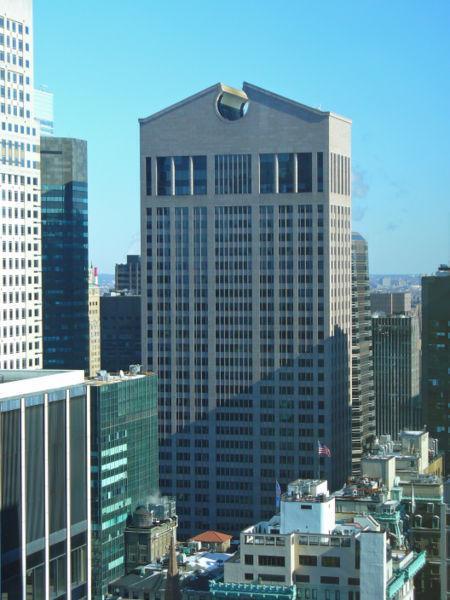
647-foot, 37-story postmodern office building completed in 1984 for the AT&T Corp. Designed by Philip Johnson with Simmons Architects for AT&T, it originally served as the company's headquarters (known as the AT&T Building) until 1992, when it became the US headquarters of Sony. Sony sold the building and moved out in 2016, and it is currently known simply as 550 Madison Avenue.
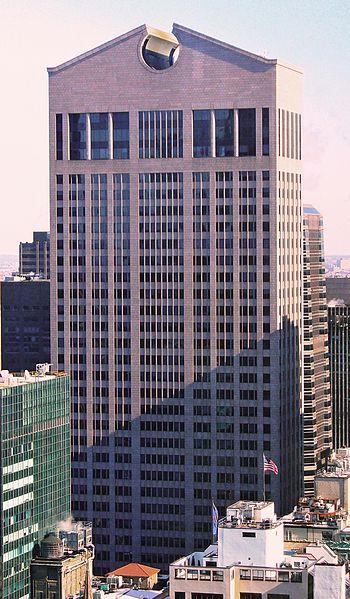
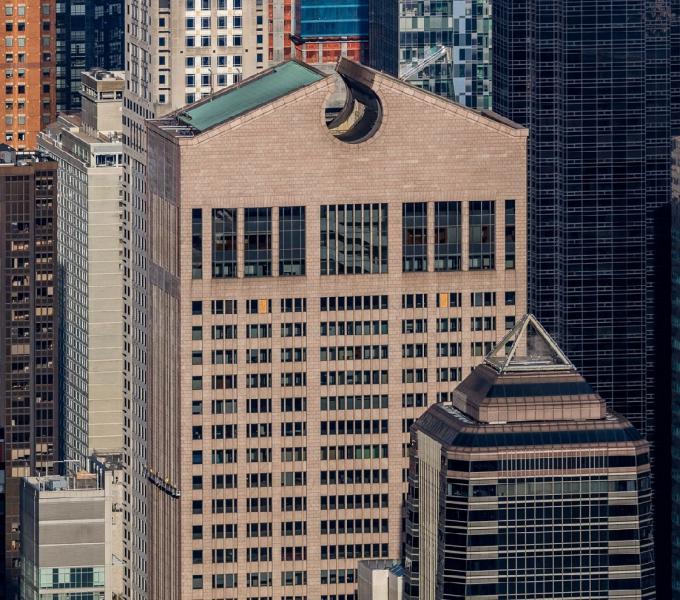
This building is identified as the first major "postmodern" structure. It is clad in greyish-pink granite from the same quarry that supplied the facade facing for Grand Central Terminal. The shape is often likened to a Chippendale highboy, designed by the master 18th century English cabinet-maker, Thomas Chippendale. The tripartite division of the facade is emphasized by a large entrance and pedestrian arcade at the base, a tall shaft with regular windows, and a wide band of windows just below the building's crown.
Although the building rises 647 feet high, it only has 37 floors, a small number for a building that height, because of its 7-story tall lobby, designed to house a large bronze statue: "The Spirit of Communications", by Evelyn L. Batchelder. The 20,000-pound statue formerly occupied AT&T's former headquarters building at 195 Broadway in Lower Manhattan. The statue was eventually moved out of the lobby after AT&T left the building in 1992; it now sits at AT&T's headquarters in New Jersey.
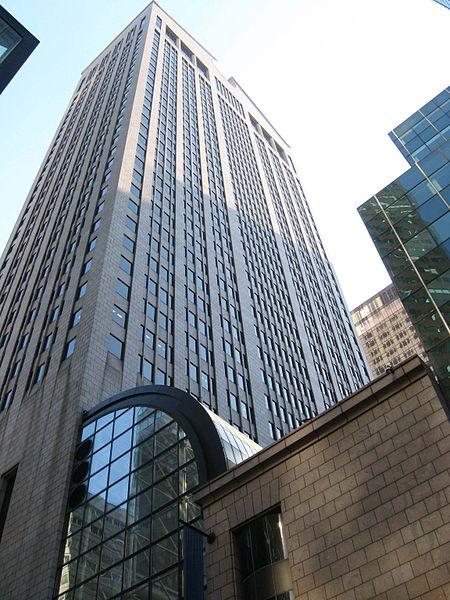
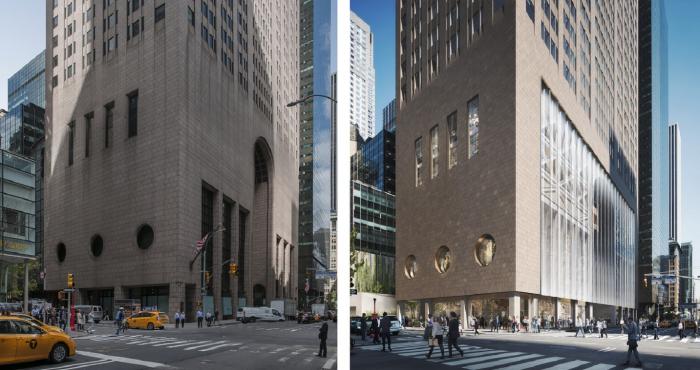
At the base there is an arcade at both the north and south ends, with the avenue frontage dominated by a large 4-story colonnade with a monumental, 7-story, recessed arch at the center. The rear wall of the recessed arch has a cross-hatched masonry pattern framing a 4-story round-arch of metal-and-glass infill that matches the height of the three bays on either side, which also have matching metal-and-glass infill. Above is a very large oculus window with the same style of metal framing. At the ground floor, the three bays on either side of the grand central arch have projecting storefronts. On the north and south facades, above the ground-floor arcades, there are three large porthole openings that originally allowed light into the lobby, but later were filled by metal vents. Above these, at the top of the base, are four narrow, 2-story window openings.
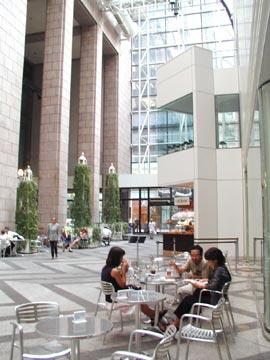
The open-air plaza behind the tower, connecting 55th to 56th streets, never succeeded as a public space and was converted to an enclosed retail arcade space when Sony purchased the building. The glass cladding has an arched top connecting to the top of the base of the tower. On the other side of the retail plaza is a 3-story annex structure, clad in the same granite as the tower.
Above the base, the shaft of the tower has vertical bands of windows. The center band is the widest, flanked by three narrower bands on either side, and single-window bays at the ends. The narrower north and south facades have four tripartite window bays flanked by single-window end bays. Just below the pedimented top, the upper floors have 3-story bands of windows in a similar configuration to those below, but with fewer of the thin metal mullions on most of the bays.
647-foot, 37-story postmodern office building completed in 1984 for the AT&T Corp. Designed by Philip Johnson with Simmons Architects for AT&T, it originally served as the company's headquarters (known as the AT&T Building) until 1992, when it became the US headquarters of Sony. Sony sold the building and moved out in 2016, and it is currently known simply as 550 Madison Avenue.
This building is identified as the first major "postmodern" structure. It is clad in greyish-pink granite from the same quarry that supplied the facade facing for Grand Central Terminal. The shape is often likened to a Chippendale highboy, designed by the master 18th century English cabinet-maker, Thomas Chippendale. The tripartite division of the facade is emphasized by a large entrance and pedestrian arcade at the base, a tall shaft with regular windows, and a wide band of windows just below the building's crown.
Although the building rises 647 feet high, it only has 37 floors, a small number for a building that height, because of its 7-story tall lobby, designed to house a large bronze statue: "The Spirit of Communications", by Evelyn L. Batchelder. The 20,000-pound statue formerly occupied AT&T's former headquarters building at 195 Broadway in Lower Manhattan. The statue was eventually moved out of the lobby after AT&T left the building in 1992; it now sits at AT&T's headquarters in New Jersey.
At the base there is an arcade at both the north and south ends, with the avenue frontage dominated by a large 4-story colonnade with a monumental, 7-story, recessed arch at the center. The rear wall of the recessed arch has a cross-hatched masonry pattern framing a 4-story round-arch of metal-and-glass infill that matches the height of the three bays on either side, which also have matching metal-and-glass infill. Above is a very large oculus window with the same style of metal framing. At the ground floor, the three bays on either side of the grand central arch have projecting storefronts. On the north and south facades, above the ground-floor arcades, there are three large porthole openings that originally allowed light into the lobby, but later were filled by metal vents. Above these, at the top of the base, are four narrow, 2-story window openings.
The open-air plaza behind the tower, connecting 55th to 56th streets, never succeeded as a public space and was converted to an enclosed retail arcade space when Sony purchased the building. The glass cladding has an arched top connecting to the top of the base of the tower. On the other side of the retail plaza is a 3-story annex structure, clad in the same granite as the tower.
Above the base, the shaft of the tower has vertical bands of windows. The center band is the widest, flanked by three narrower bands on either side, and single-window bays at the ends. The narrower north and south facades have four tripartite window bays flanked by single-window end bays. Just below the pedimented top, the upper floors have 3-story bands of windows in a similar configuration to those below, but with fewer of the thin metal mullions on most of the bays.
Wikipedia article: http://en.wikipedia.org/wiki/550_Madison_Avenue
Nearby cities:
Coordinates: 40°45'41"N 73°58'24"W
This article is protected.
- 399 Park Avenue 0.2 km
- Neuberger Berman Building 0.5 km
- JP Morgan Chase World Headquarters 0.6 km
- Radio City Music Hall 0.6 km
- Comcast Building (30 Rockefeller Plaza) 0.6 km
- JP Morgan Chase Global Headquarters 0.6 km
- 1285 Avenue of the Americas 0.7 km
- Time & Life Building 0.7 km
- AXA Equitable Center 0.8 km
- Rockefeller Center 0.8 km
- Park Avenue Malls 0.5 km
- Lenox Hill 0.8 km
- Sutton Place 0.8 km
- Turtle Bay 0.8 km
- Midtown (North Central) 0.9 km
- Midtown (Manhattan, NY) 1.6 km
- Upper East Side 2.1 km
- Manhattan 2.1 km
- Queens 15 km
- The Palisades 22 km