
South Sumatra Province Pavilion, TMII (Jakarta)
Indonesia /
Jawa Barat /
Depok /
Jakarta
World
/ Indonesia
/ Jawa Barat
/ Depok
World / Indonesia / Jakarta Raya
pavilion, interesting place
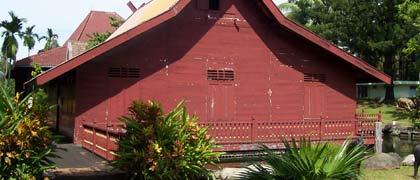
South Sumatera Province Pavilion featuring three custom house, the 'limas' (pyramid) house, 'ulu' house, and the 'rakit' (floating) house, each representing a tribe of Palembang, inland tribes, and residents who living on the river tribes.
'Limas' house is the main building, consisting of a stage house with rectangular shape, a pyramid shaped roof and at the top there are a decorative chrysolite flower buds ('simbar') and at the end have 'short-tailed ducks' decorative arches. At the door and window there is a decoration serves of ventilation. Stairs into the house located on the front with odd rungs. In the past, 'limas house' is home to the nobles.
'Limas house' has a five-terraced room ('kekijing'), symbolizing the five levels in society, according to: age, sex, talents, rank, and dignity. The first level is a room without wall, a sort of veranda, called the 'tenggalung' fence, used to rest and receive visitors when there are traditional ceremonies. The second room is called 'jogan', exclusively for men. The third room is called the third 'kekijing', with terraced and higher floor, separated by a baffle ('kiyam'), serves as the seat of invitee, or elderly relatives when there are traditional ceremonies. The fourth room, called fourth 'kekijing' with terraced and higher floor, serves as a place for the invitee, older relatives, 'Tumenggung', 'dapunto', and 'datuk'. The fifth room 'Gegajah', is the largest room, is used to receive guests or a honorable lady seating.
The 'limas house' in South Sumatera Province Pavilion functions as exhibition space for various aspects of culture, such as the seats of the king ('puade'), traditional clothes, songket woven fabrics, wedding bridal, ceramics, various handicrafts of ivory, brass, and tin.
The second building is the 'ulu house', which is the home of ordinary people who live in rural areas of South Sumatra with agrarian nature. This wooden house are stage shaped with the intention of avoiding seasonal high tides and wild animal disorders. 'Ulu house' has only one stair, located in front of the house and children and have an odd rungs. The upper part is used for living, while the lower part is used for saving household appliances: rice pounder ('isaran'), 'lesung' (dimple), winnowing tool ('nyiru'), firewood, and cages of ducks, or chickens.
The third house is 'rakit'(raft) house, is an example of a house located on the banks of Musi, Ogan, and Komering rivers. Rectangular houses, two pairs roof, called a 'kajang'(awning) roof. At the four corners have the wooden pillar in order to avoid the raft floating away. This house made of wood and thatch-roofed, has a porch which the family can sit on, guest room in the front, living room and bedroom in the middle and rear. The kitchen is located beside the house. Aside from being a place to live, floating house also serves to trade.
On Sundays or public holidays this platform held a variety of art performances such as the 'Gending Sriwijaya' dance, song, music, and sometimes 'Dul Muluk'drama, the typical drama of Palembang, and even at times provide the exhibition of traditional specialty foods like boiled catfish, empek-empek, fish crackers and tekwan.
Among the guests of South Sumatera Province Pavilion are Japanese Prime Minister Zenko Suzuki (1981) and Australian Prime Minister's wife, Mrs. Hazel Bob Hawke (1983), and President Martti Ahtsaari Filandia (1995).
'Limas' house is the main building, consisting of a stage house with rectangular shape, a pyramid shaped roof and at the top there are a decorative chrysolite flower buds ('simbar') and at the end have 'short-tailed ducks' decorative arches. At the door and window there is a decoration serves of ventilation. Stairs into the house located on the front with odd rungs. In the past, 'limas house' is home to the nobles.
'Limas house' has a five-terraced room ('kekijing'), symbolizing the five levels in society, according to: age, sex, talents, rank, and dignity. The first level is a room without wall, a sort of veranda, called the 'tenggalung' fence, used to rest and receive visitors when there are traditional ceremonies. The second room is called 'jogan', exclusively for men. The third room is called the third 'kekijing', with terraced and higher floor, separated by a baffle ('kiyam'), serves as the seat of invitee, or elderly relatives when there are traditional ceremonies. The fourth room, called fourth 'kekijing' with terraced and higher floor, serves as a place for the invitee, older relatives, 'Tumenggung', 'dapunto', and 'datuk'. The fifth room 'Gegajah', is the largest room, is used to receive guests or a honorable lady seating.
The 'limas house' in South Sumatera Province Pavilion functions as exhibition space for various aspects of culture, such as the seats of the king ('puade'), traditional clothes, songket woven fabrics, wedding bridal, ceramics, various handicrafts of ivory, brass, and tin.
The second building is the 'ulu house', which is the home of ordinary people who live in rural areas of South Sumatra with agrarian nature. This wooden house are stage shaped with the intention of avoiding seasonal high tides and wild animal disorders. 'Ulu house' has only one stair, located in front of the house and children and have an odd rungs. The upper part is used for living, while the lower part is used for saving household appliances: rice pounder ('isaran'), 'lesung' (dimple), winnowing tool ('nyiru'), firewood, and cages of ducks, or chickens.
The third house is 'rakit'(raft) house, is an example of a house located on the banks of Musi, Ogan, and Komering rivers. Rectangular houses, two pairs roof, called a 'kajang'(awning) roof. At the four corners have the wooden pillar in order to avoid the raft floating away. This house made of wood and thatch-roofed, has a porch which the family can sit on, guest room in the front, living room and bedroom in the middle and rear. The kitchen is located beside the house. Aside from being a place to live, floating house also serves to trade.
On Sundays or public holidays this platform held a variety of art performances such as the 'Gending Sriwijaya' dance, song, music, and sometimes 'Dul Muluk'drama, the typical drama of Palembang, and even at times provide the exhibition of traditional specialty foods like boiled catfish, empek-empek, fish crackers and tekwan.
Among the guests of South Sumatera Province Pavilion are Japanese Prime Minister Zenko Suzuki (1981) and Australian Prime Minister's wife, Mrs. Hazel Bob Hawke (1983), and President Martti Ahtsaari Filandia (1995).
Nearby cities:
Coordinates: 6°18'3"S 106°53'37"E
- The Miniature Indonesian Archipelago 0.1 km
- Taman Mini Indonesia Indah (TMII) 1.8 km
- Klub Eksekutif Persada (Persada Executive Club) 4.9 km
- RW 16 Vila Nusa Indah 7.9 km
- Pemancingan kiloan pondok kopi 12 km
- DeLayA Kedai dan Galeri 14 km
- The Columbus Waterpark Mutiara Gading Timur 15 km
- PT HANDAL JAYA SERVICE 18 km
- Jakarta Islamic Centre 20 km
- SGC Cikarang 28 km
- The Purna Bhakti Pertiwi Museum 0.8 km
- The Taman Museum Purnabhakti Park 0.8 km
- Taman Mini Interchange 1.1 km
- Ceger 1.1 km
- pinang ranti - jakarta timur 1.3 km
- Lubang Buaya 1.4 km
- Pinang Ranti 1.7 km
- Bambu Apus 1.8 km
- Rambutan 2 km
- Jakarta 11 km