
AN/FPS-16 Single Object Tracking Radar
USA /
California /
Lompoc /
Tranquillon Mountain Road
World
/ USA
/ California
/ Lompoc
World / United States / California
military, radar station
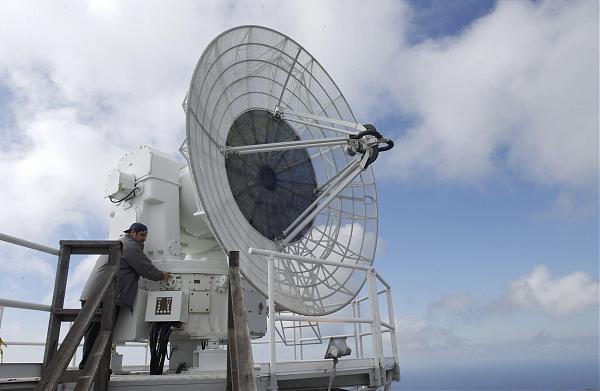

The AN/FPS-16 is a highly accurate ground-based monopulse single object tracking radar (SOTR), used extensively by the NASA manned space program and the U.S. Air Force. The accuracy of Radar Set AN/FPS-16 is such that the position data obtained from point-source targets has azimuth and elevation angular errors of less than 0.1 milliradian (approximately 0.006 degree) and range errors of less than 5 yards (5 m) with a signal-to-noise ratio of 20 decibels or greater.
The first monopulse radar was developed at the Naval Research Laboratory (NRL) in 1943 to overcome the angular limitations of existing designs. The monopulse technique makes angular determinations simultaneously on each individual received pulse. This improvement in radar technology provides a tenfold increase in angular accuracy over previous fire and missile control radars at longer ranges. The monopulse radar is now the basis for all modern tracking and missile control radars. Although monopulse radar was developed independently and secretly by several countries, R.M. Page from the NRL holds the U.S. patent on this technique.
The monopulse technique was first applied to the Nike-Ajax missile system, an early U.S. continental air defense weapon. Many improvements were made to provide a more compact and efficient monopulse antenna feed and lobe comparison waveguide circuitry, such that monopulse tracking radar became the generally accepted tracking radar system for military and civilian agencies, such as NASA and the FAA.
The NRL's work on monopulse radars eventually led to the AN/FPS-16, developed jointly by NRL and RCA as the first radar designed especially for missile ranges. The AN/FPS-16 was used to guide the first U.S. space satellite launches, Explorer I and Vanguard I, at Cape Canaveral in 1958.
en.wikipedia.org/wiki/AN/FPS-16
The first monopulse radar was developed at the Naval Research Laboratory (NRL) in 1943 to overcome the angular limitations of existing designs. The monopulse technique makes angular determinations simultaneously on each individual received pulse. This improvement in radar technology provides a tenfold increase in angular accuracy over previous fire and missile control radars at longer ranges. The monopulse radar is now the basis for all modern tracking and missile control radars. Although monopulse radar was developed independently and secretly by several countries, R.M. Page from the NRL holds the U.S. patent on this technique.
The monopulse technique was first applied to the Nike-Ajax missile system, an early U.S. continental air defense weapon. Many improvements were made to provide a more compact and efficient monopulse antenna feed and lobe comparison waveguide circuitry, such that monopulse tracking radar became the generally accepted tracking radar system for military and civilian agencies, such as NASA and the FAA.
The NRL's work on monopulse radars eventually led to the AN/FPS-16, developed jointly by NRL and RCA as the first radar designed especially for missile ranges. The AN/FPS-16 was used to guide the first U.S. space satellite launches, Explorer I and Vanguard I, at Cape Canaveral in 1958.
en.wikipedia.org/wiki/AN/FPS-16
Nearby cities:
Coordinates: 34°34'57"N 120°33'41"W
- Vandenberg Air Force Base (VBG/KVBG) 37 km
- Port Hueneme, California 131 km
- Naval Construction Battalion Center (CBC), Port Hueneme 131 km
- Naval Air Station Point Mugu 138 km
- Camp Roberts 148 km
- San Nicolas Island 171 km
- Fort Hunter Liggett 188 km
- Naval Air Station Lemoore 207 km
- San Clemente Island 250 km
- Special Warfare Training Area Three (SWAT-3), SCI Underwater Range 256 km
- Rancho La Espada 5.2 km
- Celite Corporation Diatomite Quarry 11 km
- Jalama Ranch 12 km
- Cojo-Jalama Ranch 16 km
- Unocal Government Point Production Facilities (site) 18 km
- Cojo Bay 19 km
- Hollister Ranch 25 km
- Arita Hills Vineyard 27 km
- Gaviota State Park 32 km
- Los Padres National Forest 84 km