
Bolinas, California
| unincorporated area / community, CDP - Census Designated Place
USA /
California /
Bolinas /
World
/ USA
/ California
/ Bolinas
World / United States / California
unincorporated area / community, CDP - Census Designated Place



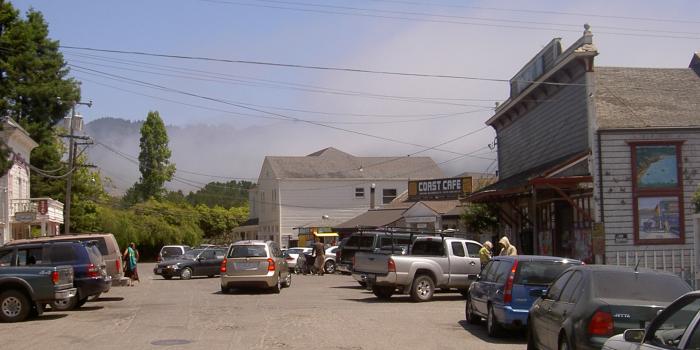
Bolinas is a census-designated place (CDP) in Marin County.
The population was 1,246 at the 2000 census. Located along the coast and accessible only via unmarked roads, Bolinas is known for its reclusive residents. Road signs pointing the way into town on Highway One have invariably been torn down (by local residents?)
Residents of the area have been reputed to give tourists deliberately misleading directions, so that no matter where the tourists wish to go, they find themselves on the road leading out of town.
Bolinas and its reclusive reputation feature in the 1981 novel "Ecotopia Emerging" by Ernest Callenbach.
Bolinas has been described as a "hippie enclave." Even in the past, this has been only partially true.
The turning point for this quirky beach town can be traced to a 1971 recall vote in which elected officials were removed from the local utility district and replaced with a quasi-revolutionary board.
After its success in the recall election, the five-member Bolinas utility district established itself as the town’s most powerful local institution and principal public forum. Because the community is unincorporated, there is no mayor or city council. So the utility district has taken on many of those functions.
The keys to the utility district’s power are water and sewage. In a bold attempt to block a major highway and harbor development plan for the area, a handful of local residents discovered that they could effectively control growth by limiting water and sewer permits.
After winning control of the board in 1971, the new utility board members, including two residents from a nearby communal farm, issued a moratorium on new permits that stands today. One of the young activists was Orville Schell, the Bay Area writer and China scholar. Schell (later to become dean of the UC Berkeley Graduate School of Journalism) wrote “The Town that Fought to Save Itself,” a book that chronicles the Bolinas anti-growth movement.
Although it did restrict population growth, the Bolinas movement also had the unintended consequence of helping to drive housing and land prices far beyond the means of the modest farming and countercultural population that had been living here at the time of the utility district coup d’etat.
In 1975, the year Schell’s book was published, the median household income of the town was about $8,000. Large homes were available for less than $20,000.
According to the 2000 census, the median household income here has risen to $53,187, and the average home value is about $465,000, with some of the older Victorian homes selling for as much as $2 million.
The water moratorium also had the effect of turning water permits into the town’s most valuable commodity. Although no new permits are allowed, they can sometimes be sold and transferred if the original home slides off the ocean cliff or is deemed uninhabitable. Water permits can now sell for $265,000 or more.
The consequence is that tiny little Bolinas, bastion in the fight against gentrification and mindless growth, may have the most expensive water meters in the world.
Wealthy non-"hippie"-types have moved to Bolinas in recent years, especially with the rise of the Internet and the possibilities of telecommuting. Rents on homes and even backyard shacks have risen and many long-time Bolinas residents have departed for greener pastures. There is a substantial new population of the upper middle-class sort.
Black and white photo shows the town of Bolinas, in it's entirety, about 100 years ago. Note the flat bottomed lighters, for servicing ships too large to enter the lagoon.
The population was 1,246 at the 2000 census. Located along the coast and accessible only via unmarked roads, Bolinas is known for its reclusive residents. Road signs pointing the way into town on Highway One have invariably been torn down (by local residents?)
Residents of the area have been reputed to give tourists deliberately misleading directions, so that no matter where the tourists wish to go, they find themselves on the road leading out of town.
Bolinas and its reclusive reputation feature in the 1981 novel "Ecotopia Emerging" by Ernest Callenbach.
Bolinas has been described as a "hippie enclave." Even in the past, this has been only partially true.
The turning point for this quirky beach town can be traced to a 1971 recall vote in which elected officials were removed from the local utility district and replaced with a quasi-revolutionary board.
After its success in the recall election, the five-member Bolinas utility district established itself as the town’s most powerful local institution and principal public forum. Because the community is unincorporated, there is no mayor or city council. So the utility district has taken on many of those functions.
The keys to the utility district’s power are water and sewage. In a bold attempt to block a major highway and harbor development plan for the area, a handful of local residents discovered that they could effectively control growth by limiting water and sewer permits.
After winning control of the board in 1971, the new utility board members, including two residents from a nearby communal farm, issued a moratorium on new permits that stands today. One of the young activists was Orville Schell, the Bay Area writer and China scholar. Schell (later to become dean of the UC Berkeley Graduate School of Journalism) wrote “The Town that Fought to Save Itself,” a book that chronicles the Bolinas anti-growth movement.
Although it did restrict population growth, the Bolinas movement also had the unintended consequence of helping to drive housing and land prices far beyond the means of the modest farming and countercultural population that had been living here at the time of the utility district coup d’etat.
In 1975, the year Schell’s book was published, the median household income of the town was about $8,000. Large homes were available for less than $20,000.
According to the 2000 census, the median household income here has risen to $53,187, and the average home value is about $465,000, with some of the older Victorian homes selling for as much as $2 million.
The water moratorium also had the effect of turning water permits into the town’s most valuable commodity. Although no new permits are allowed, they can sometimes be sold and transferred if the original home slides off the ocean cliff or is deemed uninhabitable. Water permits can now sell for $265,000 or more.
The consequence is that tiny little Bolinas, bastion in the fight against gentrification and mindless growth, may have the most expensive water meters in the world.
Wealthy non-"hippie"-types have moved to Bolinas in recent years, especially with the rise of the Internet and the possibilities of telecommuting. Rents on homes and even backyard shacks have risen and many long-time Bolinas residents have departed for greener pastures. There is a substantial new population of the upper middle-class sort.
Black and white photo shows the town of Bolinas, in it's entirety, about 100 years ago. Note the flat bottomed lighters, for servicing ships too large to enter the lagoon.
Wikipedia article: http://en.wikipedia.org/wiki/Bolinas,_California
Nearby cities:
Coordinates: 37°54'28"N 122°41'59"W
- Copperopolis, California 179 km
- Mountain Ranch, California 190 km
- Rail Road Flat, California 191 km
- Durham, California 212 km
- Rancho Tehama Reserve, California 237 km
- Shingletown, California 301 km
- Shaver Lake, California 306 km
- Dayton, Nevada 309 km
- Squaw Valley, California 327 km
- Silver Springs, Nevada 340 km
- Duxbury Reef 1.7 km
- Bolinas Lagoon 2.7 km
- Bolinas Bay 3.4 km
- Mount Tamalpais Watershed 7.5 km
- Kent Lake 7.9 km
- Wildcat Beach 10 km
- Drake's Bay 23 km
- Point Reyes National Seashore 23 km
- San Andreas Fault Zone (approx.) 29 km
- Farallon Islands 37 km
Comments