
Prussian Royal Palace (Wroclaw)
Poland /
Dolnoslaskie /
Wroclaw /
Kazimierza Wielkiego, 35
World
/ Poland
/ Dolnoslaskie
/ Wroclaw
World / Poland / Lower Silesian
palace, castle, museum, 1710s construction

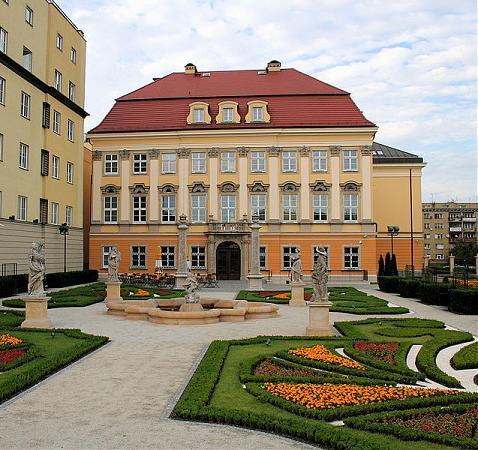

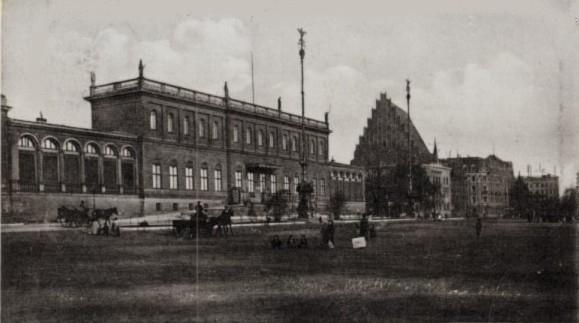

The Royal Palace, formerly the Spätgen Palace, is a former royal residence and currently holds the city museum. The palace was built for Heinrich Gottfried Spaetgen in 1717 in the Vienna style. In 1750, after Prussia took control over the Silesia in the First Silesian War, it was bought by the Prussian king Frederick the Great and converted to his residence. The palace was extended in 1751-53 in the baroque style with rococo interior designs by the royal architect Johann Boumann. Boumann’s additions included a transverse wing with a festive hall, throne hall and Frederick the Great's private quarters.
The successor of Frederick the Great, who died in 1786, was his nephew Frederick Wilhelm II (1744–1797). He performed remodeling of the royal palace according to design of Karl Gotthard Langhans (1732–1808). The remodeling took place in 1795-1796 in the classical style. As a result, the wings surrounding the northern courtyard, a new staircase and utility rooms were added.
In March 1813, during the Prussian war with Napoleon, Frederick William III announced two famous manifestos: “To My People” and “To My Military Commanders”. On April 1813, in the Yellow Living Room of the Palace, the king proclaimed the Iron Cross as a war medal.
In the middle of the 19th century, drawing on a Florence renaissance style, Berliner architect Frederich August Stüler added a new southern wing (1844–1846) and a new courtyard wings along with the gate and railing (1858). In 1918 the palace was donated to the Municipality of Breslau. On 20 September 1926 the Palace Museum (Schlossmuseum) was opened, displaying an exposition devoted to Frederick II The Great, including reconstructions of original interiors and a collection of Silesian art.
In May 1945 the palace was heavily damaged during the Siege of Breslau at the end of the Second World War. In the 1960s the wings designed by Stüler were demolished by the Communist government, mostly for ideological reasons , to remove traces of the city's Prussian/German history. The remaining wings were adapted to host Archeological Museum (until 1999) and Ethnographic Museum (until 2004). In 2008 a renovation was finished and a new museum was established, presenting 1000 years of History of Wrocław.
The successor of Frederick the Great, who died in 1786, was his nephew Frederick Wilhelm II (1744–1797). He performed remodeling of the royal palace according to design of Karl Gotthard Langhans (1732–1808). The remodeling took place in 1795-1796 in the classical style. As a result, the wings surrounding the northern courtyard, a new staircase and utility rooms were added.
In March 1813, during the Prussian war with Napoleon, Frederick William III announced two famous manifestos: “To My People” and “To My Military Commanders”. On April 1813, in the Yellow Living Room of the Palace, the king proclaimed the Iron Cross as a war medal.
In the middle of the 19th century, drawing on a Florence renaissance style, Berliner architect Frederich August Stüler added a new southern wing (1844–1846) and a new courtyard wings along with the gate and railing (1858). In 1918 the palace was donated to the Municipality of Breslau. On 20 September 1926 the Palace Museum (Schlossmuseum) was opened, displaying an exposition devoted to Frederick II The Great, including reconstructions of original interiors and a collection of Silesian art.
In May 1945 the palace was heavily damaged during the Siege of Breslau at the end of the Second World War. In the 1960s the wings designed by Stüler were demolished by the Communist government, mostly for ideological reasons , to remove traces of the city's Prussian/German history. The remaining wings were adapted to host Archeological Museum (until 1999) and Ethnographic Museum (until 2004). In 2008 a renovation was finished and a new museum was established, presenting 1000 years of History of Wrocław.
Wikipedia article: http://en.wikipedia.org/wiki/Wrocław_Palace
Nearby cities:
Coordinates: 51°6'27"N 17°1'44"E
- Archbishop's Palace 1.3 km
- Szczodre Castle 15 km
- Palace 24 km
- Palace 27 km
- Castle 34 km
- Castle 43 km
- Palace 51 km
- Castle 57 km
- Palace 57 km
- Pałac, Gimnazjum 126 km
- Pokoyhof Passage 0.2 km
- Salt Market 0.2 km
- Regional Police Headquarters 0.3 km
- Świebodzki Station 0.7 km
- Wrocław - Old Town 0.9 km
- Marketplace - Swiebodzki Central Station 1.2 km
- Osiedle Szczepin 1.7 km
- Śródmieście district 3 km
- Wrocław Krzyki (district) 3.8 km
- Psie Pole (district) 4.3 km