
A Phoenix Caisson
United Kingdom /
England /
Dymchurch-Saint Marys Bay /
World
/ United Kingdom
/ England
/ Dymchurch-Saint Marys Bay
historic ruins
Add category
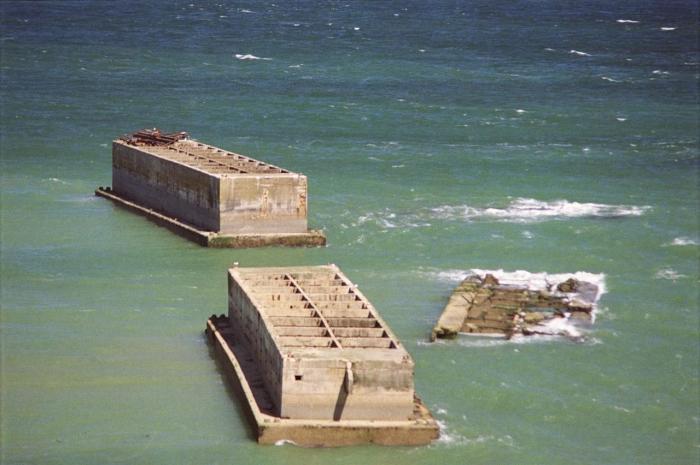


Just off the coast of Littlestone, this is one of 212 floating caissons that, when floated to a spot and linked together, became a floating, movable harbor. During the darkest days of WWII 45,000 British engineers and laborers spent 9 months building the caissons.
These water tight concrete structures were a part of Operation Mulberry floating harbor. The caissons were built along the English coastline and sunk in place, hiding them from German view. Then on June 7, 1944 they were re-floated (hence the name "Phoenix") and hauled by tugs (at the rate of 3 knots) to the French coast where they were connected together to form a two mile long break water and floating harbor. Their purpose was to calm the waters enough that boats and ships could dock and transfer supplies for the Allies during the D-Day invasion. Designed to last only 90 days, the kept doing their job for 10 months.
During the invasion the Phoenix Caissons were responsible for helping to unload 2.5 million men, half a million vehicles, and 4 million tons of goods and supplies.
This particular caisson never made it to France. The seabed was too deep and sticky, and they were unable to get it to rise to a floating level. It lies abandoned, stuck in the mud.
These water tight concrete structures were a part of Operation Mulberry floating harbor. The caissons were built along the English coastline and sunk in place, hiding them from German view. Then on June 7, 1944 they were re-floated (hence the name "Phoenix") and hauled by tugs (at the rate of 3 knots) to the French coast where they were connected together to form a two mile long break water and floating harbor. Their purpose was to calm the waters enough that boats and ships could dock and transfer supplies for the Allies during the D-Day invasion. Designed to last only 90 days, the kept doing their job for 10 months.
During the invasion the Phoenix Caissons were responsible for helping to unload 2.5 million men, half a million vehicles, and 4 million tons of goods and supplies.
This particular caisson never made it to France. The seabed was too deep and sticky, and they were unable to get it to rise to a floating level. It lies abandoned, stuck in the mud.
Wikipedia article: https://en.wikipedia.org/wiki/Mulberry_harbour
Nearby cities:
Coordinates: 50°58'59"N 0°58'59"E
- Dungeness Minefield 7.1 km
- South Boom Battery 53 km
- Remains Of Chattenden Barracks 59 km
- Curtis’s and Harvey Ltd Explosives Factory 67 km
- Ter Duinen abbey (ruins) 116 km
- Saint Mary's Abbey, West Dereham 182 km
- Remnant of Runway 09-27 265 km
- Remnant of Runway 15-33 265 km
- Ommerschans 413 km
- Former Oflag VI-B Dössel 572 km
- Littlestone Golf Club 1.8 km
- Romney, Hythe and Dymchurch Railway, Kent 2.2 km
- Romney Marsh Nature Reserve 2.3 km
- Runway 03/21 4.3 km
- Lydd Airport 4.4 km
- Lydd Golf Club 4.5 km
- Romney Marsh 7.2 km
- Hythe Ranges 10 km
- Roman Shore Fort 10 km
- Kent 30 km