
Castle Clinton
USA /
New Jersey /
Hoboken /
World
/ USA
/ New Jersey
/ Hoboken
World / United States / New York
museum, monument, fort, NRHP - National Register of Historic Places


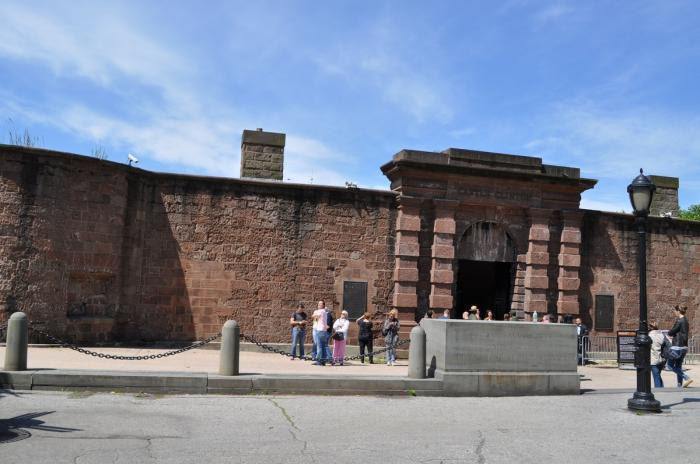
Originally built offshore to protect the city from invasion in the run-up to the War of 1812, the former fort eventually ended up inland because of landfill. After it became obsolete, it was roofed and became a public theater called Castle Garden, where impresario P.T. Barnum introduced the sensations Jenny Lind, "the Swedish Nightingale," and "General Tom Thumb," the stage name of two foot tall Charles Sherwood Stratton, whom Barnum taught to sing, dance and impersonate famous figures, such as Napoleon Bonaparte and Cupid.
In 1855, the facility was converted to an immigrant processing facility and remained in that capacity until its functions were moved to Ellis Island in the 1890s. At that time, it became the New York Aquarium. Later alterations were made by McKim, Mead & White in 1896.
In 1941, the Aquarium at Castle Clinton became the center of a controversy, as Parks Commissioner and master-builder Robert Moses sought to demolish it to build the planned Brooklyn Battery Bridge (later changed to the Brooklyn Battery Tunnel, out of fear that it would ruin the view of the harbor). Preservationists, including, it was rumored, Eleanor Roosevelt, interceded. The New York Aquarium was demolished by Moses, presumably out of spite for having failed to get a Brooklyn-Battery Bridge built. The sandstone walls of the former fort remained and the site was abandoned until renovated for the bicentennial in 1976.
It subsequently became the ticket office for the Statue of Liberty and Ellis Island Ferry, which it remains today, in addition to housing exhibits about its varied past.
www.nps.gov/cacl/
archive.org/details/landmarksofnewyo0006eddiam_h5l5/pag...
In 1855, the facility was converted to an immigrant processing facility and remained in that capacity until its functions were moved to Ellis Island in the 1890s. At that time, it became the New York Aquarium. Later alterations were made by McKim, Mead & White in 1896.
In 1941, the Aquarium at Castle Clinton became the center of a controversy, as Parks Commissioner and master-builder Robert Moses sought to demolish it to build the planned Brooklyn Battery Bridge (later changed to the Brooklyn Battery Tunnel, out of fear that it would ruin the view of the harbor). Preservationists, including, it was rumored, Eleanor Roosevelt, interceded. The New York Aquarium was demolished by Moses, presumably out of spite for having failed to get a Brooklyn-Battery Bridge built. The sandstone walls of the former fort remained and the site was abandoned until renovated for the bicentennial in 1976.
It subsequently became the ticket office for the Statue of Liberty and Ellis Island Ferry, which it remains today, in addition to housing exhibits about its varied past.
www.nps.gov/cacl/
archive.org/details/landmarksofnewyo0006eddiam_h5l5/pag...
Wikipedia article: http://en.wikipedia.org/wiki/Castle_Clinton
Nearby cities:
Coordinates: 40°42'12"N 74°1'0"W
- Snug Harbor Cultural Center & Botanical Garden 10 km
- Museum Mile 11 km
- Salt Marsh Nature Center 13 km
- Floyd Bennett Field Park 14 km
- Greenbelt Conservancy of Staten Island 16 km
- Teaneck Creek conservancy 20 km
- Greenwood Gardens 25 km
- Untermyer Park & Gardens 31 km
- Frelinghuysen Arboretum 39 km
- Fosterfields Living Historical Farm 43 km
- Battery Park 0.1 km
- Financial District 0.8 km
- Battery Park City 0.9 km
- Hugh L. Carey Tunnel 1.2 km
- Lower (Downtown) Manhattan 2.7 km
- Upper New York Bay 4.5 km
- Hudson County, New Jersey 5.8 km
- Manhattan 9 km
- Brooklyn 9 km
- IND Zero 12 km