
Jingo-ji temple (Kyoto)
| place with historical importance, interesting place, buddhist temple
Japan /
Kyoto /
Kyoto /
Umegahata Takao-cho, 5
World
/ Japan
/ Kyoto
/ Kyoto
temple, place with historical importance, interesting place, buddhist temple



Tel. 075-861-1769
Fax: 075-862-0354
Jingo-ji (神護寺) is a Shingon sect Buddhist temple. Its honzon is a statue of Yakushi Nyorai, the Buddha of Healing or "Medicine Buddha".
The temple was established in the year 824, as a merger of two private temples founded earlier by Wake no Kiyomaro. They were the Jingan-ji (神願寺) in Kiyomaro's home province and the Takaosan-ji (高雄山寺).
Jingo-ji holds sixteen National Treasures of Japan. They include the honzon and other statues. Another treasure is a list written by Kūkai in 812 called the "Name List of Abhiseka [Initiates]" (灌頂歴名, kanjōrekimyō) and displays some of Kukai's talent for calligraphy. This list contains people and deities in 812 who underwent the Abhiseka ritual at Takaosan-ji, presided by Kukai.
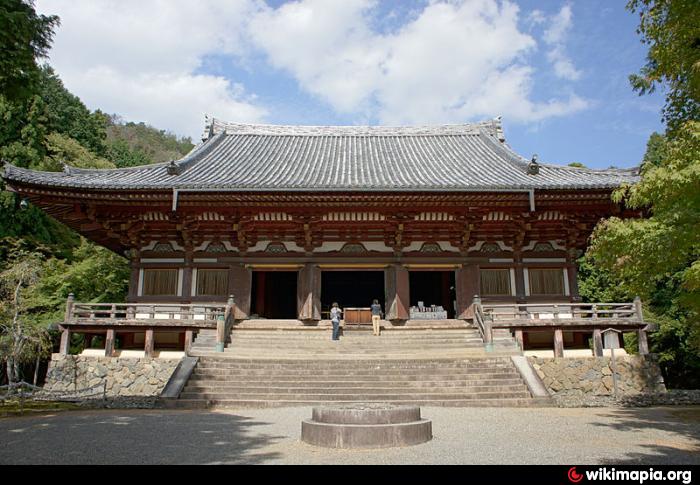
Buildings at Jingo-ji have been destroyed by fire and war. Of the original buildings, only the Daishi-dō survived the Ōnin War; even the present Daishi-dō is of uncertain date. Itakura Katsushige, a daimyo and former Kyoto shoshidai in the Tokugawa shogunate, commissioned a major reconstruction in 1623. Another reconstruction took place in the 1930s with a contribution from Gendō Yamaguchi.
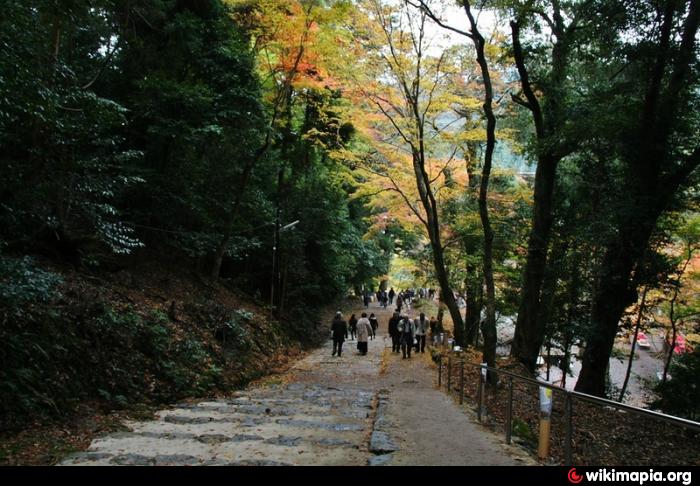
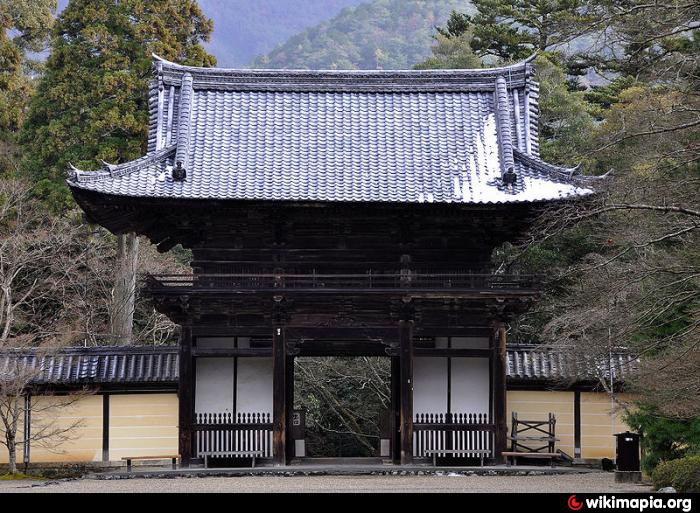
Buses from the center of the city arrive at a stop alongside the road. A long set of stairs leads down to the river, and a short bridge leads across it. A similar set of stairs leads up to the gate of the temple.
Address: 5 Takao-chō, Ume-ga-hata, Ukyō-ku Kyoto, Kyoto Prefecture
Fax: 075-862-0354
Jingo-ji (神護寺) is a Shingon sect Buddhist temple. Its honzon is a statue of Yakushi Nyorai, the Buddha of Healing or "Medicine Buddha".
The temple was established in the year 824, as a merger of two private temples founded earlier by Wake no Kiyomaro. They were the Jingan-ji (神願寺) in Kiyomaro's home province and the Takaosan-ji (高雄山寺).
Jingo-ji holds sixteen National Treasures of Japan. They include the honzon and other statues. Another treasure is a list written by Kūkai in 812 called the "Name List of Abhiseka [Initiates]" (灌頂歴名, kanjōrekimyō) and displays some of Kukai's talent for calligraphy. This list contains people and deities in 812 who underwent the Abhiseka ritual at Takaosan-ji, presided by Kukai.
Buildings at Jingo-ji have been destroyed by fire and war. Of the original buildings, only the Daishi-dō survived the Ōnin War; even the present Daishi-dō is of uncertain date. Itakura Katsushige, a daimyo and former Kyoto shoshidai in the Tokugawa shogunate, commissioned a major reconstruction in 1623. Another reconstruction took place in the 1930s with a contribution from Gendō Yamaguchi.
Buses from the center of the city arrive at a stop alongside the road. A long set of stairs leads down to the river, and a short bridge leads across it. A similar set of stairs leads up to the gate of the temple.
Address: 5 Takao-chō, Ume-ga-hata, Ukyō-ku Kyoto, Kyoto Prefecture
Wikipedia article: http://en.wikipedia.org/wiki/Jingo-ji
Nearby cities:
Coordinates: 35°3'15"N 135°40'13"E
- Kyoto 31 km
- Heijō Palace (Old Imperial Palace site) 41 km
- Site of Azuchi castle 44 km
- Kasugayama (Mikasayama) 44 km
- Eiheiji 131 km
- Gero Onsen 165 km
- Ena Valley 165 km
- Ogi-machi, Shirakawa-go 175 km
- Kamikochi 223 km
- Snow Corridor 241 km
- Jikishi-an Temple 2.4 km
- Sawa Pond 2.5 km
- Sawa-Yama Hill 3 km
- Daikaku-ji Temple 3 km
- A bamboo grove 3.4 km
- Shirasuna-Yama Hill 3.4 km
- Atago-jinja Shrine 7.8 km
- Mt.Kuroo 13 km
- Haida tunnel 13 km
- Lake Amawaka 15 km
Comments