
DuMont Building
| office building, skyscraper, Neo-Gothic (architecture), 1931_construction
USA /
New Jersey /
West New York /
Madison Avenue, 515
World
/ USA
/ New Jersey
/ West New York
World / United States / New York
office building, skyscraper, Neo-Gothic (architecture), 1931_construction
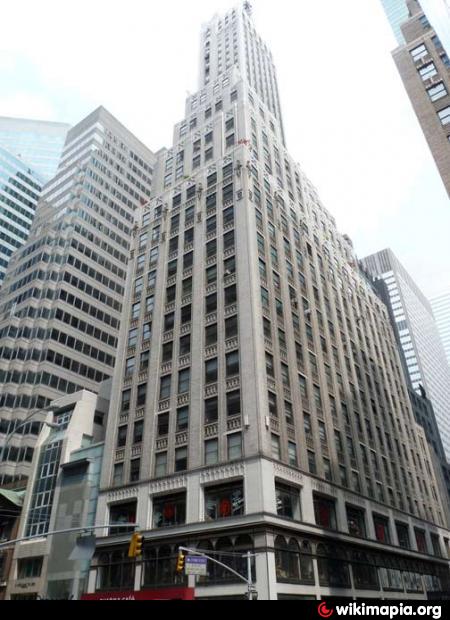


532-foot, 42-story Art-Deco/Neo-Gothic office building completed in 1931. Designed by J.E.R. Carpenter, it is clad in buff-colored brick and terra-cotta above a 3-story limestone base, three bays wide on the west facade, and eight along the south on 53rd Street. The ground floor has a black granite water table, and bronze-framed, plate-glass storefronts in the three bays on the avenue. The five western bays on 53rd have storefronts, with the main building entrance in the 6th bay. It has a recessed portico framed by blank granite piers with a segmental-arch lined by pointed dentils. The portico has a vaulted ceiling and glass doors at the rear wall. Above the arch is an intricate Gothic marquise (canopy) composed of black cast-iron and glass. The next bay has another storefront, and the narrower east end bay has a loading dock at the ground floor, and a tripartite window at the 2nd. The rest of the 2nd floor to the west has large, bronze-framed tripartite windows with round-arches. At the top of the 2nd floor, the piers, spaces between the arches, and a band along the top all have overlays of thin bronze patterns resembling tracery. The 3rd floor has slightly smaller tripartite windows between wider piers, recessed between beveled moldings, each with transoms and bronze framing. Each of the bays is topped by rows of Gothic arch panels above small rosettes, with a small stone band course capping the base.
The brick upper floors have paired windows in each bay, with brick sills and lintels, and terra-cotta spandrels, each featuring four Gothic foils. The narrower east end bay sets back above the 7th floor and again above the 11th. The rest of the south and west facades set back above the 13th floor, as well as above the 17th, 20th, and 23rd floors, where the lower roof line is. Each of these setbacks is marked by quatrefoil spandrel panels. The piers are also decorated by diamond-shape Gothic ornament at the 13th floor, projecting above outlined panels that extend down to smaller panels between the 13th and 14th floors that have additional carved ornament. The north elevation of the lower floors is also clad in brick and has four bays of paired window; the spandrels are plainer, having only three simple, vertical rectangles in each. At the north end, the west-facing wall that wraps around the two shorter buildings next to the Du Mont Building has two bays of single-windows up to the lower roof line.
A slender upper tower extends from the northeast corner of the lower building mass. At its west facade, the two bays of single-windows from the lower floors becomes four bays, with the northern one set apart from the other three. Each bay has terra-cotta spandrels similar to those on the lower floors of the main south and west facades, colored slightly darker than the brick of the piers. The south face of the upper tower has six bays of single-windows, with spandrels matching the west face. The north side has two bays of single-windows at the ends, and the east facade matches the west, with a northern bay separated from three south bays. The spandrels between the 38th-40th are painted white, and there is a white stone parapet topping the 41st floor, with Gothic pointed-arches topping each window. On the north facade there is a third bay in the middle at the 39th-41st floors, with white terra-cotta spandrels.
A penthouse level rises at the 42nd floor from the north half of the tower, capped by a sloped copper roof. On its north face are two round, white terra-cotta medallions with plus-shape openings. On the 41st-floor roof at the south half rises a tall broadcasting antenna, which is one of the building's most distinctive features, tracing back to the building's role in the first television broadcasts of Allen B. DuMont experimental television station W2XWV in 1938. The station became commercially licensed as WABD—named for DuMont's initials—in 1944, WNEW-TV in 1958, and is now WNYW. The station was one of the few television channels that continued to broadcast through World War II.
The ground floor is occupied by Davidoff of Geneva cigar shop, 'Essen deli, a subway entrance, and a Starbucks coffee, with Franco Ercole Custom Tailor and U.S. Athletic Training Center on the 3rd floor.
www.artdeco.org/new-york-art-deco-registry-map
usmodernist.org/PA/PP-1931-07.pdf
The brick upper floors have paired windows in each bay, with brick sills and lintels, and terra-cotta spandrels, each featuring four Gothic foils. The narrower east end bay sets back above the 7th floor and again above the 11th. The rest of the south and west facades set back above the 13th floor, as well as above the 17th, 20th, and 23rd floors, where the lower roof line is. Each of these setbacks is marked by quatrefoil spandrel panels. The piers are also decorated by diamond-shape Gothic ornament at the 13th floor, projecting above outlined panels that extend down to smaller panels between the 13th and 14th floors that have additional carved ornament. The north elevation of the lower floors is also clad in brick and has four bays of paired window; the spandrels are plainer, having only three simple, vertical rectangles in each. At the north end, the west-facing wall that wraps around the two shorter buildings next to the Du Mont Building has two bays of single-windows up to the lower roof line.
A slender upper tower extends from the northeast corner of the lower building mass. At its west facade, the two bays of single-windows from the lower floors becomes four bays, with the northern one set apart from the other three. Each bay has terra-cotta spandrels similar to those on the lower floors of the main south and west facades, colored slightly darker than the brick of the piers. The south face of the upper tower has six bays of single-windows, with spandrels matching the west face. The north side has two bays of single-windows at the ends, and the east facade matches the west, with a northern bay separated from three south bays. The spandrels between the 38th-40th are painted white, and there is a white stone parapet topping the 41st floor, with Gothic pointed-arches topping each window. On the north facade there is a third bay in the middle at the 39th-41st floors, with white terra-cotta spandrels.
A penthouse level rises at the 42nd floor from the north half of the tower, capped by a sloped copper roof. On its north face are two round, white terra-cotta medallions with plus-shape openings. On the 41st-floor roof at the south half rises a tall broadcasting antenna, which is one of the building's most distinctive features, tracing back to the building's role in the first television broadcasts of Allen B. DuMont experimental television station W2XWV in 1938. The station became commercially licensed as WABD—named for DuMont's initials—in 1944, WNEW-TV in 1958, and is now WNYW. The station was one of the few television channels that continued to broadcast through World War II.
The ground floor is occupied by Davidoff of Geneva cigar shop, 'Essen deli, a subway entrance, and a Starbucks coffee, with Franco Ercole Custom Tailor and U.S. Athletic Training Center on the 3rd floor.
www.artdeco.org/new-york-art-deco-registry-map
usmodernist.org/PA/PP-1931-07.pdf
Wikipedia article: http://en.wikipedia.org/wiki/DuMont_Building
Nearby cities:
Coordinates: 40°45'35"N 73°58'25"W
- 399 Park Avenue 0.1 km
- JP Morgan Chase Global Headquarters 0.4 km
- JP Morgan Chase World Headquarters 0.4 km
- Neuberger Berman Building 0.5 km
- Radio City Music Hall 0.6 km
- Comcast Building (30 Rockefeller Plaza) 0.6 km
- 1285 Avenue of the Americas 0.7 km
- Time & Life Building 0.7 km
- AXA Equitable Center 0.8 km
- Rockefeller Center 0.8 km
- LIRR Grand Central Madison Tunnels 0.4 km
- Turtle Bay 0.6 km
- Park Avenue Malls 0.6 km
- Midtown (North Central) 0.8 km
- Sutton Place 0.8 km
- Midtown (Manhattan, NY) 1.5 km
- Upper East Side 2.3 km
- Manhattan 2.3 km
- Queens 15 km
- The Palisades 22 km