
Keeler Needle
USA /
California /
Lone Pine /
World
/ USA
/ California
/ Lone Pine
World / United States / California
mountain
Add category

Elevation roughly 14,300 feet.
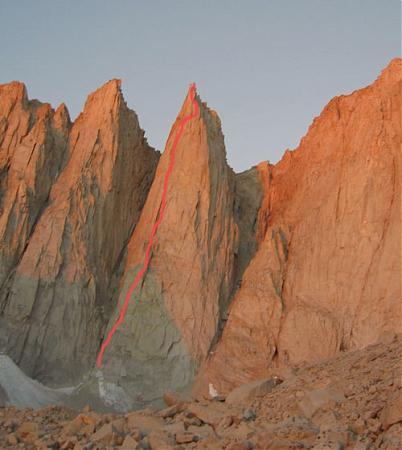
First ascent of the 2,000 foot East Face using direct aid was in July 1960 by Warren Harding, accompanied by R.McKnight, F.Groenberg and G.Denny. First free ascent on basically the same route was by G.Rowell, G.Wiltsie and C.VanDiver. The Harding route consists of 17 continuous pitches, mostly grade 5.7 to 5.9. Two of the pitches are grade 5.10c.
Complicating the climb is the loose and broken rock, in contrast to the solid granite in Yosemite. Also, the Big Walls in Yosemite generally finish at below 8,000 feet, whereas this one STARTS at 12,000 feet.
Photo by Chris McNamara, the red line tracing Harding's Route.
This peak was named for the American astronomer and physicist James E. Keeler (1857-1900)
In 1880 Allegheny Observatory director Samuel P. Langley, accompanied by Keeler and William Day, undertook on a research expedition to the summit of Mount Whitney. The purpose of the expedition was to study how the Sun's radiation was selectively absorbed by the Earth's atmosphere, comparing the results at high altitude with those found at lower levels.
First ascent of the 2,000 foot East Face using direct aid was in July 1960 by Warren Harding, accompanied by R.McKnight, F.Groenberg and G.Denny. First free ascent on basically the same route was by G.Rowell, G.Wiltsie and C.VanDiver. The Harding route consists of 17 continuous pitches, mostly grade 5.7 to 5.9. Two of the pitches are grade 5.10c.
Complicating the climb is the loose and broken rock, in contrast to the solid granite in Yosemite. Also, the Big Walls in Yosemite generally finish at below 8,000 feet, whereas this one STARTS at 12,000 feet.
Photo by Chris McNamara, the red line tracing Harding's Route.
This peak was named for the American astronomer and physicist James E. Keeler (1857-1900)
In 1880 Allegheny Observatory director Samuel P. Langley, accompanied by Keeler and William Day, undertook on a research expedition to the summit of Mount Whitney. The purpose of the expedition was to study how the Sun's radiation was selectively absorbed by the Earth's atmosphere, comparing the results at high altitude with those found at lower levels.
Wikipedia article: http://en.wikipedia.org/wiki/Mt_Whitney
Nearby cities:
Coordinates: 36°34'31"N 118°17'29"W
- Sherman Peak 63 km
- Rocky Hill 80 km
- Cummings Mountain 171 km
- Soledad Mountain 176 km
- Middle Butte 178 km
- Gold Hill 215 km
- Antonovich Open Space Park (Joughin Ranch Section) 250 km
- Wildwood Park/Janss Conejo (MGM) Film Ranch 266 km
- Davidson Seamount 415 km
- Cortes Bank 461 km
- Rock Creek 10 km
- Alabama Hills 14 km
- Horseshoe Meadows 17 km
- Alabama Hills 18 km
- Sequoia National Park 27 km
- Giant Forest 41 km
- Kings Canyon National Park 50 km
- Ponderosa 57 km
- Inyo National Forest 65 km
- Springville, California 69 km