
The Knickerbocker Hotel
USA /
New Jersey /
West New York /
Broadway, 1466
World
/ USA
/ New Jersey
/ West New York
World / United States / New York
hotel, NRHP - National Register of Historic Places, Beaux-Arts (architecture)
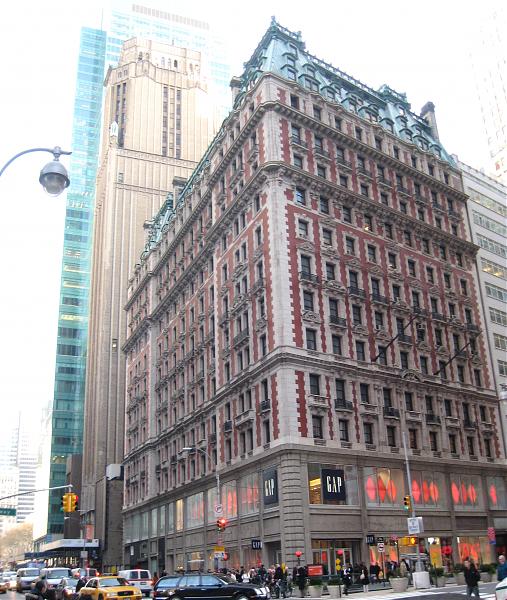
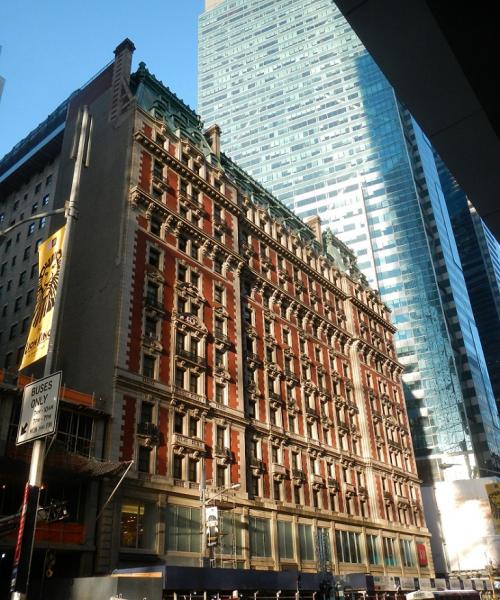
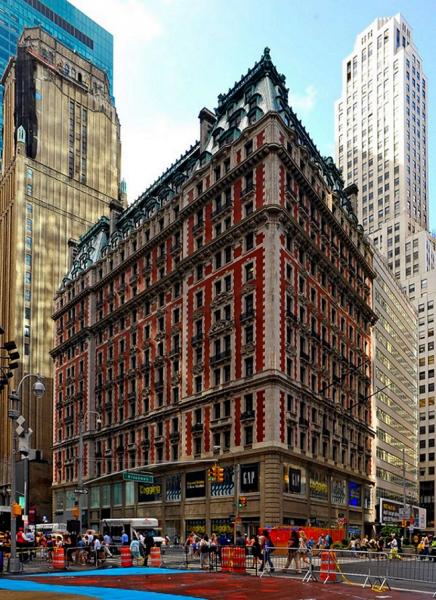

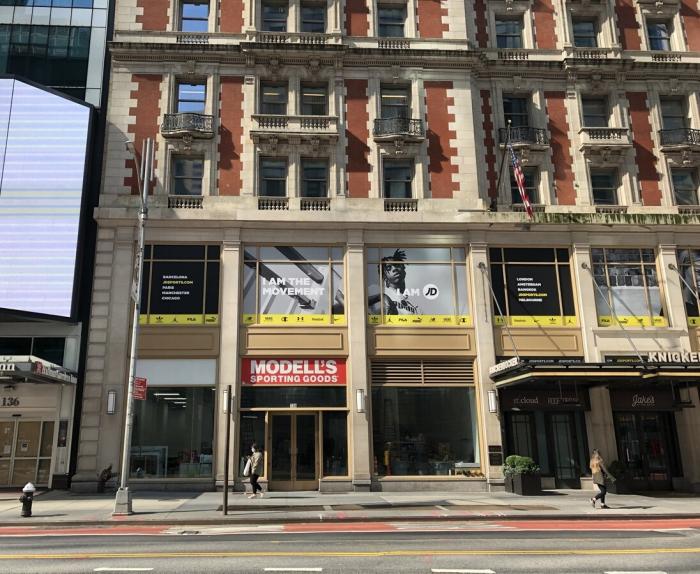
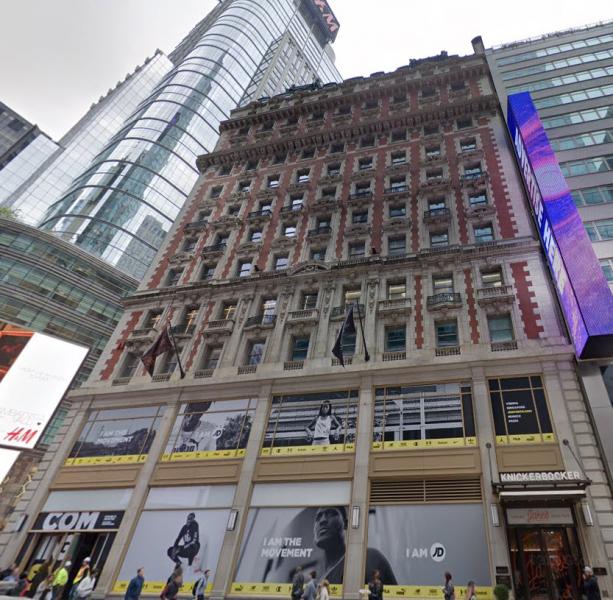
195-foot, 16-story Beaux-Arts hotel completed in 1906. Designed by Brice Price and Marvin & Davis with interiors by Trowbridge & Livingtson for John Jacob Astor, IV/J.E. and A.L. Pennock, it is clad in red brick and terra-cotta. After John Jacob Astor IV died on the Titanic in 1912, his son Vincent Astor inherited the hotel. It continued to run successfully under James B. Regan, its operator since opening, until 1920, when Regan retired and surrendered his lease. Prohibition, enacted the year before in 1919, had impacted upon the hotel's business in its restaurants and bars, and Vincent decided to close the hotel and convert the structure into an office building, called the Knickerbocker Building with alterations made by Charles A. Platt. The building was later home to Newsweek magazine between 1940 – 1959 and was known and the Newsweek Building. After major remodeling in 1980 the building was converted to use for garment showrooms and offices and became known as 6 Times Square. It was converted back to a hotel in 2013, reopening in 2014 after a complete renovation as the Knickerbocker Hotel, with 330 guest rooms.
The hotel site also includes an annex with a narrow Romanesque-Revival facade on West 41st Street which pre-dates the main building. This structure, which was used as a service entrance, was originally a small hotel, designed by Philip C. Brown in 1894.
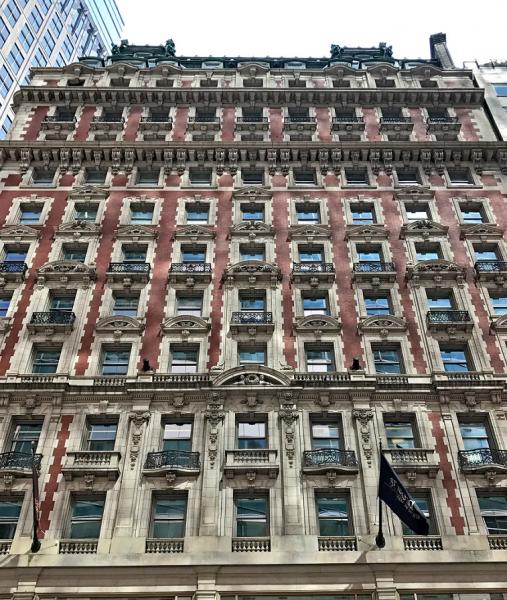
Above the 2nd floor, the exterior of the Knickerbocker looks much as it did in 1906. The 14-story building is faced with red brick and is ornamented with terra-cotta and Indiana limestone. Both the Broadway and the West 42nd Street facades have corner pavilions that are brought slightly forward, and both facades are adorned by a series of balconies, cornices, and classical pediments that balance the vertical thrust of the building with their horizontal continuity. The former main facade on Broadway contains a 7-bay center pavilion flanked by 4-bay pavilions on each side. Terra-cotta quoins mark the corners and paired window aedicules of the corner wings. These highly ornamented windows feature a feast of French Renaissance ornament: cornucopias, wreaths and putti surmounted by sculpted, segmental-arched or swan's neck pediments. The other windows in this facade are ornamented with iron balconies or smaller stone balconies on the 4th, 6th, 7th and 11th floors. This, combined with five extant cornices using various degrees of ornament gives the building a sense of rhythm that combines with the color of the facade to create an ornate yet dignified design.
The structure is crowned by a 3-story, steeply pitched green copper mansard roof punctuated with segmental-arched dormer windows and topped with its original corner urns and cresting. Four brick and stone chimneys mark the corners of the pavilions, rising above the roof line on the 42nd Street facade. The Broadway facade is very similar to that of 42nd Street, except that it is nine bays wide and the visual focus is a large, segmental-arched pediment set above the central bay of the 4th floor. In 1908-10 architect C.H. Cullen added a penthouse which was to be used for upholstery repair. In 1911, the portico on the sidewalk level of 42nd Street was removed, probably to accommodate the widening of the street.
Standing at 143 West 41st Street, the annex to the Knickerbocker Hotel has a narrow 8-story Romanesque-Revival facade with Beaux-Arts ornament faced in buff-colored brick and terra-cotta. The altered ground story and the 3-bay 2nd floor are crowned by a classical cornice that serves as a sill for a wide brick arch with terra-cotta trim that encloses a relieving arch framing the 4th and 5th floors. Two corner brackets at the 6th floor serve as bases for raised pilasters that frame the 6th, 7th, and 8th floors. Instead of conventional capitals, the pilasters have heavy modillions that support a bracketed cornice. The 6th floor is two bays wide, while the 7th floor is the same width composed of three narrower windows. The 8th floor is also three bays wide, with paired half-columns separating the bays. A brick arch crowns each window, one arch flowing into the next. The attic story is a 1906 addition consisting of two dormer windows framed by short columns and crowned by triangular pediments faced in green copper. Griffins on pedestals stand guard beside the windows on each corner.
The lower two floors of the main building is occupied by JD Sports. In 2015, the interior was rebuilt by Gabellini Sheppard Associates for FelCor Lodging Trust. The property is operated by Highgate Hotels.
www.theknickerbocker.com/
www.beyondthegildedage.com/2012/01/knickerbocker-hotel....
daytoninmanhattan.blogspot.com/2010/08/1906-knickerbock...
hdl.handle.net/2027/uc1.c033529549?urlappend=%3Bseq=104...
The hotel site also includes an annex with a narrow Romanesque-Revival facade on West 41st Street which pre-dates the main building. This structure, which was used as a service entrance, was originally a small hotel, designed by Philip C. Brown in 1894.
Above the 2nd floor, the exterior of the Knickerbocker looks much as it did in 1906. The 14-story building is faced with red brick and is ornamented with terra-cotta and Indiana limestone. Both the Broadway and the West 42nd Street facades have corner pavilions that are brought slightly forward, and both facades are adorned by a series of balconies, cornices, and classical pediments that balance the vertical thrust of the building with their horizontal continuity. The former main facade on Broadway contains a 7-bay center pavilion flanked by 4-bay pavilions on each side. Terra-cotta quoins mark the corners and paired window aedicules of the corner wings. These highly ornamented windows feature a feast of French Renaissance ornament: cornucopias, wreaths and putti surmounted by sculpted, segmental-arched or swan's neck pediments. The other windows in this facade are ornamented with iron balconies or smaller stone balconies on the 4th, 6th, 7th and 11th floors. This, combined with five extant cornices using various degrees of ornament gives the building a sense of rhythm that combines with the color of the facade to create an ornate yet dignified design.
The structure is crowned by a 3-story, steeply pitched green copper mansard roof punctuated with segmental-arched dormer windows and topped with its original corner urns and cresting. Four brick and stone chimneys mark the corners of the pavilions, rising above the roof line on the 42nd Street facade. The Broadway facade is very similar to that of 42nd Street, except that it is nine bays wide and the visual focus is a large, segmental-arched pediment set above the central bay of the 4th floor. In 1908-10 architect C.H. Cullen added a penthouse which was to be used for upholstery repair. In 1911, the portico on the sidewalk level of 42nd Street was removed, probably to accommodate the widening of the street.
Standing at 143 West 41st Street, the annex to the Knickerbocker Hotel has a narrow 8-story Romanesque-Revival facade with Beaux-Arts ornament faced in buff-colored brick and terra-cotta. The altered ground story and the 3-bay 2nd floor are crowned by a classical cornice that serves as a sill for a wide brick arch with terra-cotta trim that encloses a relieving arch framing the 4th and 5th floors. Two corner brackets at the 6th floor serve as bases for raised pilasters that frame the 6th, 7th, and 8th floors. Instead of conventional capitals, the pilasters have heavy modillions that support a bracketed cornice. The 6th floor is two bays wide, while the 7th floor is the same width composed of three narrower windows. The 8th floor is also three bays wide, with paired half-columns separating the bays. A brick arch crowns each window, one arch flowing into the next. The attic story is a 1906 addition consisting of two dormer windows framed by short columns and crowned by triangular pediments faced in green copper. Griffins on pedestals stand guard beside the windows on each corner.
The lower two floors of the main building is occupied by JD Sports. In 2015, the interior was rebuilt by Gabellini Sheppard Associates for FelCor Lodging Trust. The property is operated by Highgate Hotels.
www.theknickerbocker.com/
www.beyondthegildedage.com/2012/01/knickerbocker-hotel....
daytoninmanhattan.blogspot.com/2010/08/1906-knickerbock...
hdl.handle.net/2027/uc1.c033529549?urlappend=%3Bseq=104...
Click to show deleted objects Deleted objects
Add place (company, shop, etc.) to this building
Wikipedia article: http://en.wikipedia.org/wiki/The_Knickerbocker_Hotel_(New_York)
Nearby cities:
Coordinates: 40°45'19"N 73°59'9"W
- New York Marriott Marquis Hotel 0.4 km
- Hotel Pennsylvania site 0.7 km
- Old Waldorf-Astoria Hotel 0.7 km
- The Towers of the Waldorf Astoria New York 1 km
- Waldorf Astoria New York 1 km
- New York Hilton Midtown 1 km
- The Ambassador Hotel 1.1 km
- The Plaza 1.4 km
- Mandarin Oriental 1.6 km
- The William Vale Hotel 4.4 km
- Times Square – 42nd Street Subway Station (1,2,3,7,<7>,N,Q,R,S) 0.1 km
- Times Square Area 0.3 km
- Garment District 0.4 km
- Theater District 0.4 km
- Midtown (North Central) 0.4 km
- Hell's Kitchen (Clinton) 1.1 km
- Murray Hill 1.2 km
- Manhattan 3.1 km
- Hudson County, New Jersey 7.8 km
- Queens 15 km