
Ghazanchetsots Cathedral (Shusha)
Azerbaijan /
Susa /
Shusha
World
/ Azerbaijan
/ Susa
/ Susa
World / Azerbaijan
Armenian Apostolic church
Add category


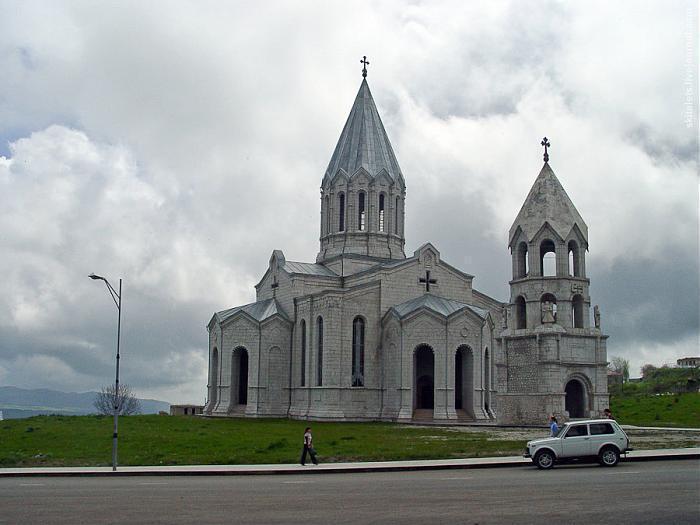
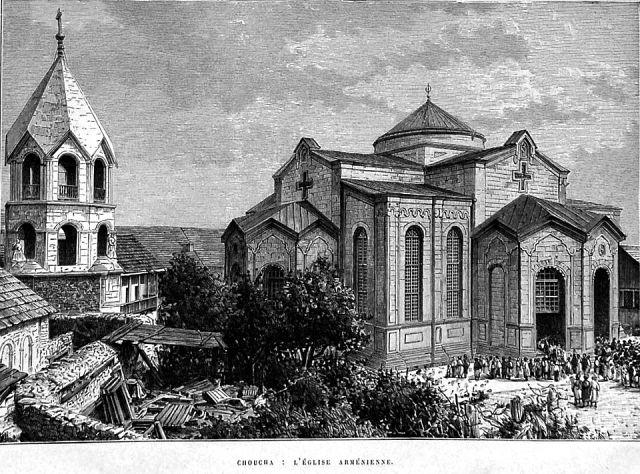


Holy Savior Cathedral (Armenian: Սուրբ Ամենափրկիչ մայր տաճար, Surb Amenap′rkich mayr tachar), commonly referred to as Ghazanchetsots (Ղազանչեցոց),[b] is an Armenian Apostolic cathedral in Shusha (Shushi), in the disputed region of Nagorno-Karabakh (Artsakh). It is the seat of the Diocese of Artsakh of the Armenian Apostolic Church.
Built between 1868 and 1887, the cathedral was consecrated in 1888. It was damaged during the March 1920 massacre of Armenians of the city by Azerbaijanis and experienced a decades-long decline, well into the Soviet period. During the Nagorno-Karabakh War Azerbaijan used the cathedral as an armory to store hundreds of missiles. Subsequently, during the 2020 Nagorno-Karabakh conflict, It was damaged by Azerbaijani shelling, on 8 October 2020.
The cathedral was extensively restored in the aftermath of the War and reconsecrated in 1998. A landmark of Shusha and Karabakh and a listed cultural and historical monument of the Artsakh Republic, it has become an icon for the Karabakh Armenian cause. Standing 35 metres (115 ft) high, Ghazanchetsots is one of the largest Armenian churches in the world.
Its architect, Simon Ter-Hakobyan, intended the church to resemble Etchmiadzin Cathedral. In front of the west entrance is a freestanding three-story bell tower, constructed in 1858. Large statues of angels blowing trumpets stood at each corner of the bell tower's second story. However, they were destroyed during the Nagorno-Karabakh War when τthe town was under Azeri control.
According to historical records, a small basilica church stood on its place as early as 1722.
The cathedral has seen a number of uses over the years. Its use as a functioning church ended after the Shusha pogrom of 1920. During the Soviet period period it was used as a granary, and then as a garage. During the Nagorno-Karabakh War, Azerbaijani forces used the cathedral as a GRAD munitions storehouse until May 1992, when Shusha was captured by Armenian forces. In the years after that capture the church was repaired and renovated. Replica angel statues were made to replace the destroyed originals; an image of one forms part of the coat-of-arms of Shusha. In 1998 it was re-consecrated as a church, and now serves as the main cathedral and headquarters of the Armenian Apostolic Church's Diocese of Artsakh
Built between 1868 and 1887, the cathedral was consecrated in 1888. It was damaged during the March 1920 massacre of Armenians of the city by Azerbaijanis and experienced a decades-long decline, well into the Soviet period. During the Nagorno-Karabakh War Azerbaijan used the cathedral as an armory to store hundreds of missiles. Subsequently, during the 2020 Nagorno-Karabakh conflict, It was damaged by Azerbaijani shelling, on 8 October 2020.
The cathedral was extensively restored in the aftermath of the War and reconsecrated in 1998. A landmark of Shusha and Karabakh and a listed cultural and historical monument of the Artsakh Republic, it has become an icon for the Karabakh Armenian cause. Standing 35 metres (115 ft) high, Ghazanchetsots is one of the largest Armenian churches in the world.
Its architect, Simon Ter-Hakobyan, intended the church to resemble Etchmiadzin Cathedral. In front of the west entrance is a freestanding three-story bell tower, constructed in 1858. Large statues of angels blowing trumpets stood at each corner of the bell tower's second story. However, they were destroyed during the Nagorno-Karabakh War when τthe town was under Azeri control.
According to historical records, a small basilica church stood on its place as early as 1722.
The cathedral has seen a number of uses over the years. Its use as a functioning church ended after the Shusha pogrom of 1920. During the Soviet period period it was used as a granary, and then as a garage. During the Nagorno-Karabakh War, Azerbaijani forces used the cathedral as a GRAD munitions storehouse until May 1992, when Shusha was captured by Armenian forces. In the years after that capture the church was repaired and renovated. Replica angel statues were made to replace the destroyed originals; an image of one forms part of the coat-of-arms of Shusha. In 1998 it was re-consecrated as a church, and now serves as the main cathedral and headquarters of the Armenian Apostolic Church's Diocese of Artsakh
Wikipedia article: http://en.wikipedia.org/wiki/Ghazanchetsots_Cathedral
Nearby cities:
Coordinates: 39°45'31"N 46°44'51"E
- Holy Mother of God Church 22 km
- Gandzasar monastery 38 km
- Vanq, Gandzasar Monastery. 39 km
- Nabiyurd monastery 97 km
- Verin Agulis / Upper Aylis 110 km
- Ruines of Surb Astvatzatzni Metz Anapat monastery 111 km
- Church of Yulus 112 km
- Charekavank monastery 113 km
- Karmir Vank - Armenian monastery 136 km
- Makaravank Monastery 193 km
- Aghadadali Quarter 0.2 km
- Mamayi quarter 0.2 km
- Shusha plateau rocks 0.5 km
- Shusha health resort 0.7 km
- Uch mikh reserve 0.9 km
- Verin T'agh Quarter 1 km
- Gizil Gaya mount 1.1 km
- Gaybaly Valley 2.2 km
- Shusha district 8.6 km
- Khojaly District 10 km