
The Albert Memorial (London)
United Kingdom /
England /
London
World
/ United Kingdom
/ England
/ London
World / United Kingdom / England
memorial
Add category
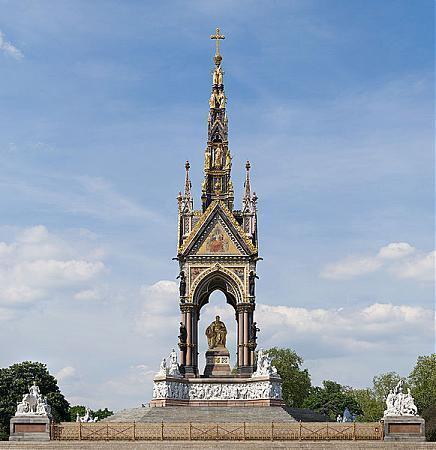


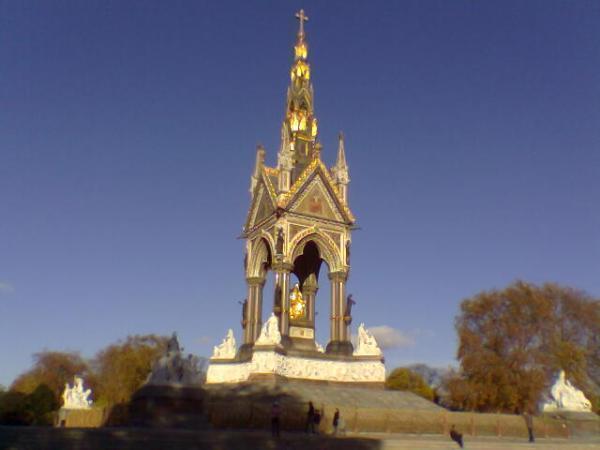
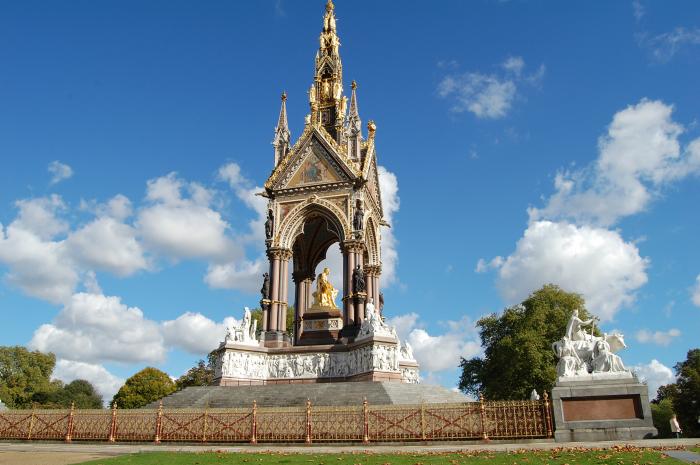
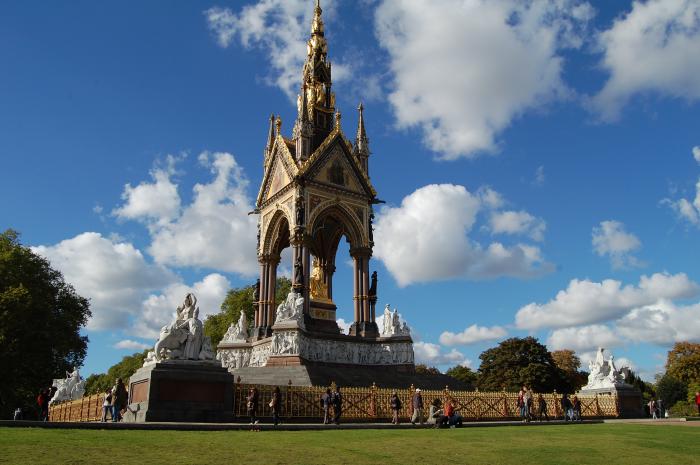

The Albert Memorial is situated in Kensington Gardens, London, England, directly to the north of the Royal Albert Hall, close to the "Ring" which runs through Hyde Park.
It was commissioned by Queen Victoria in memory of her beloved husband, Prince Albert of Saxe-Coburg-Gotha who died of typhoid in 1861, and designed by Sir George Gilbert Scott in the Gothic revival style. "My idea in designing the Memorial," Gilbert Scott wrote, "was to erect a kind of ciborium to protect a statue of the Prince; and its special characteristic was that the ciborium was designed in some degree on the principles of the ancient shrines. These shrines were models of imaginary buildings, such as had never in reality been erected; and my idea was to realise one of these imaginary structures with its precious materials, its inlaying, its enamels, etc. etc." However, the Memorial was not the first revivalist design for a canopied statue in a Gothic style - the Scott Monument in Edinburgh had been designed by George Meikle Kemp over twenty years earlier.
Opened in 1872, with the statue of Albert ceremonially "seated" in 1875, the memorial consists of an ornate canopy or pavilion containing a statue of Prince Albert facing south. This is surrounded by the elaborate sculptural Frieze of Parnassus, which depicts 169 individual composers, architects, poets, painters, and sculptors. There are two allegorical sculpture programs: four groups depicting Victorian industrial arts and sciences (agriculture, commerce, engineering and manufacturing), and four more groups representing Europe, Asia, Africa and The Americas at the four corners, each continent-group including several ethnographic figures and a large animal. (A camel for Africa, a buffalo for the Americas, an elephant for Asia and a bull for Europe.) The sculptor Henry Hugh Armstead coordinated this massive effort among several artists of the Royal Academy, including Hamo Thornycroft.
It was commissioned by Queen Victoria in memory of her beloved husband, Prince Albert of Saxe-Coburg-Gotha who died of typhoid in 1861, and designed by Sir George Gilbert Scott in the Gothic revival style. "My idea in designing the Memorial," Gilbert Scott wrote, "was to erect a kind of ciborium to protect a statue of the Prince; and its special characteristic was that the ciborium was designed in some degree on the principles of the ancient shrines. These shrines were models of imaginary buildings, such as had never in reality been erected; and my idea was to realise one of these imaginary structures with its precious materials, its inlaying, its enamels, etc. etc." However, the Memorial was not the first revivalist design for a canopied statue in a Gothic style - the Scott Monument in Edinburgh had been designed by George Meikle Kemp over twenty years earlier.
Opened in 1872, with the statue of Albert ceremonially "seated" in 1875, the memorial consists of an ornate canopy or pavilion containing a statue of Prince Albert facing south. This is surrounded by the elaborate sculptural Frieze of Parnassus, which depicts 169 individual composers, architects, poets, painters, and sculptors. There are two allegorical sculpture programs: four groups depicting Victorian industrial arts and sciences (agriculture, commerce, engineering and manufacturing), and four more groups representing Europe, Asia, Africa and The Americas at the four corners, each continent-group including several ethnographic figures and a large animal. (A camel for Africa, a buffalo for the Americas, an elephant for Asia and a bull for Europe.) The sculptor Henry Hugh Armstead coordinated this massive effort among several artists of the Royal Academy, including Hamo Thornycroft.
Wikipedia article: http://en.wikipedia.org/wiki/Albert_Memorial
Nearby cities:
Coordinates: 51°30'8"N -0°10'39"E
- Princess Diana Memorial Fountain 0.5 km
- Tomb of The Unknown Warrior 3.4 km
- Bridge House Gardens & Rotary Gardens 10 km
- Air Forces Memorial 28 km
- American Military Cemetery and Memorial 39 km
- Meppershall St Mary's Church and War Memorial 58 km
- Chattri Memorial 69 km
- Chelveston 94 km
- War Memorial Park 136 km
- The Lynn Lumley Sports Fields 141 km
- Imperial College London South Kensington Campus 0.4 km
- Kensington Gardens 0.5 km
- Natural History Museum 0.7 km
- South Kensington 0.8 km
- Lycée Français Charles de Gaulle 0.9 km
- Brompton 1.2 km
- Kensington 1.5 km
- City of Westminster 1.5 km
- Earl's Court 1.7 km
- Chelsea 2 km
Comments