
The Information Museum (Jakarta)
Indonesia /
Jawa Barat /
Bekasi /
Jakarta /
Jl. Taman Mini Indonesia Indah
World
/ Indonesia
/ Jawa Barat
/ Bekasi
World / Indonesia / Jakarta Raya
museum, media museum

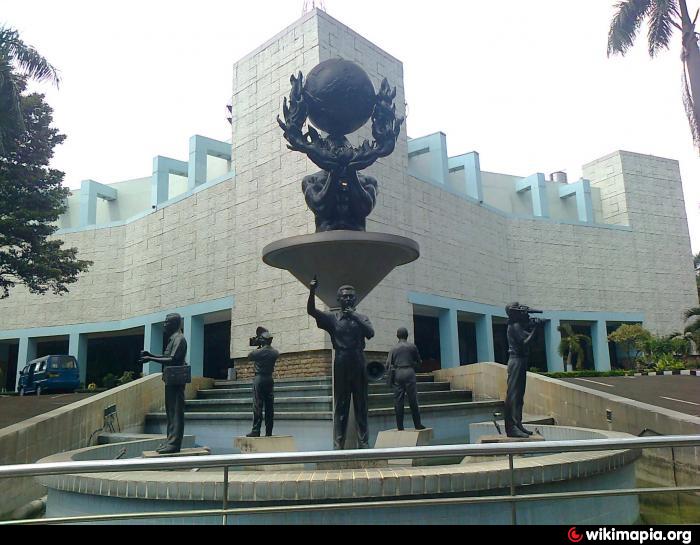
The Information Museum has been designed as a star with five angles symbolizing the "Pancasila" (the five basic principles of the Republic of Indonesia) and the five information elements. The museum collects, studies, displays and takes care of objects of the history of information and communication as well as a communication means of the sixth era after face-to-face encounters, radio, TV, film and press.
There is a monument in the front yard that supports the symbol of information "Api Nan Tak Kunjung Padam" ("Eternal Flame", lit. "The Never Extinguished Fire") surrounded by the statues of five information skilled workers and a fountain, a meeting of the water from the top of the monument with the water sprouting from below, symbolizing the interrelationship between the government, community and the mass media. The building consists of three floors, has the form of a cylinder projecting an image of the "kentongan" (bamboo or wooden drum struck to sound an alarm) as traditional information element, supporting a television antenna as a modern element.
The exhibition has been arranged outside and inside the building, with in its totality portrays the history of information since the national movement up to the modern Indonesia era. The collection outside the building consists among others of four TVRI (Televition of the Republic of Indonesia) Outside Broadcasting Cars, an Information Stage Car, a "PFN" (Film State Enterprise) Cinerama unit car, a "RRI" (Radio of the Republic of Indonesia) outside broadcasting Car and the first TVRI Outside Broadcasting Car used to cover the IVth Asian Games in Jakarta in 1962, considered as the start of the existence of TVRI and a three era of printing machine.
The collection of the first floor consists of objects with an information and communication historical value from films, radio, television, face-to-face media, including the "wayang suluh" (information provided through "wayang" performances), and the development of press and graphical media with 17 half-body statues of information and communication leaders. Moreover there are four small dioramas of information operations in the village ("Pependes"), the process of developing the intellectual life of the nation, dealing with natural disasters and "kelompencapir" (a group of listeners, readers and viewers; a "RRI" rural broadcast). Other collections are a Javanese character typewriter used since 1917 by the "Surakarta" Palace, a camera that has recorded the first Republic of Indonesia Cabinet Meeting, a Public Radio of the year 1940, etc. There is also a library and a mini-theater with a capacity of 60 people, completed with a modern sound-system which can be used to convey information audio-visually and to turn on a documentary film.
The second floor covers a 150 meters relief visualizing the history of information in Indonesia for the five periods, the role of information in building the national unity and integrity and the delivery of information through the printing and electronic media both traditional and modern. There are also seven dioramas picturing information activities to arouse nationalism, to unite the nation and to fill the independence with development including the printing of the "Retno Dhoemilah" newspaper. Moreover, the painting of the face of "Dr. Wahidin Soedirohusodo" by "Sumidjo", measuring 8 m x 7 m, the biggest painting in Indonesia that has obtained a MURI certificate, can also be found.
The collections of the third floor are three mini studio of the "PFN" (Perusahaan Film Negara or State Film Enterprise), a RRI mini studio, a TVRI mini studio and a display of transparent photographs.
There is a monument in the front yard that supports the symbol of information "Api Nan Tak Kunjung Padam" ("Eternal Flame", lit. "The Never Extinguished Fire") surrounded by the statues of five information skilled workers and a fountain, a meeting of the water from the top of the monument with the water sprouting from below, symbolizing the interrelationship between the government, community and the mass media. The building consists of three floors, has the form of a cylinder projecting an image of the "kentongan" (bamboo or wooden drum struck to sound an alarm) as traditional information element, supporting a television antenna as a modern element.
The exhibition has been arranged outside and inside the building, with in its totality portrays the history of information since the national movement up to the modern Indonesia era. The collection outside the building consists among others of four TVRI (Televition of the Republic of Indonesia) Outside Broadcasting Cars, an Information Stage Car, a "PFN" (Film State Enterprise) Cinerama unit car, a "RRI" (Radio of the Republic of Indonesia) outside broadcasting Car and the first TVRI Outside Broadcasting Car used to cover the IVth Asian Games in Jakarta in 1962, considered as the start of the existence of TVRI and a three era of printing machine.
The collection of the first floor consists of objects with an information and communication historical value from films, radio, television, face-to-face media, including the "wayang suluh" (information provided through "wayang" performances), and the development of press and graphical media with 17 half-body statues of information and communication leaders. Moreover there are four small dioramas of information operations in the village ("Pependes"), the process of developing the intellectual life of the nation, dealing with natural disasters and "kelompencapir" (a group of listeners, readers and viewers; a "RRI" rural broadcast). Other collections are a Javanese character typewriter used since 1917 by the "Surakarta" Palace, a camera that has recorded the first Republic of Indonesia Cabinet Meeting, a Public Radio of the year 1940, etc. There is also a library and a mini-theater with a capacity of 60 people, completed with a modern sound-system which can be used to convey information audio-visually and to turn on a documentary film.
The second floor covers a 150 meters relief visualizing the history of information in Indonesia for the five periods, the role of information in building the national unity and integrity and the delivery of information through the printing and electronic media both traditional and modern. There are also seven dioramas picturing information activities to arouse nationalism, to unite the nation and to fill the independence with development including the printing of the "Retno Dhoemilah" newspaper. Moreover, the painting of the face of "Dr. Wahidin Soedirohusodo" by "Sumidjo", measuring 8 m x 7 m, the biggest painting in Indonesia that has obtained a MURI certificate, can also be found.
The collections of the third floor are three mini studio of the "PFN" (Perusahaan Film Negara or State Film Enterprise), a RRI mini studio, a TVRI mini studio and a display of transparent photographs.
Nearby cities:
Coordinates: 6°17'57"S 106°53'35"E
- National Film Archive 2353 km
- Philippine Film Heritage Building 2797 km
- The Artyom Borovik Journalism Museum 9322 km
- National Film Archive 10236 km
- Media center 10315 km
- National Science and Media Museum 11804 km
- Pickford Center for Motion Picture Study 14459 km
- Vintage Radio and Communications Museum of Connecticut 16078 km
- Elinor Bunin Munroe Film Center 16199 km
- Grammy 16482 km
- Taman Mini Indonesia Indah (TMII) 0.2 km
- The Taman Museum Purnabhakti Park 0.8 km
- Taman Mini Interchange 1.2 km
- pinang ranti - jakarta timur 1.2 km
- Ceger 1.3 km
- Lubang Buaya 1.4 km
- Pinang Ranti 1.5 km
- Rambutan 1.9 km
- Bambu Apus 1.9 km
- Jakarta 10 km