
SDSS 2.5 meter Telescope
USA /
New Mexico /
Alamogordo /
World
/ USA
/ New Mexico
/ Alamogordo
World / United States / New Mexico
telescope
Add category

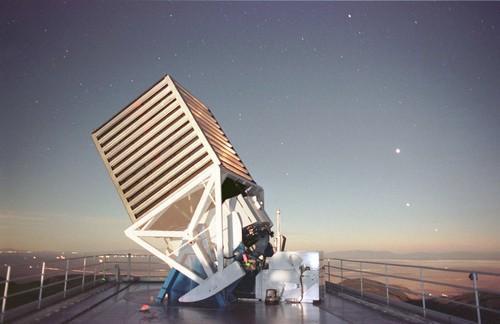


98 inch Cassegrainian telescope for the Sloan Digital Sky Survey.
In the summer of 2008, after eight years of charting the cosmos, the Sloan Digital Sky Survey completed the deepest, most comprehensive map of the heavens ever produced.
It is a three-dimensional model of the universe that allows an observer to travel from the dwarf galaxies hugging the skirts of the Milky Way to the frontiers of the most distant quasars, billions of light-years away.
In its 5 terabytes of data are 217 million individual objects, including 800,000 galaxies (which themselves contain billions of stars and planets) and 100,000 quasars -- objects once so rare and strange that they weren't even detected until 1962.
The Astrophysical Research Consortium is made up of 300 astronomers who helped carry out the $100-million sky-mapping project.
Among the survey's notable achievements has been helping to confirm the existence of dark energy, the mysterious force believed to be causing the universe's expansion. The survey has shown that the universe is "flat" and has lent weight to the big-bang theory that the universe began with a single explosion, followed by rapid inflation that continues to this day, but perhaps its greatest achievement has been to bring a sense of order to the seemingly undefined vastness of the universe.
The Sloan astronomers have struggled to make that most unfathomable of places -- the whole universe -- as navigable as the local shopping mall.
About half of the project's observers have left over the years.
The Sloan survey was the brainchild of Jim Gunn, an astrophysicist at Princeton University and one of the world's leading experts on galaxy formation.
Before Sloan, the most authoritative map of the heavens in visible light was the Palomar Observatory Sky Survey, which from 1950 to 1957 mapped the Northern Hemisphere's night sky with the 48-inch Samuel Oschin Schmidt telescope. The result was a master reference work for amateur and professional astronomers alike, but by the mid-1980s, it was out of date.
Radio, X-ray and infrared astronomers had launched their own sky surveys, some of which surpassed Palomar in breadth and detail.
Another motivating factor was a seminal discovery in the 1980s: Galaxies, once thought to be the largest structures in the universe, sometimes formed clusters. This was a hint of larger structures in the universe.
It was unclear what those gigantic structures might be, but the hope of finding them gave impetus to Dr. Gunn's plans.
With grants from the Alfred P. Sloan Foundation, the National Science Foundation, NASA and the Department of Energy, Gunn began designing a new telescope capable of capturing four times as much light as the 48 inch Schidt instrument at Palomar.
Gunn's goal was to map 1,000,000 galaxies.
As ambitious as it was, the new survey would contain blind spots. The great river of stars in the Milky Way galaxy cut through the night sky, obscuring a chunk of the universe behind it. Further, the telescope's location in the Northern Hemisphere meant that much of the sky in the Southern Hemisphere would remain cælum incognito.
The most daunting part of the survey was determining the distances to objects, so that the map could be constructed in three dimensions.
Astronomer Edwin Hubble discovered nearly 80 years ago that the farther away a star or galaxy, the more its light is shifted toward the red end of the spectrum.
So how to determine the red shifts of millions of objects?
Professor Gunn and his collaborators realized that could take hundreds of years.
Gunn's team came up with a simple solution.
By feeding the image of the sky through aluminum plates with holes drilled to match the placement of stars and galaxies, the team could analyze 640 objects at a time.
Each morning, scientists at the University of Chicago sent orders for the objects they wanted measured. The physics lab at the University of Washington drilled the holes and sent the plates to Apache Point, where a team of plate-pluggers connected light-sensitive fibers to each hole.
The fiber optic sent the light to two spectrographs where it was resolved into the various wave lengths for analysis.
To make the work more manageable, the team chose about 1.4 million of the most interesting objects in what Dr. Gunn called "the relatively near universe" -- within 2 billion light-years of Earth.
From two hours before sunset to an hour past dawn, two observers sat in the control room, monitoring weather and conditions in the telescope. They were known as the pilot and copilot, or, more sardonically, the warm observer and cold observer, so named because when any work needed to be done at the telescope, it was the cold observer who went outside and did it.
Workers from other parts of Apache Point would often stop in for a peek. The list of discoveries by scientists using Sloan data include the most distant quasar ever found, as well as evidence that the Milky Way was formed by "cannibalism" in neighboring galaxies. Sloan also uncovered many more dwarf galaxies around the Milky Way than were thought to exist.
Large-scale cosmological discoveries include great expanses of nothingness, known as, uh, "voids."
The survey also found large numbers of galaxies clustered together, as if seeking companionship. The largest structure of all is the "Great Wall," a huge collection of galaxy clusters strung out in a huge filament arcing across the night sky, about 600 million light-years away.
In March 2008, the last of the 3,000 or so aluminum plates was plugged.
The Sloan collaboration now prepares to launch the project's next phase: a six-year survey looking more deeply at galaxy clustering and the chemistry of the Milky Way.
sdss.org/
In the summer of 2008, after eight years of charting the cosmos, the Sloan Digital Sky Survey completed the deepest, most comprehensive map of the heavens ever produced.
It is a three-dimensional model of the universe that allows an observer to travel from the dwarf galaxies hugging the skirts of the Milky Way to the frontiers of the most distant quasars, billions of light-years away.
In its 5 terabytes of data are 217 million individual objects, including 800,000 galaxies (which themselves contain billions of stars and planets) and 100,000 quasars -- objects once so rare and strange that they weren't even detected until 1962.
The Astrophysical Research Consortium is made up of 300 astronomers who helped carry out the $100-million sky-mapping project.
Among the survey's notable achievements has been helping to confirm the existence of dark energy, the mysterious force believed to be causing the universe's expansion. The survey has shown that the universe is "flat" and has lent weight to the big-bang theory that the universe began with a single explosion, followed by rapid inflation that continues to this day, but perhaps its greatest achievement has been to bring a sense of order to the seemingly undefined vastness of the universe.
The Sloan astronomers have struggled to make that most unfathomable of places -- the whole universe -- as navigable as the local shopping mall.
About half of the project's observers have left over the years.
The Sloan survey was the brainchild of Jim Gunn, an astrophysicist at Princeton University and one of the world's leading experts on galaxy formation.
Before Sloan, the most authoritative map of the heavens in visible light was the Palomar Observatory Sky Survey, which from 1950 to 1957 mapped the Northern Hemisphere's night sky with the 48-inch Samuel Oschin Schmidt telescope. The result was a master reference work for amateur and professional astronomers alike, but by the mid-1980s, it was out of date.
Radio, X-ray and infrared astronomers had launched their own sky surveys, some of which surpassed Palomar in breadth and detail.
Another motivating factor was a seminal discovery in the 1980s: Galaxies, once thought to be the largest structures in the universe, sometimes formed clusters. This was a hint of larger structures in the universe.
It was unclear what those gigantic structures might be, but the hope of finding them gave impetus to Dr. Gunn's plans.
With grants from the Alfred P. Sloan Foundation, the National Science Foundation, NASA and the Department of Energy, Gunn began designing a new telescope capable of capturing four times as much light as the 48 inch Schidt instrument at Palomar.
Gunn's goal was to map 1,000,000 galaxies.
As ambitious as it was, the new survey would contain blind spots. The great river of stars in the Milky Way galaxy cut through the night sky, obscuring a chunk of the universe behind it. Further, the telescope's location in the Northern Hemisphere meant that much of the sky in the Southern Hemisphere would remain cælum incognito.
The most daunting part of the survey was determining the distances to objects, so that the map could be constructed in three dimensions.
Astronomer Edwin Hubble discovered nearly 80 years ago that the farther away a star or galaxy, the more its light is shifted toward the red end of the spectrum.
So how to determine the red shifts of millions of objects?
Professor Gunn and his collaborators realized that could take hundreds of years.
Gunn's team came up with a simple solution.
By feeding the image of the sky through aluminum plates with holes drilled to match the placement of stars and galaxies, the team could analyze 640 objects at a time.
Each morning, scientists at the University of Chicago sent orders for the objects they wanted measured. The physics lab at the University of Washington drilled the holes and sent the plates to Apache Point, where a team of plate-pluggers connected light-sensitive fibers to each hole.
The fiber optic sent the light to two spectrographs where it was resolved into the various wave lengths for analysis.
To make the work more manageable, the team chose about 1.4 million of the most interesting objects in what Dr. Gunn called "the relatively near universe" -- within 2 billion light-years of Earth.
From two hours before sunset to an hour past dawn, two observers sat in the control room, monitoring weather and conditions in the telescope. They were known as the pilot and copilot, or, more sardonically, the warm observer and cold observer, so named because when any work needed to be done at the telescope, it was the cold observer who went outside and did it.
Workers from other parts of Apache Point would often stop in for a peek. The list of discoveries by scientists using Sloan data include the most distant quasar ever found, as well as evidence that the Milky Way was formed by "cannibalism" in neighboring galaxies. Sloan also uncovered many more dwarf galaxies around the Milky Way than were thought to exist.
Large-scale cosmological discoveries include great expanses of nothingness, known as, uh, "voids."
The survey also found large numbers of galaxies clustered together, as if seeking companionship. The largest structure of all is the "Great Wall," a huge collection of galaxy clusters strung out in a huge filament arcing across the night sky, about 600 million light-years away.
In March 2008, the last of the 3,000 or so aluminum plates was plugged.
The Sloan collaboration now prepares to launch the project's next phase: a six-year survey looking more deeply at galaxy clustering and the chemistry of the Milky Way.
sdss.org/
Wikipedia article: http://en.wikipedia.org/wiki/Sloan_Digital_Sky_Survey
Nearby cities:
Coordinates: 32°46'46"N 105°49'13"W
- NRAO Very Large Array 247 km
- Prude Ranch / Texas Star Party 299 km
- Kitt Peak National Observatory 553 km
- Combined Array for Research in Millimeter-wave Astronomy (CARMA) at Cedar Flat 1229 km
- OVRO Solar Array 1240 km
- Russel Research Station 1588 km
- Vermilion River Observatory - University of Illinois 1820 km
- Pisgah Astronomical Research Institute (PARI), Formerly Rosman Research Station, NSA SIGINT Site 2130 km
- NRAO - Green Bank 2424 km
- Defford Radio Telescope 8040 km
- Oliver Lee Memorial State Park 11 km
- Mountain Park, New Mexico 19 km
- High Rolls, New Mexico 19 km
- Timberon, New Mexico 21 km
- La Luz, New Mexico 24 km
- Holloman Air Force Base 34 km
- Rocket Sled Track - Holloman Air Base 37 km
- White Sands National Park 46 km
- Mescalero Apache Reservation 50 km
- White Sands Missile Range 64 km