
Washington Park (Albany, New York)
USA /
New York /
Albany /
Albany, New York
World
/ USA
/ New York
/ Albany
World / United States / New York
park, historic landmark
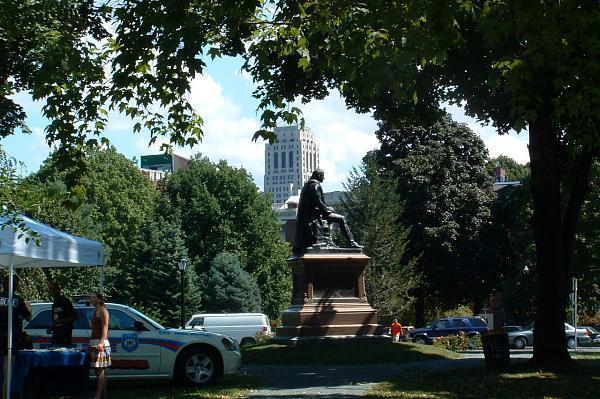


Much of the land that today makes up Washington Park has been public land since the City of Albany was chartered in 1686. Washington Park, like Central Park in New York City, was conceived by Calvert Vaux and Frederick Law Olmstead, America’s premier landscape architects. Olmstead also created the gardens and extensive park at Biltmore, the Vanderbilt estate in Asheville, North Carolina. Though Olmsted and Vaux were not involved in the actual design of the park their broad vision was followed by John Bogart and John Cuyler who drew the plans for the park in 1870. Development of the park began around 1870, as the city began moving westward after the Civil War. The curving roadways, wooded glades and vistas of lakes and ornamental plantings are consistent with the Romantic and Esthetic movements ideal of the natural and gardenesque. The mature plantings date from the 1890’s when the park was under the direction of William S. Edgerton, who for over thirty-eight years continued Vaux and Olmstead’s vision by saving old trees and constructing decorative pavilions and boathouses.
The streets facing Washington Park provide residential architectural styles spanning the entire late Victorian and early Modern periods, and reflect Albany’s importance as a major industrial and financial hub during the opulent decades following the Civil War. The city is fortunate to have had this entire area survive into the present day. There are houses by internationally known architects such as Henry Hobson Richardson, Sanford White, and R.W. Gibson, as well as the local greats Albert Fuller and Marcus T. Reynolds.
The Civil War Monument (Soldiers and Sailors Monument) dates from 1912 and dominates the northern entrance to Washington Park, facing elegant "mansion row" on State Street. Behind the large bronze figure depicting Peace, is a procession of more than sixty life-sized figures carved in marble in low relief. The memorial was restored in 1986, and is a popular spot in the park, in that it connects a beautiful elm tree-lined pedestrian promenade with the Moses Fountain on the parks southern end.
The streets facing Washington Park provide residential architectural styles spanning the entire late Victorian and early Modern periods, and reflect Albany’s importance as a major industrial and financial hub during the opulent decades following the Civil War. The city is fortunate to have had this entire area survive into the present day. There are houses by internationally known architects such as Henry Hobson Richardson, Sanford White, and R.W. Gibson, as well as the local greats Albert Fuller and Marcus T. Reynolds.
The Civil War Monument (Soldiers and Sailors Monument) dates from 1912 and dominates the northern entrance to Washington Park, facing elegant "mansion row" on State Street. Behind the large bronze figure depicting Peace, is a procession of more than sixty life-sized figures carved in marble in low relief. The memorial was restored in 1986, and is a popular spot in the park, in that it connects a beautiful elm tree-lined pedestrian promenade with the Moses Fountain on the parks southern end.
Wikipedia article: http://en.wikipedia.org/wiki/Washington_Park
Nearby cities:
Coordinates: 42°39'23"N 73°46'16"W
- Schodack Island State Park 15 km
- Albany Pine Bush Preserve 15 km
- Vischer Ferry Nature & Historic Preserve 18 km
- John Boyd Thatcher State Park 21 km
- Cherry Plain State Park 27 km
- Grafton Lakes State Park 28 km
- Saratoga National Historical Park 41 km
- Mount Greylock 44 km
- Saratoga Spa State Park 46 km
- Taconic State Park 58 km
- West Hill 1.1 km
- Pine Hills 1.4 km
- New Scotland/Woodlawn 1.8 km
- South End 2.3 km
- North Albany 3.1 km
- Upper Washington 3.1 km
- Bethlehem, New York 7.8 km
- Colonie, New York 11 km
- Albany County, New York 17 km
- Rensselaer County, New York 20 km
Comments